Luxembourgish proverbs: 16 sayings, what they mean, with native audio
Sixteen sayings every Luxembourger knows — word for word, what they really mean, the English proverb that matches, and a native speaker reading each one.
Updated · 4 min read

Luxembourgish proverbs are short, concrete and often funny: cats, dogs, donkeys, farmers and forests carry most of the wisdom. Many share their images with German and Dutch, a few will look familiar from English, and some take a turn of their own. Every saying below comes from the Lëtzebuerger Online Dictionnaire (LOD), the official dictionary of the Luxembourgish language, and the recording you hear is LOD's native speaker.
How to read each card: the saying, then *Literally* (word for word, so you can see how Luxembourgish builds a sentence), then *Meaning* (what people actually mean when they say it). Press the speaker to hear it.
16 Luxembourgish proverbs, with their meaning
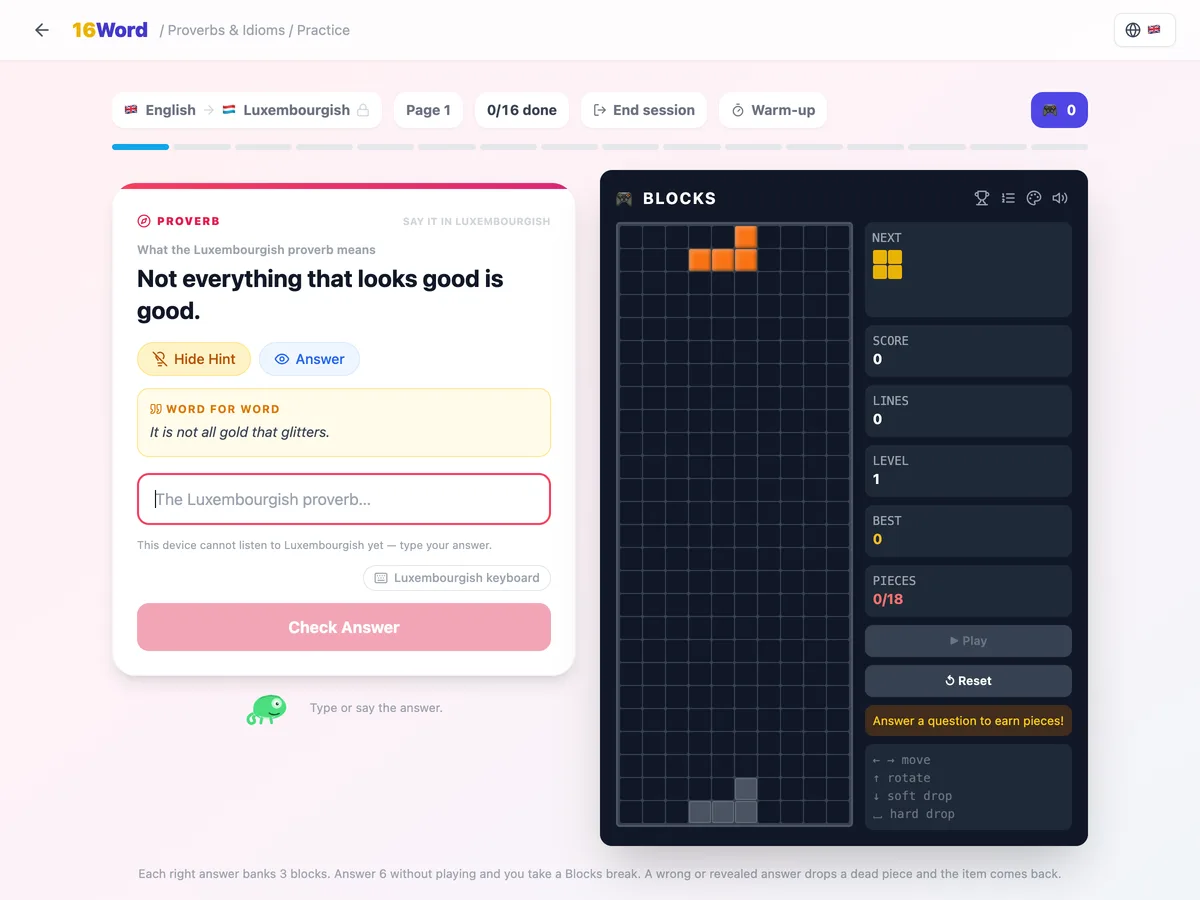
Et ass net alles Gold, wat blénkt.
Literally: It is not all gold that glitters.
Meaning: Not everything that looks good is good. English has: All that glitters is not gold.
Wann d'Kaz fort ass, sinn d'Mais Meeschter.
Literally: When the cat is away, the mice are masters.
Meaning: When the person in charge is away, everyone does as they please. English has: When the cat's away, the mice will play.
Note the twist: in Luxembourgish the mice do not just play — they become the masters of the house.
Honn, déi billen, bäissen net.
Literally: Dogs that bark do not bite.
Meaning: People who seem fierce are often not dangerous. English has: Barking dogs seldom bite.
Wou Damp ass, ass och Feier.
Literally: Where there is smoke, there is fire too.
Meaning: There is usually some truth behind a rumour. English has: There is no smoke without fire.
Et ass nach kee Meeschter vum Himmel gefall.
Literally: No master has ever fallen from the sky.
Meaning: You have to learn for a long time before you are good at something.
The closest English is "Rome wasn't built in a day" — but the Luxembourgish is about people: nobody is born an expert.
Muer ass nach en Dag.
Literally: Tomorrow is still a day.
Meaning: It can wait until tomorrow; there is no need to hurry.
A favourite for putting things off with a smile. Use it about yourself rather than your boss.
D'Léift mécht blann.
Literally: Love makes blind.
Meaning: When you are in love, you do not see the other person's faults. English has: Love is blind.
Honger ass dee beschte Kach.
Literally: Hunger is the best cook.
Meaning: When you are hungry, any food tastes good. English has: Hunger is the best sauce.
English chose a sauce; Luxembourgish chose the cook.
Esou wéi een an de Bësch rifft, esou schaalt et erëm.
Literally: The way you call into the forest, so it echoes back.
Meaning: People treat you the way you treat them. English has: As you sow, so shall you reap.
The image is an echo in the forest: what you shout in comes back to you.
Deemno Geld, deemno Wuer.
Literally: Such money, such goods.
Meaning: Cheap things are usually of poor quality; you get what you pay for. English has: You get what you pay for.
D'gebroden Dauwe fléien engem net an de Mond.
Literally: The roast pigeons do not fly into your mouth.
Meaning: Nothing comes to you without effort. English has: Good things don't fall into your lap.
Roast pigeons flying into your mouth — the land of plenty that does not exist.
E gudden Iesel stéisst sech nëmmen eemol.
Literally: A good donkey bumps itself only once.
Meaning: A sensible person does not make the same mistake twice. English has: Once bitten, twice shy.
Luxembourgish gives the lesson to a donkey — a good one.
Kleng Kesselen hu grouss Oueren.
Literally: Little kettles have big ears.
Meaning: Children hear more than adults think. English has: Little pitchers have big ears.
Watch what you say in front of children.
Et ass eng schlecht Maus, déi nëmmen ee Lach huet.
Literally: It is a poor mouse that has only one hole.
Meaning: You should always keep more than one option open. English has: Don't put all your eggs in one basket.
Den Toun mécht d'Musek.
Literally: The tone makes the music.
Meaning: What matters is not only what you say but how you say it. English has: It's not what you say, it's how you say it.
Gutt Frënn sinn dënn geséit.
Literally: Good friends are thinly sown.
Meaning: Good friends are rare. English has: A friend in need is a friend indeed.
Not the same saying, but the same point from the other side: good friends are rare.
Why learn proverbs at all?
A proverb is a full sentence that natives already know by heart — so when you learn one, you learn grammar, word order and pronunciation in one go, in a form that sticks. It also tells you how people think: Luxembourgish wisdom is practical, rural and a little ironic.
- Word order: *Wou Damp ass, ass och Feier* shows the verb jumping to the end of a subordinate clause and back to second place in the main clause — the same rule you need for every Luxembourgish sentence.
- The n-rule: watch the final -n of a word appear and disappear depending on the next word (*en Dag*, *e gudden Iesel*). Proverbs are a painless way to get used to it.
- Listening: the LOD recordings are spoken at a natural pace, which is exactly what the listening part of the Sproochentest expects you to follow.
Say all 16 from memory in five minutes
16Word's Proverbs & Idioms track has 196 Luxembourgish sayings, all from LOD with native audio. The first sixteen — the ones above — are free: you see the meaning, you say the proverb, and a game of Blocks keeps you going.

Frequently asked questions
Where do these Luxembourgish proverbs come from?
From the Lëtzebuerger Online Dictionnaire (LOD), the official dictionary of the Luxembourgish language. It is maintained by the Zenter fir d'Lëtzebuerger Sprooch (Centre for the Luxembourgish Language), set up by the law of 20 July 2018, and lists proverbs and fixed expressions with an explanation and a native recording.
Are Luxembourgish proverbs the same as German ones?
Many share the same image as their German or Dutch cousins — the cat and the mice, the smoke and the fire — because the languages are closely related. But the wording and the pronunciation are Luxembourgish, and some sayings exist only in Luxembourgish or take a different turn, so it is worth learning them as Luxembourgish.
What does “Muer ass nach en Dag” mean?
Literally “tomorrow is still a day”: it can wait until tomorrow, there is no need to hurry. It is used lightly, often about yourself.
What is the Luxembourgish for “all that glitters is not gold”?
Et ass net alles Gold, wat blénkt. Literally “it is not all gold that glitters” — the same meaning as the English proverb.
Do I need proverbs for the Sproochentest?
No. The Sproochentest is an oral test about everyday life, and nobody is asked to recite proverbs. Learning them still helps: they train your ear for natural Luxembourgish and give you whole sentences you can say with confidence. See our Sproochentest guide.
How do I pronounce Luxembourgish proverbs correctly?
Listen to the native recording of each one above, then say it aloud yourself. In 16Word you can also record your own voice next to the native speaker and compare the two.
How many Luxembourgish proverbs and idioms can I learn on 16Word?
196, all from LOD with native audio, sixteen at a time. The first sixteen are free for every account; the rest come with the Basic plan.
Is it worth learning Luxembourgish if most people also speak French or German?
Yes, if you live or work in Luxembourg or plan to apply for Luxembourgish nationality: Luxembourgish is the language of everyday social life there, and the nationality procedure includes a Luxembourgish language test (the Sproochentest).