TOPIK levels explained: TOPIK I and II, scores, IBT and speaking
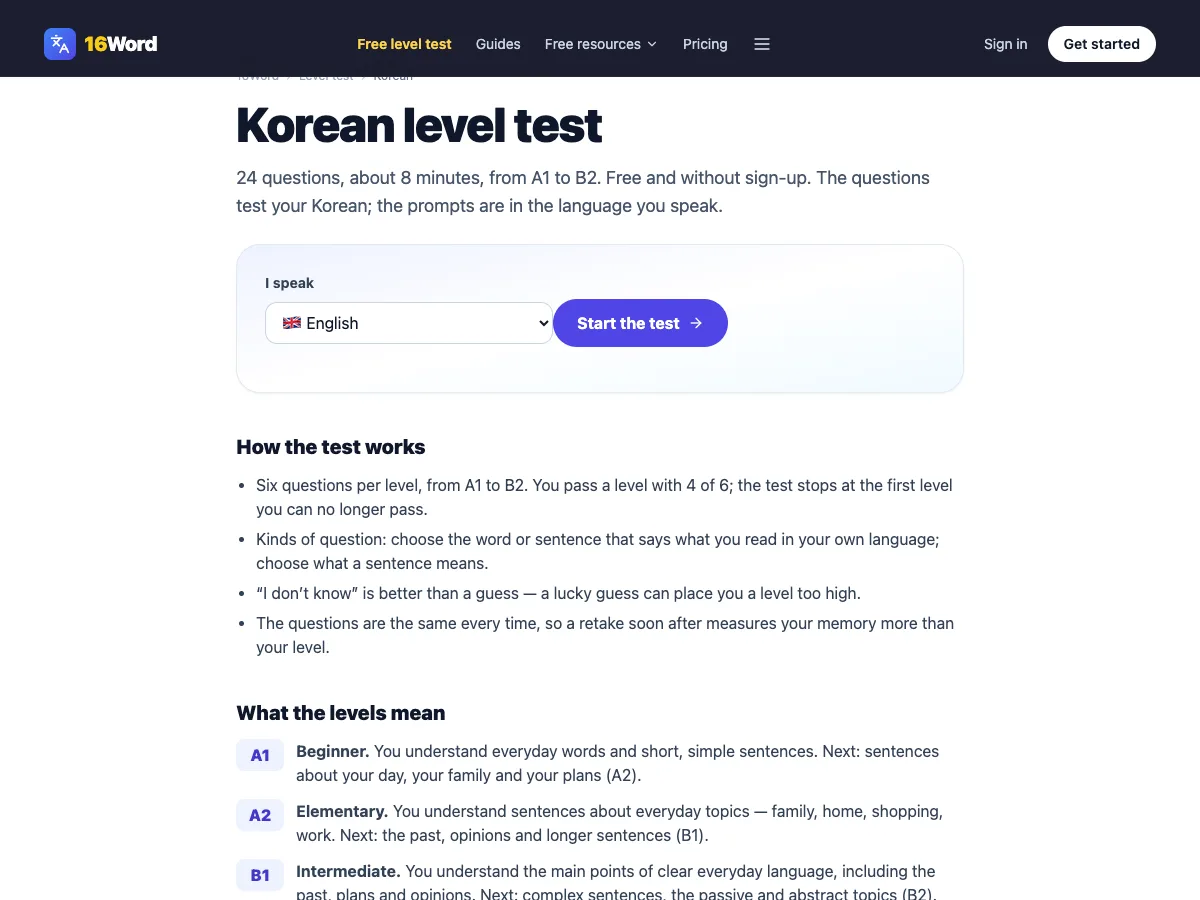
TOPIK (한국어능력시험, the Test of Proficiency in Korean) is South Korea's official Korean exam for non-native speakers, run by the National Institute for International Education (NIIED) under the Ministry of Education. Understanding the TOPIK levels comes down to one idea: there are two tests, and your total score decides your level. This guide explains TOPIK I and II, the score bands for levels 1 to 6, the paper and internet-based versions, the separate speaking test and the fees, using TOPIK's own pages. Check your starting point with the free Korean level test first.
Updated · 5 min read
Two tests, six levels
You do not register for "level 3". You choose TOPIK I (beginner) or TOPIK II (intermediate and advanced), and your total score places you in a level — or in none, if it is below the lowest band. The paper-based TOPIK page gives these cut-offs:
| Test | Level | Total score |
|---|---|---|
| TOPIK I (out of 200) | Level 1 (1급) | 80–139 |
| TOPIK I (out of 200) | Level 2 (2급) | 140–200 |
| TOPIK II (out of 300) | Level 3 (3급) | 120–149 |
| TOPIK II (out of 300) | Level 4 (4급) | 150–189 |
| TOPIK II (out of 300) | Level 5 (5급) | 190–229 |
| TOPIK II (out of 300) | Level 6 (6급) | 230–300 |
If you are around level 2 or 3, choose carefully: a TOPIK I score can never give you more than level 2, and a TOPIK II score below 120 gives you no level at all.
What is tested, and for how long
TOPIK I tests listening and reading; TOPIK II adds writing. In Korea the paper test runs on this timetable (times abroad are set by the local organiser):
| Test | Period | Sections | Time in Korea | Minutes |
|---|---|---|---|---|
| TOPIK I | 1st | Listening, reading | 10:00–11:40 (in the room by 9:20) | 100 |
| TOPIK II | 1st | Listening, writing | 13:00–14:50 (in the room by 12:20) | 110 |
| TOPIK II | 2nd | Reading | 15:20–16:30 (in the room by 15:10) | 70 |
The current format dates from the 35th test on 20 July 2014, according to the test overview.
Paper or computer: TOPIK IBT
Since 2023 there is also an internet-based test, taken at a test centre on a PC or tablet. The TOPIK IBT page says it has the same validity and the same grades as the paper test, but shorter timings and no break:
- TOPIK I IBT: listening 30 minutes + reading 40 minutes = 70 minutes.
- TOPIK II IBT: listening 35 + reading 40 + writing 50 = 125 minutes.
- Be in the room 40 minutes before the start; after the entry time you cannot go in, and anyone who leaves early gets no score.
The TOPIK Speaking test
Speaking is a separate test (since 2022), not part of TOPIK I or II. It lasts 30 minutes and has six tasks, each with a short preparation time, as the TOPIK Speaking page sets out:
| Task | Type | Preparation | Answer |
|---|---|---|---|
| 1 | Answer questions | 20 s | 30 s |
| 2 | Role play from a picture | 30 s | 40 s |
| 3 | Tell a story from pictures | 40 s | 60 s |
| 4 | Complete a conversation | 40 s | 60 s |
| 5 | Interpret data | 70 s | 80 s |
| 6 | Give an opinion | 70 s | 80 s |
Answers are judged on content and how well the task is done, on language use (range and accuracy of words and expressions) and on delivery — pronunciation, intonation and a natural pace. For the Korean Government Scholarship Programme (GKS), a speaking result of level 4 or above adds 3 points.
Fees in Korea and validity
| Test | Fee in Korea |
|---|---|
| TOPIK I (paper) | 40,000 won |
| TOPIK II (paper) | 55,000 won |
| TOPIK I IBT | 70,000 won |
| TOPIK II IBT | 95,000 won |
| TOPIK Speaking | 80,000 won |
These are the fees in Korea; abroad, registration runs through each country's organiser, so check the price there. Every TOPIK result is valid for two years from the date the results are published.
What TOPIK is used for
- admission to and graduation from Korean universities and graduate schools;
- jobs in Korean companies and public bodies, in Korea and abroad;
- permanent residence and employment visas;
- the Korean Government Scholarship Programme;
- credits and graduation requirements in Korean studies at universities abroad.
How often it is held
TOPIK has grown fast: in 2025 there were 15 sittings — six paper, six internet-based and three speaking tests. In Korea the paper test's 2026 dates are 11 January, 12 April, 17 May, 5 July, 18 October and 15 November, as listed on the TOPIK home page; dates and registration abroad differ by country and region.
Build the vocabulary TOPIK reading needs
16 words a day, about five minutes, with spaced repetition and a Blocks break between answers. 16Word is free to start.
Learning Japanese or Chinese too?
Many Korean learners also study Japanese or Chinese. Japan's equivalent works differently — see JLPT levels N5 to N1 — and you can test yourself in Japanese or Chinese, read why learn Japanese and why learn Chinese, or start with Japanese grammar basics and Chinese grammar basics. 16Word teaches both: learn Japanese · learn Chinese.
Keep learning
- Free Korean level test
- Level tests in 36 languages
- JLPT levels N5 to N1
- 16Word plans and prices
- All guides
Questions about TOPIK
What score do I need for each TOPIK level?
In TOPIK I (out of 200): level 1 from 80, level 2 from 140. In TOPIK II (out of 300): level 3 from 120, level 4 from 150, level 5 from 190 and level 6 from 230.
Should I take TOPIK I or TOPIK II?
TOPIK I can only give level 1 or 2, while TOPIK II gives levels 3 to 6. Take TOPIK II only if you expect at least 120 out of 300; otherwise TOPIK I is the safer choice.
How long is a TOPIK result valid?
Two years from the day the results are published. This applies to the paper test, the IBT and the speaking test.
Is TOPIK IBT the same as the paper test?
It has the same validity and the same grading system, but it is taken on a PC or tablet at a test centre and is shorter: 70 minutes for TOPIK I and 125 minutes for TOPIK II, with no break.
Does TOPIK test speaking?
Not in TOPIK I or II. Speaking is a separate 30-minute test with six tasks, from answering simple questions to giving an opinion.
How much does TOPIK cost?
In Korea, 40,000 won for TOPIK I and 55,000 won for TOPIK II on paper; 70,000 and 95,000 won for the IBT; 80,000 won for the speaking test. Abroad, check with the local organiser.
Was this guide useful?
Official sources
Keep going
- /level-test/korean
- /level-test
- The Dutch inburgering exam in 2026: routes, parts, fees and FAQ
- Sproochentest speaking (A2): topics, picture description and how to prepare
- Sproochentest listening (B1): the three recordings and how to practise
- A 60-day Sproochentest preparation plan, week by week
- Luxembourgish levels A1 to B2: what each CEFR level means in practice
- What level of Luxembourgish do you need for citizenship?
- The inburgering reading exam (A2 and B1): format, question types and tips
- The inburgering listening exam (A2 and B1): what to expect and how to train
- All guides