JLPT levels N5 to N1: sections, times and pass marks
The Japanese-Language Proficiency Test (JLPT, 日本語能力試験), run by the Japan Foundation and Japan Educational Exchanges and Services, is the best-known Japanese exam in the world. This guide explains the JLPT levels from N5 to N1 as the official JLPT site describes them: what you should be able to do at each level, how long each paper takes and how many points you need to pass. Not sure where you are? The free Japanese level test gives you a first estimate in a few minutes.
Updated · 5 min read
Five levels, N5 is the easiest
According to the official level summary, the JLPT has five levels — N1, N2, N3, N4 and N5 — and N5 is the easiest, N1 the hardest. N5 and N4 test the basic Japanese mostly learned in class; N2 and N1 test the Japanese of real life in a wide range of situations; N3 bridges the two.
| Level | In short (from the official summary) |
|---|---|
| N5 | Read typical phrases in hiragana, katakana and basic kanji; follow short, slow conversations about daily life and class. |
| N4 | Read passages on familiar topics in basic vocabulary and kanji; follow everyday conversations spoken slowly. |
| N3 | Read everyday texts and newspaper headlines; follow everyday conversations at near-natural speed. |
| N2 | Read clearly written articles and commentaries; follow conversations and news at nearly natural speed. |
| N1 | Read complex, abstract writing such as editorials; follow lectures, news and conversations at natural speed in detail. |
What the JLPT tests — and what it does not
The JLPT's key characteristics are three elements: Language Knowledge (vocabulary and grammar), Reading and Listening. Answers are machine-scored, and the test has no speaking or writing section. If you need to prove you can speak Japanese, plan to practise and show that another way.
Because nothing is written by hand, the JLPT rewards recognising kanji and vocabulary quickly. Daily vocabulary review pays off at every level.
Test sections and times
The test sections page gives these times. N1 and N2 combine vocabulary, grammar and reading in one long paper; N3 to N5 split vocabulary off into its own short paper:
| Level | Language Knowledge / Reading | Listening | Total |
|---|---|---|---|
| N1 | 110 min (vocabulary, grammar, reading) | 55 min | 165 min |
| N2 | 105 min (vocabulary, grammar, reading) | 50 min | 155 min |
| N3 | 30 min vocabulary + 70 min grammar and reading | 40 min | 140 min |
| N4 | 25 min vocabulary + 55 min grammar and reading | 35 min | 115 min |
| N5 | 20 min vocabulary + 40 min grammar and reading | 30 min | 90 min |
The JLPT notes that section times may change and that Listening can differ slightly with the length of the recordings.
Pass marks: total and per section
Every level is scored out of 180. On the scoring page, N1–N3 have three scoring sections of 0–60 each (Language Knowledge, Reading, Listening); N4 and N5 have two (Language Knowledge and Reading together 0–120, Listening 0–60). To pass you need both the overall pass mark and the minimum in every section — one section below its minimum means a fail, however high your total.
| Level | Overall pass mark (of 180) | Section minimum |
|---|---|---|
| N1 | 100 | 19 of 60 in each section |
| N2 | 90 | 19 of 60 in each section |
| N3 | 95 | 19 of 60 in each section |
| N4 | 90 | 38 of 120 · 19 of 60 |
| N5 | 80 | 38 of 120 · 19 of 60 |
The JLPT uses scaled scores: sessions differ slightly in difficulty, so raw answers are converted to a common scale and a score means the same whichever session you sit.
When the test takes place
In 2026 the JLPT was held on Sunday 5 July and Sunday 6 December. Outside Japan some cities hold it only in July or only in December, so check the schedule for your city. Everyone receives a score report and those who pass also receive a certificate; outside Japan, the results page says reports arrive around mid-October for the July test and mid-March for the December test.
Build your Japanese vocabulary daily
16Word gives you 16 words a day in about five minutes, with spaced repetition and a Blocks break between answers. Free to start.
Which level should you choose?
- Just started? N5 is a good first goal once you read hiragana and katakana comfortably.
- You can handle daily life slowly? N4, then N3 — the bridge from classroom to real Japanese.
- Aiming at work or study in Japan? Look at the level your employer or school asks for; N2 and N1 cover the Japanese of newspapers, news and lectures.
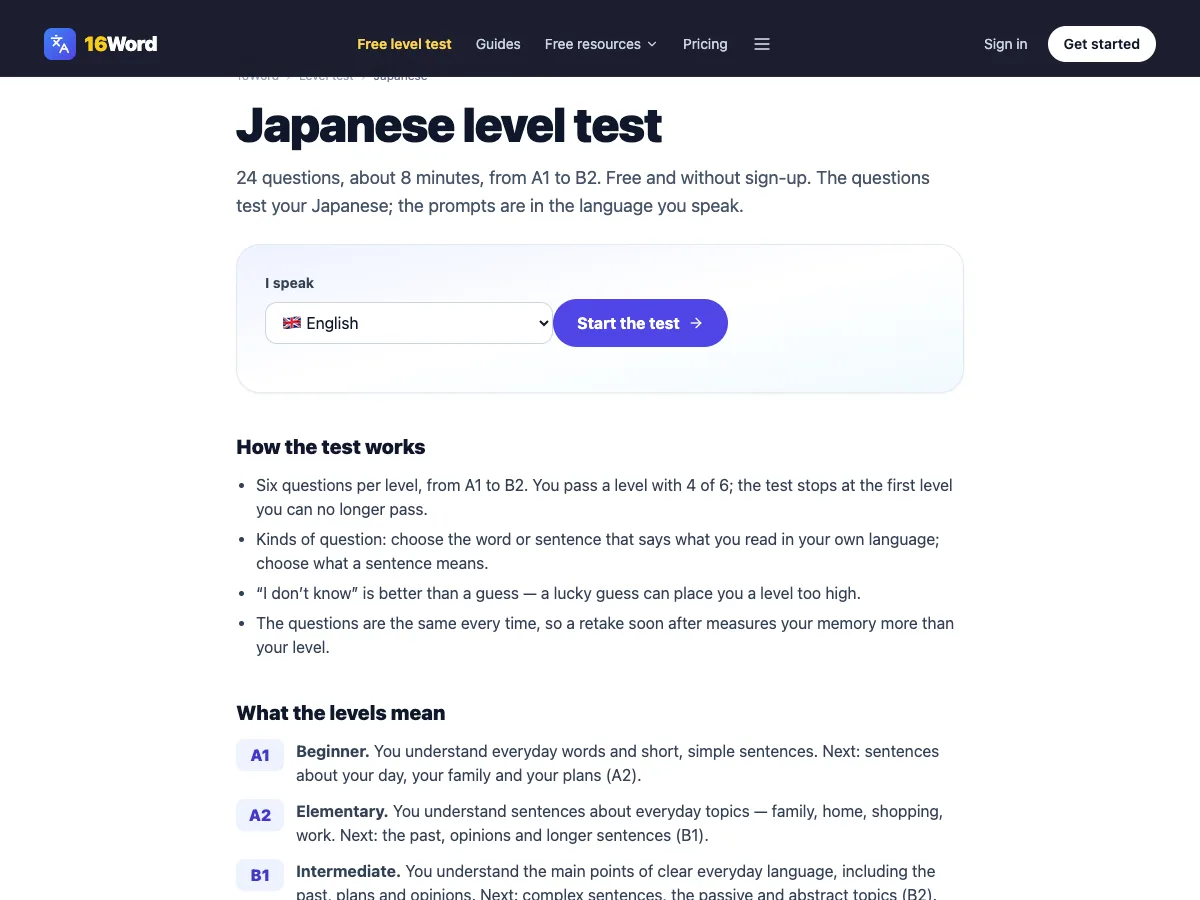
- Not sure? Take the Japanese level test before you register.
A study plan that matches the test
- Vocabulary and kanji every day. Short daily sessions beat weekend marathons — that is how 16Word's Japanese course is built.
- Reading at your level. Graded readers for N5–N4, short news articles for N3 and above.
- Listening without subtitles. The sections get faster as levels rise; train your ear at the speed of your target level.
- Timed practice. Do full papers with the times above, so the long N1/N2 paper does not surprise you.
- Watch every section. The section minimums mean a weak listening score can sink a strong total.
Japanese, Chinese and kanji
Japanese kanji come from Chinese characters, which is why many learners study both. If you are curious, read a short history of Chinese, why learn Chinese or the Chinese grammar basics, and try the Chinese level test or our Chinese course. Learning Korean as well? Try the Korean level test.
Keep learning
- Learn Japanese with 16Word
- Free Japanese level test
- Level tests in 36 languages
- TOPIK levels explained: the Korean exam
- All guides
- 16Word plans
JLPT levels: questions
Which JLPT level is the easiest?
N5 is the easiest and N1 the most difficult. N5 and N4 cover basic classroom Japanese, N3 is the bridge, and N2 and N1 cover Japanese used in real life.
Does the JLPT test speaking or writing?
No. The JLPT tests language knowledge (vocabulary and grammar), reading and listening, and is machine-scored. There is no speaking or writing section.
What score do I need to pass N3?
At least 95 of 180 overall and at least 19 of 60 in each of the three sections. Falling below 19 in any one section means a fail.
How long is the N1 exam?
110 minutes for language knowledge and reading, and 55 minutes for listening — 165 minutes in all, according to the official test sections page.
When is the JLPT held?
Twice a year, in July and December; in 2026 on 5 July and 6 December. Some cities outside Japan hold only one of the two sessions.
When do I get my results?
Outside Japan, score reports arrive around mid-October for the July test and mid-March for the December test. Those who pass also receive a certificate.
Was this guide useful?
Official sources
Keep going
- Free Japanese level test — A1 to B2, no sign-up
- Learn Japanese 16 words a day
- Polish citizenship: the B1 Polish certificate and how to get it
- The Greek Certificate of Attainment: levels, dates and fees
- TOPIK levels explained: TOPIK I and II, scores, IBT and speaking
- The Dutch inburgering exam in 2026: routes, parts, fees and FAQ
- Sproochentest speaking (A2): topics, picture description and how to prepare
- Sproochentest listening (B1): the three recordings and how to practise
- A 60-day Sproochentest preparation plan, week by week
- Luxembourgish levels A1 to B2: what each CEFR level means in practice
- All guides