Italian travel phrases: trains, cafés, the bill and getting around
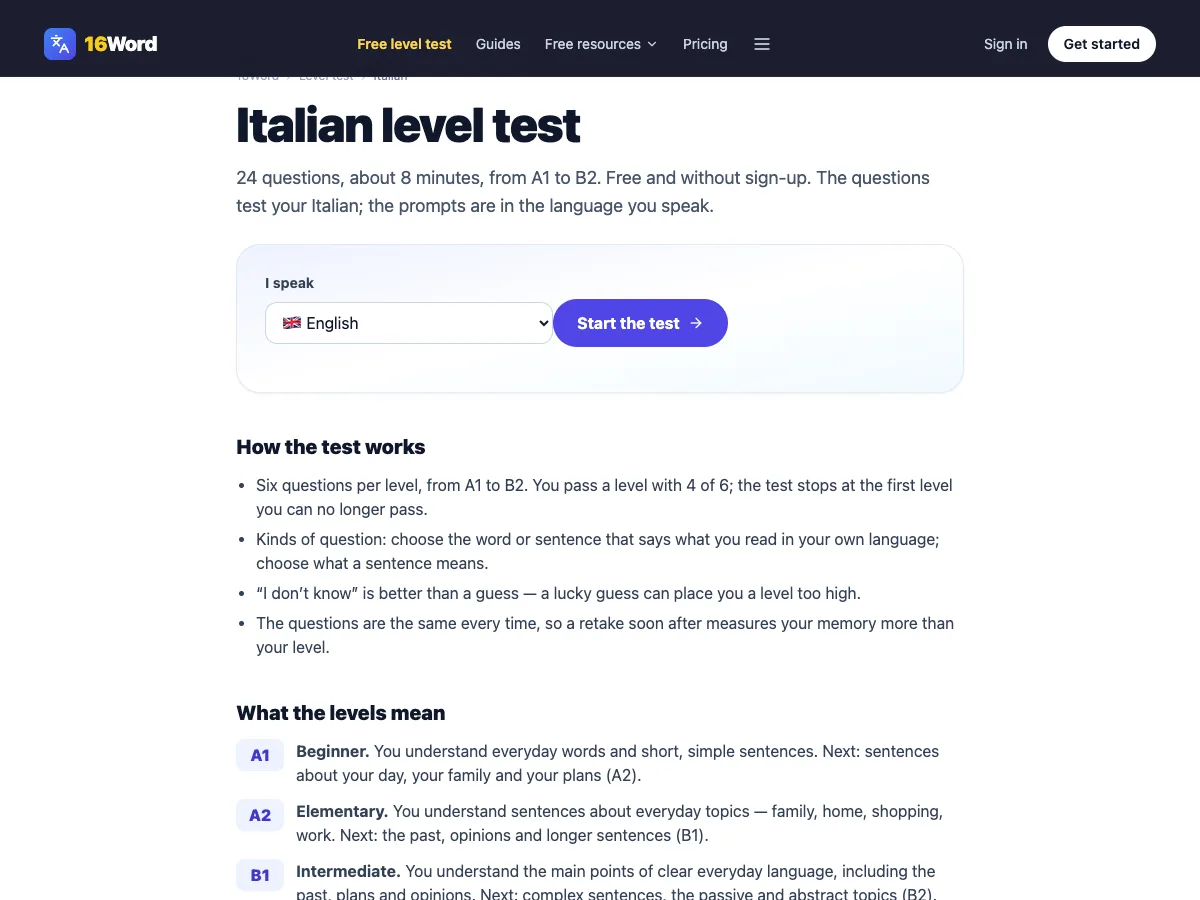
These Italian travel phrases are the ones you will actually use on a trip: greeting people, buying and validating a train ticket, ordering at a café, asking for the bill and finding your way. Every word was checked in a dictionary, and the train rules come from Trenitalia's own page. A few phrases and a polite buongiorno change how people answer you — and when you want to go further, the free Italian level test shows where you stand.
Updated · 5 min read
Greetings and the polite words
| Italian | English | When |
|---|---|---|
| buongiorno | good morning, good day; hello | from morning into the early afternoon |
| buonasera | good evening | later in the day (in some regions already in the afternoon) |
| per favore | please | with every request |
| grazie | thank you | always |
| prego | you're welcome; of course; after you | see below |
| mi scusi | sorry, excuse me | to a stranger (formal) |
| parla inglese? | do you speak English? | formal, to a stranger |
Wiktionary gives buongiorno as "good day" and "good morning", also for the very early afternoon, and by extension simply "hello". Buonasera is "good evening", in some regions "good afternoon". Start every conversation in a shop, a ticket office or a café with one of the two.
Prego: the word with three jobs
You will hear prego everywhere. Wiktionary lists three uses: after someone thanks you, it means "you're welcome"; in answer to a request, "yes, of course"; and when holding a door or letting someone go first, "after you".
Italian travel phrases for trains
| Italian | English |
|---|---|
| la stazione | the station |
| il biglietto | the ticket |
| il binario | the platform, the track |
| la fermata | the stop (bus, tram) |
| andata / andata e ritorno | one way / return |
| convalidare | to validate, to stamp (a ticket) |
Useful sentences, built from those words (16Word's own model sentences):
- Un biglietto per Firenze, per favore. — A ticket to Florence, please.
- Andata e ritorno, per favore. — A return ticket, please.
- Da quale binario parte il treno per Roma? — Which platform does the train to Rome leave from?
- Dov'è la stazione? — Where is the station?
- Dov'è la fermata dell'autobus? — Where is the bus stop?
Binario is the word on every departure board: "track" or "platform". Dov'è is short for dove è, "where is…?" — Wiktionary's example is Dov'è la mia giacca?, "Where is my jacket?".
Validate your paper ticket before you board
This is the rule that catches travellers out. On regional trains, says Trenitalia, a single paper regional ticket must be validated before the train leaves, in the validating machines at the station where your journey begins; validation can be done until 11.59 p.m. on the date printed on the ticket, and you must then finish the journey within four hours, subject to exceptions in specific regional fares. The Italian verb for it is convalidare — to validate, or to stamp a train or bus ticket.
Bought online? Trenitalia says an Electronic Regional Ticket (ERT) does not need validation and is valid for four hours from the departure of the train you chose, and a Digital Regional Ticket (DRT) is validated automatically at your train's scheduled departure. Only paper tickets go into the machine. Rules can differ in specific regional fares, so read your ticket.
At the café and the restaurant
| Italian | English |
|---|---|
| il conto | the bill |
| il coperto | the cover charge; a place setting |
| lo scontrino | the receipt |
| acqua naturale | still water |
| acqua frizzante | sparkling water (also acqua gassata) |
| quanto costa? | how much is it? |
Asking for the bill is Il conto, per favore (conto is a bill for a meal or a hotel, and also a bank account). On the bill you may see coperto: Wiktionary translates it as "cover charge" and also as a place setting at the table. Lo scontrino is the receipt you get at the till.
- Un tavolo per due, per favore. — A table for two, please.
- Un'acqua naturale, per favore. — A still water, please.
- Quanto costa? — How much is it?
- Il conto, per favore. — The bill, please.
Learn Italian words that stay with you
16Word teaches 16 words a day with active recall and spaced repetition, and a short Blocks game between answers. Free to start.
Getting help
- Mi scusi, parla inglese? — Excuse me, do you speak English?
- Non capisco. — I don't understand.
- Può ripetere, per favore? — Could you repeat that, please?
- Dov'è il bagno? — Where is the bathroom?
Use mi scusi and parla (the polite Lei form) with strangers; with friends you would say scusa and parli. Hearing these phrases is the hard part when someone answers quickly — to practise real conversations before your trip, Edluxio has teachers and professionals in many fields for live 1-to-1 lessons, with a trial lesson and a full refund if it is not the right fit. On 16Word you can hear and test your Italian in the Italian level test.
Going further with Italian
- Moving to Italy for good? Citizenship asks for B1 Italian: Italian citizenship and the B1 requirement.
- The CILS certificate, level by level: CILS Italian certificate guide and the CILS path.
- Travelling on through the Netherlands? Dutch travel phrases works the same way, with recordings.
- Make the words stick: how to memorize vocabulary.
Keep learning
- French travel phrases — trains, cafés, hotels and the bill
- Free Italian level test
- Free French level test and free Spanish level test — close cousins of Italian
- Where is French spoken?
- Free level tests in 36 languages
- All guides
Questions about Italian travel phrases
What are the most useful Italian phrases for travel?
Buongiorno (hello, good morning), per favore (please), grazie (thank you), mi scusi (excuse me), dov'è…? (where is…?), quanto costa? (how much is it?) and il conto, per favore (the bill, please).
Do I need to validate my train ticket in Italy?
A single paper regional ticket, yes: Trenitalia says it must be validated in the station's machines before the train leaves. Electronic Regional Tickets need no validation, and Digital Regional Tickets are validated automatically at the scheduled departure.
What is coperto on an Italian bill?
A cover charge. Coperto also means a place setting at the table.
How do you answer grazie in Italian?
With prego — "you're welcome". The same word also means "of course" and "after you".
Is it buongiorno or buonasera?
Buongiorno in the morning and early afternoon, buonasera later in the day; in some regions people switch to buonasera already in the afternoon.
How do you ask for still or sparkling water in Italian?
Acqua naturale is still water and acqua frizzante (or acqua gassata) is sparkling water.
Was this guide useful?
Official sources
- Trenitalia — Travelling on Regional trains (tickets and validation)
- Wiktionary — prego (Italian)
- Wiktionary — buongiorno (Italian)
- Wiktionary — binario (Italian)
- Wiktionary — convalidare (Italian)
- Wiktionary — coperto (Italian)
- Wiktionary — conto (Italian)
- Edluxio — live 1-to-1 lessons with teachers and professionals
Keep going
- /level-test/italian
- /certifications/cils
- French travel phrases: trains, cafés, hotels and the bill
- Luxembourg Airport to the city centre: tram, bus and taxi (free public transport)
- Free public transport in Luxembourg: how it works — and what is not free
- Entering Luxembourg: Schengen, passports, the EES and ETIAS (2026)
- Luxembourg to Paris by train: TGV in about 2h10, fares from €25
- Luxembourg to Brussels and Belgium: hourly trains, €21.30, no booking needed
- Luxembourg to Germany by train: Koblenz, Cologne, Frankfurt, Munich and Berlin
- Luxembourg to Trier and the Moselle: trains in 50 minutes, buses from €3
- All guides