Italian citizenship: the B1 Italian language requirement
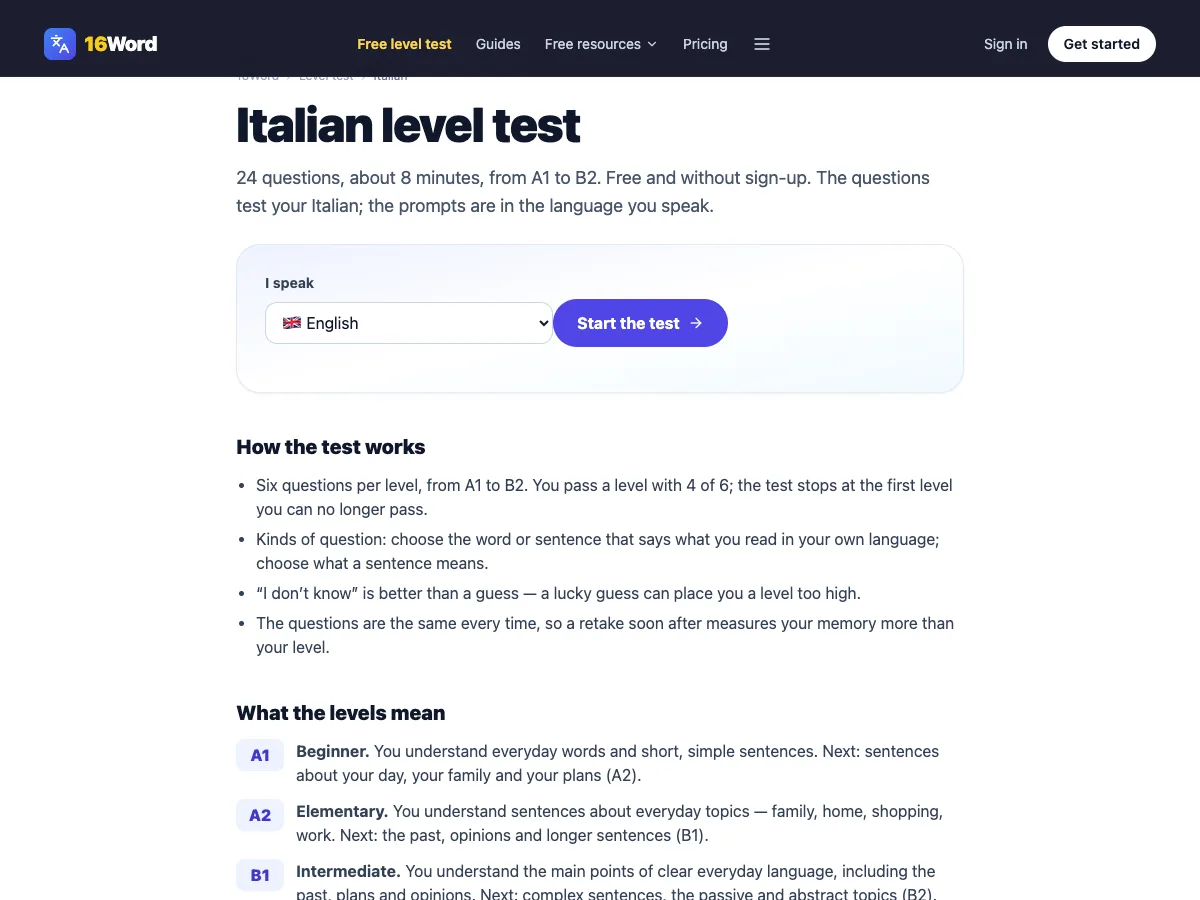
Since December 2018 anyone applying for Italian citizenship by residence or by marriage must prove they know Italian. This guide explains the B1 Italian for citizenship rule as Italy's Ministry of the Interior and its prefectures describe it: the four ways to prove it, which certificates count, and how long you must live in Italy first. To see how close you are to B1, try the free Italian level test — it checks A1 to B2 in a few minutes.
Updated · 5 min read
Who must prove Italian
The requirement was introduced by Decree-Law 113/2018, converted by Law 132/2018. According to the Ministry of the Interior, it applies to applicants for citizenship by residence (article 9 of Law 91/1992) and — on the ministry's marriage page — by marriage (article 5). The Prefecture of Pistoia's notice adds that it covers every application under those two articles submitted from 4 December 2018.
The four ways to prove your Italian
The prefecture's notice lists four alternatives. You need one of them, and the document must be scanned into your online application:
- A study title from a public or officially recognised (paritario) school, in Italy or abroad, recognised by the Italian education and foreign ministries.
- A B1 certificate (Council of Europe CEFR) from one of the four recognised certifying bodies — see below.
- The integration agreement (accordo di integrazione, article 4-bis of Legislative Decree 286/1998), if you signed it.
- An EU long-term residence permit (permesso di soggiorno UE per soggiornanti di lungo periodo), if you hold one.
Check routes 3 and 4 before you book an exam: if you already hold an EU long-term residence permit, or signed the integration agreement, the notice lists that as proof in itself.
The four certifying bodies
A certificate counts only if it is issued by one of the four bodies the notice names — or by a school in their national and international network:
| Body | Certificate | What its own site lists |
|---|---|---|
| Università per Stranieri di Perugia | CELI | CELI exams, including CELI immigrati for adult immigrants at A1–B1 |
| Università per Stranieri di Siena | CILS | CILS certificates of Italian as a foreign language |
| Società Dante Alighieri | PLIDA | PLIDA exams for adults at A2, B1, B2, C1 and C2 |
| Università Roma Tre | Cert.It | — |
An Italian certificate from any other school or company does not meet the requirement on its own: check that your exam centre belongs to one of these four networks before you pay. Formats, dates and fees are set by each body — read them on its site.
B1 is the third of the six CEFR levels: you can follow the main points of clear everyday speech, deal with most situations at an office or a doctor's, and write a short connected text about familiar topics. Our level tests check A1 to B2 in 36 languages.
How many years in Italy first
Language is one requirement among several. The ministry's pages give these periods of legal residence:
| Route | Legal residence |
|---|---|
| Non-EU national (art. 9) | 10 years |
| EU citizen (art. 9) | 4 years |
| Stateless person; adult adopted by an Italian (after the adoption) | 5 years |
| Born in Italy | 3 years |
| A parent or grandparent who is or was Italian by birth | 2 years |
| Spouse of an Italian (art. 5) | 2 years in Italy after the marriage, or 3 years from the marriage if you live abroad — halved if the couple has children born or adopted |
For applications submitted since 20 December 2020 the ministry says the procedure should end within 24 months, extendable to 36.
Get the words B1 is built on
16Word teaches Italian 16 words a day with active recall, spaced repetition and a short Blocks game between answers. Free to start.
A plan from A2 to B1
- Find your level. Take the Italian level test. It shows which level you already pass and where the next one starts.
- Pick the body, then the exam. Choose CELI, CILS, PLIDA or Cert.It by the centre nearest you and its next date; read that body's own format before you start practising.
- Recall, do not reread. Each day, try to produce a few words and phrases from memory before checking them. That is what an exam asks of you.
- Write every week. B1 papers ask for short connected texts — an email, a message, an opinion. Write one and have it corrected.
- Re-test two or three weeks before the exam.
Other countries' rules
Italy's B1 is stricter than its neighbours'. Spain asks for A2 plus a civics test; Portugal asks for A2. Luxembourg, the Netherlands and Belgium each have their own tests.
Keep learning
- Free Italian level test
- Level tests in 36 languages
- Spanish nationality: DELE A2 and CCSE — and the Spanish level test
- Portuguese nationality: A2 and the CIPLE — and the Portuguese level test
- All 16Word guides
Questions about B1 Italian for citizenship
What level of Italian do I need for citizenship?
B1 of the Council of Europe scale, when you prove it with a language certificate. The prefecture's notice also accepts a recognised study title, a signed integration agreement or an EU long-term residence permit instead.
Does the requirement apply to citizenship by marriage?
Yes. The Ministry of the Interior says the 2018 law requires knowledge of Italian for applicants by marriage (article 5) as well as by residence (article 9).
Which B1 certificates are accepted?
Those issued by the four certifying bodies: the Università per Stranieri di Perugia (CELI), the Università per Stranieri di Siena (CILS), Università Roma Tre (Cert.It) and the Società Dante Alighieri (PLIDA), including the schools in their networks.
Do I need an exam if I hold an EU long-term residence permit?
According to the Prefecture of Pistoia's notice, holding an EU long-term residence permit is one of the four accepted proofs, so no separate certificate is listed as necessary. Your prefecture has the final word on your file.
How long does an Italian citizenship application take?
For applications submitted since 20 December 2020 the ministry gives a maximum of 24 months, which can be extended to 36.
Does a B2 certificate also count?
The notice asks for a certificate attesting B1 knowledge of Italian; a higher level attests at least that. Ask your prefecture if you are unsure about a particular document.
Was this guide useful?
Official sources
- Ministry of the Interior (DLCI) — Citizenship by residence, art. 9 of Law 91/1992
- Ministry of the Interior (DLCI) — Citizenship by marriage, art. 5 of Law 91/1992
- Prefecture of Pistoia — The Italian language requirement for citizenship (PDF)
- Università per Stranieri di Perugia — CVCL (CELI)
- Società Dante Alighieri — PLIDA
- Università per Stranieri di Siena — CILS
Keep going
- /level-test/italian
- /level-test
- Portuguese nationality: the A2 requirement and the CIPLE exam
- Finnish citizenship: the language requirement and the YKI test
- The Czech A2 exam for permanent residence: format, points and fee
- JLPT levels N5 to N1: sections, times and pass marks
- Polish citizenship: the B1 Polish certificate and how to get it
- The Greek Certificate of Attainment: levels, dates and fees
- TOPIK levels explained: TOPIK I and II, scores, IBT and speaking
- The Dutch inburgering exam in 2026: routes, parts, fees and FAQ
- All guides