The Arabic alphabet: 28 letters, joining forms and short vowels
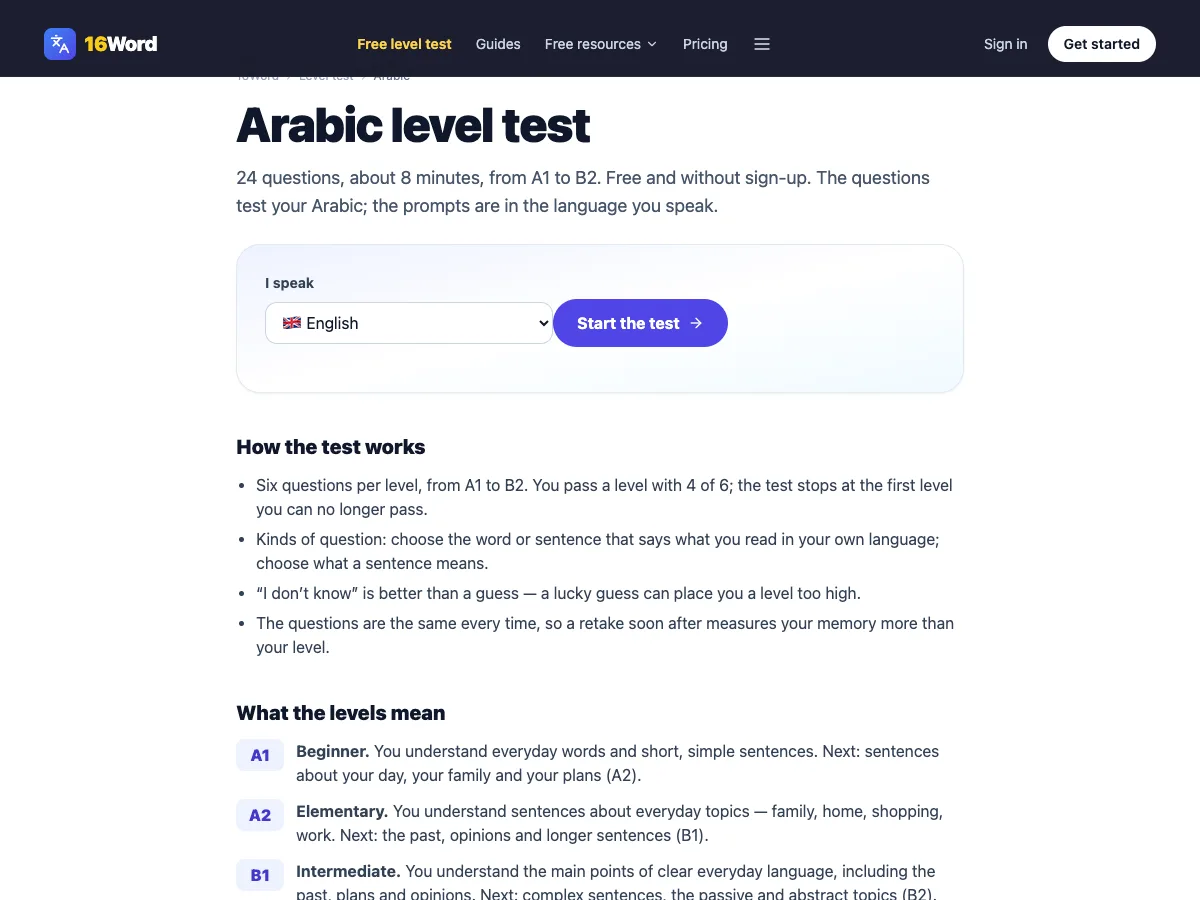
Arabic has 28 letters, written from right to left and joined together, even in print. That is what makes it look hard. In fact the system is regular: a letter keeps its core shape and changes only how it connects, six letters never connect forward, and dots tell apart letters that share a shape. This guide walks you through all of it, with words to practise on. When you are ready, try our free Arabic level test.
Updated · 6 min read
One script, many languages
Arabic is one of the six official languages of the United Nations, and its script reaches far beyond it. The Unicode Standard lists Persian, Urdu, Pashto, Sindhi and Uyghur among the languages written in extended forms of it, as well as many African languages; Urdu is often written in the ornate Nastaliq style. Turkish and Indonesian/Malay once used it and now use Latin letters. Learn the Arabic letters and you have a head start on Persian, Urdu, Pashto and Sorani Kurdish, which add a few letters of their own.
Three rules before the letters
- Right to left. Words and lines run from right to left.
- Joined, even in print. The Unicode Standard calls the script cursive, even in its printed form: the same letter may look different depending on how it joins its neighbours.
- Short vowels are usually not written. The vowel marks exist, but in normal writing they are omitted. Start with materials that print them; most of what you read later will not.
All 28 letters
Order and names follow Wiktionary's Arabic letter list; the Latin values are Wiktionary's transliteration. The sounds are our rough guide for English speakers. No in the last column marks the six letters that never join the letter after them, according to Unicode's joining data.
| Letter | Name | Latin | Rough sound | Joins next? |
|---|---|---|---|---|
| ا | alif | ā | long a; also a seat for hamza | No |
| ب | bāʾ | b | b | Yes |
| ت | tāʾ | t | t | Yes |
| ث | thāʾ | ṯ | th in think | Yes |
| ج | jīm | j | j in jam | Yes |
| ح | ḥāʾ | ḥ | a strong, breathy h | Yes |
| خ | khāʾ | ḵ | ch in Scottish loch | Yes |
| د | dāl | d | d | No |
| ذ | dhāl | ḏ | th in this | No |
| ر | rāʾ | r | a rolled r | No |
| ز | zāy | z | z | No |
| س | sīn | s | s | Yes |
| ش | shīn | š | sh | Yes |
| ص | ṣād | ṣ | a heavy, darker s | Yes |
| ض | ḍād | ḍ | a heavy, darker d | Yes |
| ط | ṭāʾ | ṭ | a heavy, darker t | Yes |
| ظ | ẓāʾ | ẓ | a heavy, darker th in this | Yes |
| ع | ʿayn | ʕ | a tight sound from the throat; no English match | Yes |
| غ | ghayn | ḡ | a gargled r, like the French r | Yes |
| ف | fāʾ | f | f | Yes |
| ق | qāf | q | a k from deep in the throat | Yes |
| ك | kāf | k | k | Yes |
| ل | lām | l | l | Yes |
| م | mīm | m | m | Yes |
| ن | nūn | n | n | Yes |
| ه | hāʾ | h | h | Yes |
| و | wāw | w (ū after u) | w, or long oo | No |
| ي | yāʾ | y (ī after i) | y, or long ee | Yes |
How joining works
Most letters are dual-joining: they connect on both sides, so each has a shape at the start, in the middle and at the end of a word, plus one standing alone. Unicode's joining data names the six exceptions: ا د ذ ر ز و join the letter before them but never the one after. After any of these six, the next letter starts fresh, as if at the beginning of a word.
Watch it in كتاب (kitāb, book). ك starts the word and joins forward; ت joins on both sides; ا joins the ت before it but not what follows, so the last letter, ب, stands on its own. That is why the word looks like two pieces: كتا and ب.
Do not learn four shapes per letter as separate drawings. Learn the core shape of each letter, then watch how it connects: in many letters the start and middle forms are the core shape without its final stroke.
Dots make the difference
Several letters share one skeleton and differ only by their dots. The Unicode Standard gives the example of ب (one dot below), ت (two above) and ث (three above), which all belong to the same shape group. The same is true of ج ح خ, of د ذ, of ر ز, of س ش, and of the heavy pairs ص ض and ط ظ. Read the dots first, and many letters stop looking alike.
Short vowels and other marks
The marks are called tashkil. Wiktionary's transliteration reads them like this:
| Mark | Name | What it does |
|---|---|---|
| بَ | fatḥa | short a |
| بِ | kasra | short i (written below) |
| بُ | ḍamma | short u |
| بْ | sukūn | no vowel after the letter |
| بّ | shadda | doubles the consonant |
| بً | fatḥatan (tanwin) | -an at the end of a word |
A long vowel is written with a letter: ا for ā, و for ū after a ḍamma, ي for ī after a kasra. The Unicode Standard also describes one obligatory ligature: when lām is followed by alif, most fonts merge them into one sign, لا. You see it in one of the first words you will learn, lā, no.
First words to read
Each word was checked on Wiktionary and is shown with its vowel marks. Read from the right.
| Arabic | Reading | Meaning |
|---|---|---|
| مَرْحَبًا | marḥaban | hello, welcome |
| سَلَام | salām | peace; greeting |
| شُكْرًا | shukran | thanks |
| نَعَم | naʿam | yes |
| لَا | lā | no |
| مَاء | māʾ | water |
| بَيْت | bayt | house |
| بَاب | bāb | door |
| كِتَاب | kitāb | book |
| عَرَبِيّ | ʿarabiyy | Arab, Arabic |
Try spotting the rules: in بَاب the alif cuts the word in two; in شُكْرًا the sukūn says no vowel after the k, and the ending is a tanwin, -an. Arabic also has its own comma ، and question mark ؟, which the Unicode Standard lists as Arabic punctuation marks.
A two-week plan
Our suggestion, about 15 minutes a day. Days 1–4: the letters in their shape groups (ب ت ث, ج ح خ, د ذ, ر ز, س ش and so on), reading words with full vowel marks. Days 5–7: the six non-joining letters and the joining forms. Days 8–11: the marks, hamza and the lām-alif ligature, writing by hand. Days 12–14: the same words without vowel marks. Then build vocabulary: 16Word drills the commonest words with spaced repetition and a Blocks break between answers, and our plans start free.
From letters to words
16 words a day, about five minutes, with spaced repetition and a Blocks break between answers. 16Word is free to start.
Keep learning
- Free Arabic level test, or all 36 level tests
- Languages in the same script: Persian, Urdu, Pashto and Sorani Kurdish level tests
- The same script with more letters: the Persian alphabet and the Urdu alphabet
- The same script for Pashto and Kurdish: the Pashto alphabet and the Sorani Kurdish alphabet
- Another right-to-left script: the Hebrew alphabet and the Hebrew level test
- Arabic once wrote Turkish: the Turkish level test
- More scripts: the Russian alphabet, the Georgian alphabet, Serbian's two alphabets and Devanagari for Hindi
- All guides
The Arabic alphabet: questions
How many letters are in the Arabic alphabet?
28, from alif to yāʾ. Hamza, the glottal stop, is written as an extra sign, on its own or on alif, wāw or yāʾ.
Is Arabic written from right to left?
Yes. Words and lines run from right to left, and letters join each other even in print.
Which Arabic letters do not connect?
Six: alif, dāl, dhāl, rāʾ, zāy and wāw (ا د ذ ر ز و). They join the letter before them but never the one after, according to Unicode's joining data.
Why is Arabic written without vowels?
The short vowels are marks above or below the letters, and the Unicode Standard notes they are omitted in normal writing. Long vowels are always written, with alif, wāw and yāʾ.
If I learn the Arabic alphabet, can I read Persian or Urdu?
You can read their letters, because both are written in extended forms of the Arabic script, with a few extra letters. The languages themselves are different, and Urdu is often written in the Nastaliq style.
How long does it take to learn the Arabic alphabet?
Our estimate: with short daily practice, most learners read slowly, with vowel marks, after two weeks. Reading without the marks comes with vocabulary.
Was this guide useful?
Official sources
Keep going
- /level-test/arabic
- /level-test
- The Persian alphabet: 32 letters, four of them not in Arabic
- The Urdu alphabet: 39 letters, Nastaliq and the sounds Arabic lacks
- The Azerbaijani alphabet: 32 letters and how it differs from Turkish
- The Pashto alphabet: 45 letters and the sounds Persian lacks
- The Sorani Kurdish alphabet: 34 letters and its own vowel letters
- The Tigrinya alphabet: reading the Ge'ez script, syllable by syllable
- Luxembourgish personal pronouns: ech, du, hien, hatt, si, mir, dir — with audio
- How to conjugate Luxembourgish verbs in the present tense
- All guides