The Azerbaijani alphabet: 32 letters and how it differs from Turkish
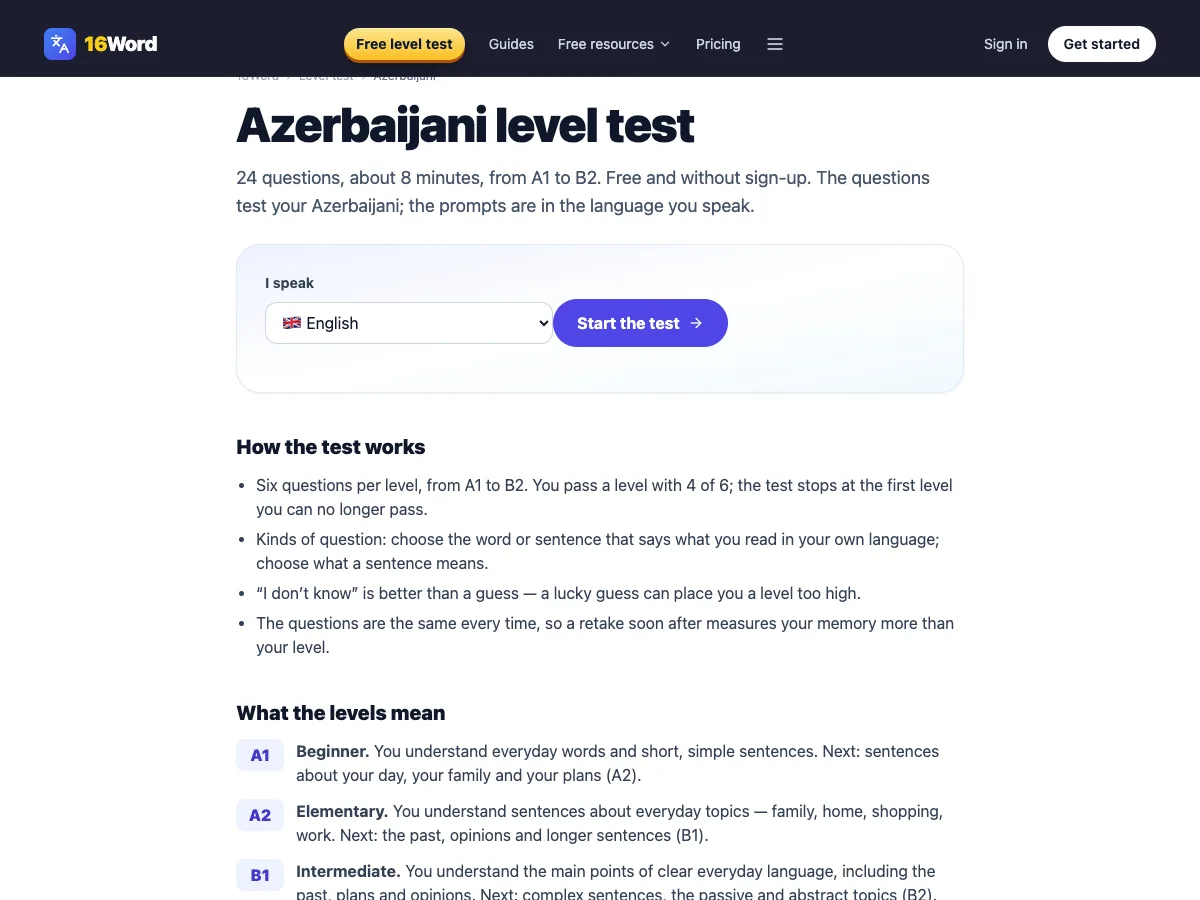
The Azerbaijani alphabet has 32 Latin letters, and you can read almost any word once you know them. Spelling follows sound closely. If you read Turkish, you already know 29 of them: Azerbaijani adds ə, q and x — and gives g and k slightly different sounds. This guide lists every letter with its name and sound, shows the traps for Turkish speakers and gives you words to practise. To see where you stand, try the free Azerbaijani level test.
Updated · 6 min read
Azerbaijani and its alphabet
Azerbaijani is the official language of the Republic of Azerbaijan: Article 21 of the Constitution says so, and adds that the state guarantees the free use and development of the other languages spoken by the population.
The language has changed scripts more than once. The Unicode Standard notes that Turkic languages have switched between Arabic, Latin and Cyrillic, and that Azerbaijani "is now officially using a Turkish-based Latin script" — the alphabet in this guide. Wiktionary still records the Cyrillic and Arabic spellings of many words: *kitab* (book) is китаб in Cyrillic and کتاب in Arabic script. If you meet the older forms, our guides to the Russian alphabet and the Persian alphabet will help.
All 32 letters
Order and names follow Wiktionary's list of Azerbaijani letter names (where two names are given, both are used). The sound column gives the basic value in Wiktionary's pronunciation rules, with our rough English hint; some letters shift a little next to certain vowels.
| Letter | Name | Sound | Rough English hint |
|---|---|---|---|
| A a | a | [ɑ] | a in father |
| B b | be | [b] | b |
| C c | ce | [dʒ] | j in jam |
| Ç ç | çe | [tʃ] | ch in church |
| D d | de | [d] | d |
| E e | e | [e] | e in bed |
| Ə ə | ə | [æ] | a in cat |
| F f | fe | [f] | f |
| G g | ge | [ɟ] | a soft g, close to the g in gear |
| Ğ ğ | ğe | [ɣ] | a gargled g, like a soft French r |
| H h | he / haş | [h] | h |
| X x | xe / iks | [x] | ch in Scottish loch — never ks |
| I ı | ı | [ɯ] | like the u in put said with spread lips |
| İ i | i | [i] | ee in see |
| J j | je | [ʒ] | s in measure |
| K k | ke / ka | [c] | a k with the tongue forward, as in key |
| Q q | qe / kü | [ɡ] | g in go |
| L l | el | [l] | l |
| M m | em | [m] | m |
| N n | en | [n] | n |
| O o | o | [o] | o in more, short |
| Ö ö | ö | [œ] | like German ö: say e with rounded lips |
| P p | pe | [p] | p |
| R r | er | [ɾ] | a tapped r |
| S s | se | [s] | s |
| Ş ş | şe | [ʃ] | sh |
| T t | te | [t] | t |
| U u | u | [u] | oo in food |
| Ü ü | ü | [y] | like German ü: say ee with rounded lips |
| V v | ve | [v] | v |
| Y y | ye / iqrek | [j] | y in yes |
| Z z | ze / zet | [z] | z |
The three letters Turkish does not have
Turkish uses 29 letters; Azerbaijani has the same 29 plus these three, each in its own place in the order (ə after e, x after h, q after k):
- Ə ə — the open a of English cat: ürək (heart), çörək (bread), Azərbaycan (Azerbaijan).
- Q q — the hard g of go, never a k: qız (girl, daughter), qardaş (brother).
- X x — the ch of Scottish loch: xalq (people, nation), xeyr (no, formal).
The trap for Turkish speakers is g and k. In Azerbaijani, the hard g of go is written q, while g and k are front sounds, made with the tongue further forward. Many words Turkish spells with k take q: Turkish kız, Azerbaijani qız. Read göz (eye) with a soft g, and qız with a hard one.
Dotted İ and dotless I
Like Turkish, Azerbaijani has two different i letters, and each keeps its dot (or lack of one) in capitals: İ i is the ee of see, I ı is a back vowel with no English match. Unicode's casing rules treat I/ı and İ/i as the case pairs for Turkish and Azerbaijani — so software set to English can turn İ into the wrong lower-case letter. Set your phone or computer to Azerbaijani when you type it.
Same word, different spelling
Azerbaijani and Turkish share many everyday words; the alphabets make the small sound differences visible. All examples are from Wiktionary — and the last one shows that a shared word can mean something different.
| Azerbaijani | Turkish | Meaning |
|---|---|---|
| ev | ev | house, home (the same) |
| su | su | water (the same) |
| qız | kız | girl, daughter |
| kitab | kitap | book |
| çörək | çörek | Azerbaijani: bread. Turkish: a kind of sweet bun or flat bread |
Learn Azerbaijani words, not just letters
16Word teaches 16 Azerbaijani words a day with active recall, spaced repetition and a short Blocks game between answers. Free to start.
First words to read
| Azerbaijani | Meaning | Cyrillic spelling |
|---|---|---|
| salam | hello | салам |
| sağ ol | thanks; goodbye | сағ ол |
| bəli | yes (formal) | бәли |
| xeyr | no (formal) | — |
| su | water | су |
| çörək | bread | чөрәк |
| ev | house, home | ев |
| qız | girl, daughter | гыз |
| Azərbaycan | Azerbaijan | Азәрбајҹан |
The Cyrillic column is there only to help you recognise older texts; today's spelling is the Latin one.
A one-week plan
- Day 1: the letters that sound roughly as in English: a, b, d, e, f, h, l, m, n, o, p, r, s, t, u, v, z.
- Day 2: c, ç, ş, j, y — the ones that look familiar but sound different.
- Day 3: ə, ı, ö, ü — the vowels English does not have.
- Day 4: g, k, q, ğ, x — say göz, kitab, qız, sağ ol, xalq until they feel different.
- Days 5–7: read the word tables aloud and learn ten words a day. Then take the Azerbaijani level test.
Learning Turkish too? The Turkish course and our guides to the TYS exam and the TÖMER exam are the next step.
Keep learning
- Serbian's two alphabets — another language read in Latin and Cyrillic
- The Persian alphabet, the Arabic alphabet and the Urdu alphabet
- The Georgian alphabet — Azerbaijan's neighbour and its unique script
- Level tests: Azerbaijani, Turkish, Persian, Russian or all 36 languages
- All guides · Plans and prices
Questions about the Azerbaijani alphabet
How many letters are in the Azerbaijani alphabet?
32 Latin letters, from a to z, including ç, ə, ğ, ı, ö, ş, ü, q and x. Wiktionary lists them in order with their names.
What is the difference between the Azerbaijani and Turkish alphabets?
Azerbaijani has the 29 Turkish letters plus ə (the a of cat), q (the hard g of go) and x (the ch of loch). Its g and k are front sounds, and many words Turkish spells with k are spelled with q, such as qız for Turkish kız (girl).
How do you pronounce ə in Azerbaijani?
Like the a in English cat — Wiktionary's pronunciation rules give it as [æ]. It is a separate letter that comes right after e in the alphabet.
Is Azerbaijani written in Latin or Cyrillic?
The Unicode Standard notes that Azerbaijani now officially uses a Turkish-based Latin script. It has also been written in Cyrillic and in Arabic script, and Wiktionary records those older spellings for many words.
Can Turkish speakers read Azerbaijani?
They can read most words at once, because the alphabets are almost the same. Learn ə, q and x and the different g and k, and watch for shared words with other meanings, such as çörək (bread) and Turkish çörek (a kind of bun).
What is the official language of Azerbaijan?
Azerbaijani, under Article 21 of the Constitution of the Republic of Azerbaijan, which also guarantees the free use and development of the other languages spoken by the population.
Was this guide useful?
Official sources
- President of the Republic of Azerbaijan — Constitution, Article 21 (official language)
- The Unicode Standard — Chapter 7, Europe I (Cyrillic, extended letters)
- Unicode Character Database — SpecialCasing.txt (Turkish and Azeri I/ı)
- Wiktionary — the Azerbaijani letter names (Template:list:Latin script letter names/az)
- Wiktionary — Azerbaijani pronunciation module (Module:az-pron)
- Wiktionary — kitab (Azerbaijani)
Keep going
- /level-test/azerbaijani
- /level-test
- The Pashto alphabet: 45 letters and the sounds Persian lacks
- The Sorani Kurdish alphabet: 34 letters and its own vowel letters
- The Tigrinya alphabet: reading the Ge'ez script, syllable by syllable
- Luxembourgish personal pronouns: ech, du, hien, hatt, si, mir, dir — with audio
- How to conjugate Luxembourgish verbs in the present tense
- Luxembourgish irregular verbs: sinn, hunn, goen, kommen and the modals
- Luxembourgish word order: verb second, verb last and separable verbs
- The Luxembourgish n-rule (Eifeler Regel) explained with examples
- All guides