The easiest way to learn German: der, die, das from day one
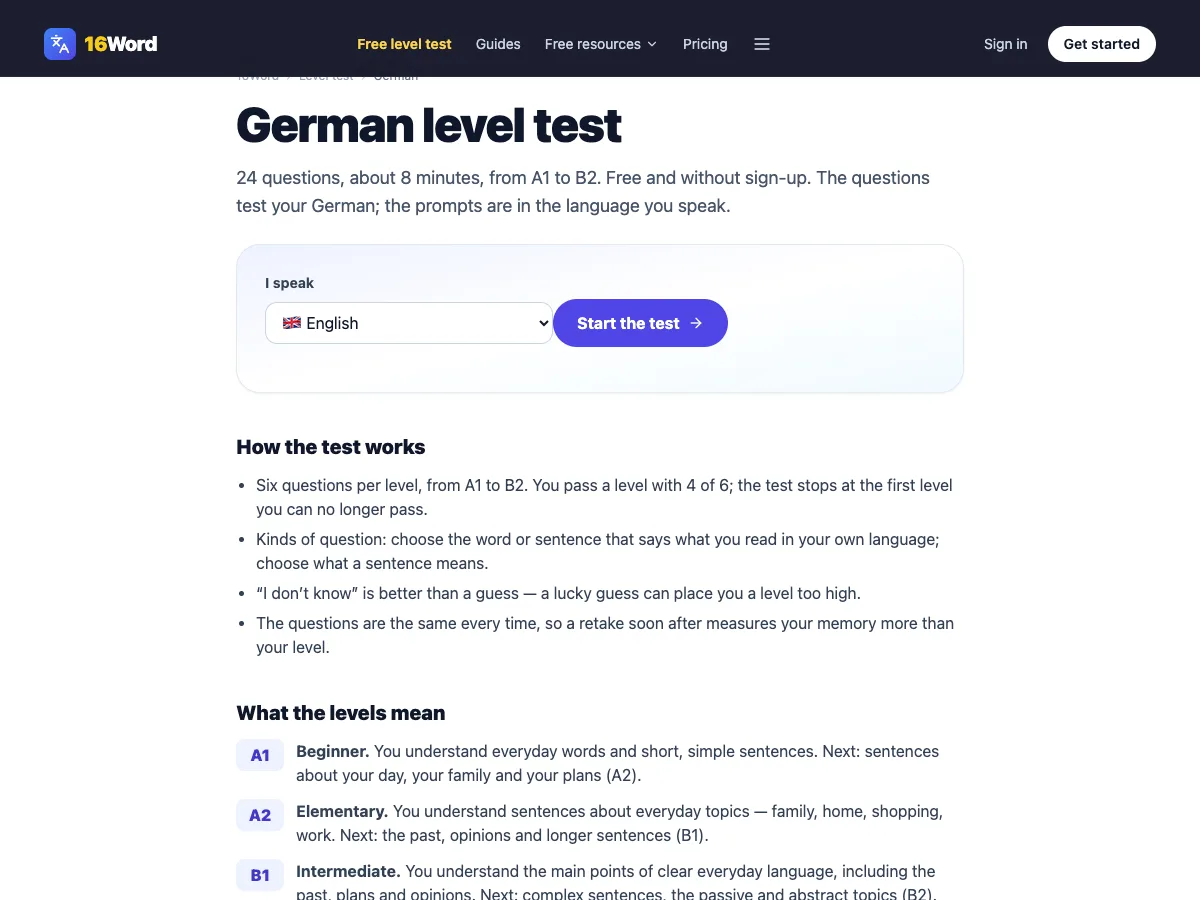
What is the easiest way to learn German? Lean on what German shares with English, and do the one hard thing early instead of late: learn every noun with its article — der, die or das — from the first day. German is English's close relative, so many words look familiar; its genders and four cases are what slow learners down, and they are far easier learned word by word than fixed later. This guide shows how, with recordings of the example words, free official practice tests and word lists. Check your level with the free German level test.
Updated · 5 min read
What makes German easy for English speakers
German belongs to the West Germanic branch, like English, Frisian and Dutch (Britannica). That shows in everyday words — Haus and "house", Sonne and "sun", Mond and "moon" — and English even uses a German word, Kindergarten. The US Foreign Service Institute puts German in its Category II: about 36 weeks of full-time training for professional speaking and listening, against 24–30 weeks for Dutch or French and 88 for Arabic or Japanese (FSI).
Haus
Literally: das Haus — the house
Sonne
Literally: die Sonne — the sun
Mond
Literally: der Mond — the moon
Kindergarten
Literally: der Kindergarten — the kindergarten
What makes it hard: three genders and four cases
German has three genders — masculine, feminine and neuter — and four cases for nouns, pronouns and adjectives: nominative, accusative, genitive and dative (Britannica). The gender often can't be guessed. Lay a table: the spoon is der Löffel, the fork die Gabel, the knife das Messer (Wiktionary, Gabel, Messer). And "the girl" is das Mädchen — grammatically neuter, so it is ein kleines Mädchen, "a little girl" (Wiktionary).
Löffel
Literally: der Löffel — the spoon
Gabel
Literally: die Gabel — the fork
Messer
Literally: das Messer — the knife
Mädchen
Literally: das Mädchen — the girl
The easiest way to learn German, step by step
1. Every noun with its article
Never learn Tisch; learn der Tisch. Never Lampe; learn die Lampe. Say the article and the noun as one sound, every time you review (our advice). Fixing a wrong gender later costs far more than learning the right one now.
Tisch
Literally: der Tisch — the table
Lampe
Literally: die Lampe — the lamp
2. Cases inside phrases, not tables
Learn short phrases you use — mit dem Zug ("by train"), für den Chef ("for the boss") — and the case comes with them (our advice). Read the tables after you have met the forms in real phrases.
3. Words first, by topic
Sixteen words a day, the most useful first. If you speak Turkish or Arabic, our German word lists give meanings, IPA and a recording in your language:
| Topic | For Turkish speakers | For Arabic speakers |
|---|---|---|
| Most common words | Almanca en sık kelimeler | common words |
| Common verbs | fiiller | common verbs |
| Everyday nouns | günlük isimler | everyday nouns |
| Home | ev eşyaları | home and household |
| Family | aile ve ilişkiler | family |
| Food and restaurants | yiyecekler ve restoran | food and restaurants |
| Work | iş ve ofis | work and office |
| Health | sağlık ve hastane | health and hospital |
| Travel | seyahat ve turizm | travel |
| School | okul ve eğitim | school and education |
All lists: for Turkish speakers and for Arabic speakers. In English, our topic guides cover German food vocabulary and family members in German, and doch — the little word that says "yes, actually!".
4. Practise with the official tests — free
The Goethe-Institut offers free exam trainings for every level from A1 to C2: practice tests built like the real exams — same structure, task types and number of tasks — with solutions, tips, topic examples and word lists, on paper or online (Goethe-Institut). Which exam? See Goethe, TestDaF or telc, the Goethe-Zertifikat guide, TestDaF and telc Deutsch, and our paths for Goethe, TestDaF and telc.
5. Speak from the first month
Genders and cases settle when someone hears your mistakes and corrects them. On Edluxio you can book live 1-to-1 lessons with teachers and professionals in many fields, starting with a trial lesson with a full refund if it is not right for you.
German on 16Word
On 16Word you learn German words from any of our 36 languages, 16 at a time in about five minutes: type or say each one from its meaning, with an on-screen keyboard for ä, ö, ü and ß, and see it again before you forget it, with a short Blocks game between answers. Pages for Turkish speakers: Almanca; the level test also runs in Turkish and in Arabic. Free to start.
Your first 16 German words
Take the level test, then learn 16 words — with their articles — in about five minutes.
Where German takes you
German is an official language of Germany, Austria and Liechtenstein, and one of the official languages of Switzerland, Luxembourg and Belgium; more than 76 million people speak Standard German as their native language and more than 57 million as a second language (Britannica). In Luxembourg it sits beside Luxembourgish and French — see the languages of Luxembourg. And German makes its neighbours easier: compare is Dutch hard to learn? and is Luxembourgish hard to learn?, or take the Dutch and Luxembourgish level tests.
Keep learning
- The easiest way to learn French · the easiest way to learn a language
- The easiest way to memorize vocabulary · the best vocabulary builder
- Language exams for citizenship · for work and visas · for studying abroad
Recordings (Wikimedia Commons, MP3 versions): Löffel — Jeuwre, CC BY-SA 4.0; Gabel — Kampy, CC BY-SA 3.0; Messer — Kampy, CC BY-SA 3.0; Mädchen — joni, CC BY-SA 3.0; Sonne — Jeuwre, CC BY-SA 4.0; Mond — Jeuwre, CC BY-SA 4.0; Haus — Kampy, CC BY-SA 3.0; Tisch — Kampy, CC BY-SA 3.0; Lampe — Kampy, CC BY-SA 3.0; Kindergarten — Holunder Gabriel, CC BY-SA 4.0.
Questions about learning German
What is the easiest way to learn German?
Use the words it shares with English, learn every noun with der, die or das from the first day, pick up the four cases inside short phrases and practise with the Goethe-Institut's free exam trainings. Add a weekly conversation so someone corrects your genders.
Is German hard for English speakers?
Moderately. The US Foreign Service Institute estimates about 36 weeks of full-time training for professional speaking and listening — more than Dutch or French (24–30 weeks), far less than Arabic or Japanese (88 weeks).
How do I remember der, die and das?
Learn the article as part of the word — der Tisch, die Lampe, das Haus — and say both every time you review. Gender often can't be guessed: spoon, fork and knife are der Löffel, die Gabel and das Messer.
Why is Mädchen neuter?
Grammatically, das Mädchen (girl) is neuter, so the words before it take neuter forms: ein kleines Mädchen. Grammatical gender doesn't always follow meaning.
Are there free German practice tests?
Yes. The Goethe-Institut publishes free exam trainings for every level from A1 to C2, with practice tests, solutions, tips and word lists.
Was this guide useful?
Official sources
- Britannica — German language
- US Department of State (NFATC) — Foreign Language Training: language learning timelines
- Goethe-Institut — free exam trainings A1–C2
- Wiktionary — Löffel (German)
- Wiktionary — Gabel (German)
- Wiktionary — Messer (German)
- Wiktionary — Mädchen (German), with its usage note
- Wikimedia Commons — German pronunciation (recordings, credited per word below)
- Edluxio — live 1-to-1 lessons with teachers and professionals
Keep going
- /level-test/german
- /certifications/goethe
- /almanca
- The easiest way to learn French: use what English already gave you
- The easiest way to memorize vocabulary: 5 minutes, no willpower
- How to learn Luxembourgish online: free and paid options compared
- Is Luxembourgish hard to learn? An honest guide for beginners
- Which language should you learn first when moving to Luxembourg?
- Best apps to learn Luxembourgish (and is it on Duolingo?)
- Free ways to learn Luxembourgish — and the 200-hour language leave
- Is Luxembourgish worth learning? Work, citizenship and everyday life
- All guides