The easiest way to learn French: use what English already gave you
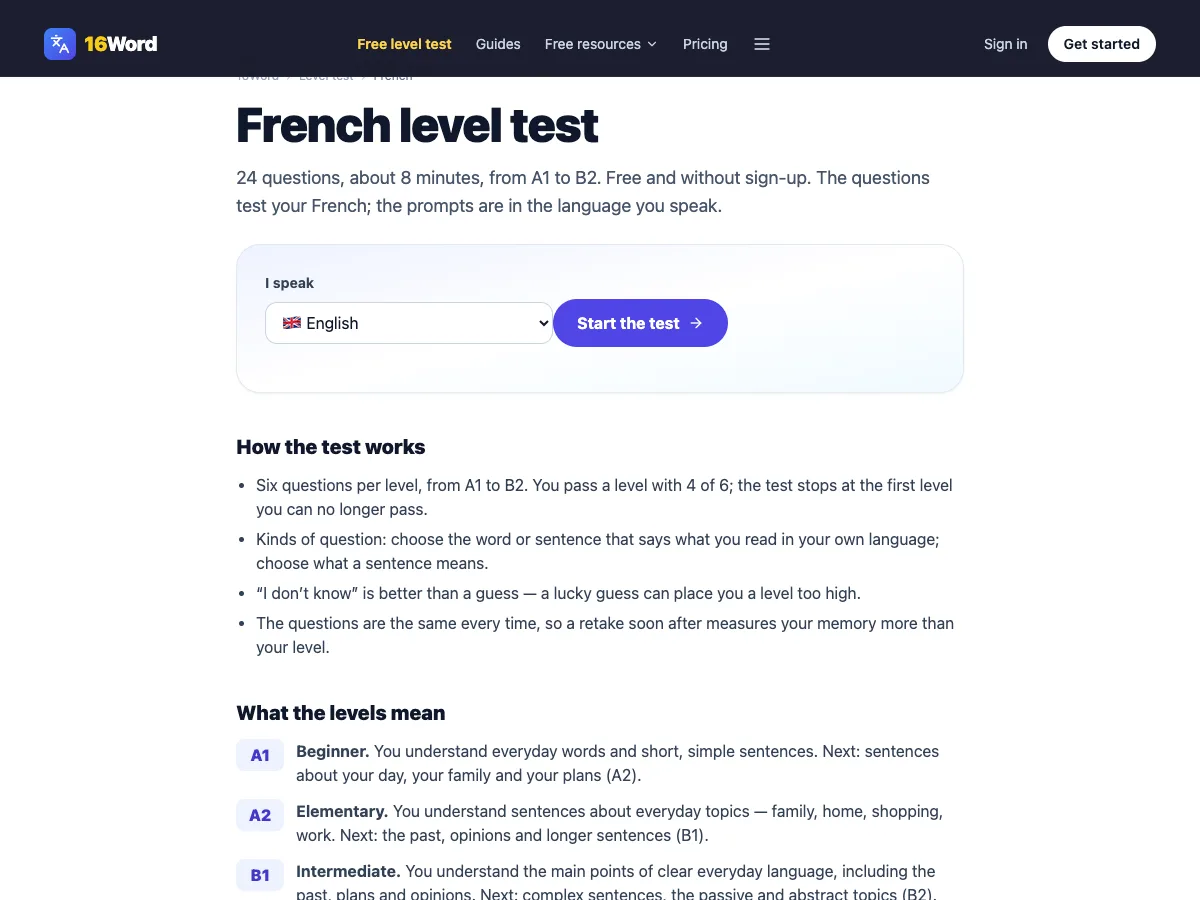
What is the easiest way to learn French? Start from what you already have. Most English vocabulary is of Romance or Classical origin, so a great many French words look familiar on day one, and the US Foreign Service Institute counts French among the languages close to English. The hard part is the ear: French writes letters it doesn't say. This guide shows how to use the shortcut, where it misleads you, and how to train your listening early — with the DELF as your first certificate. Check your level with the free French level test.
Updated · 4 min read
Why French is one of the easier languages for English speakers
Although English is Germanic in its sounds and grammar, "the bulk of English vocabulary is in fact Romance or Classical in origin" (Britannica) — which is why words like question, nation or important need no translation. The US Foreign Service Institute puts French in Category I, "languages close to English": 30 weeks of full-time training for professional speaking and listening, against about 36 for German and 88 for Arabic or Japanese (FSI).
What makes French hard: the ear
Britannica notes "numerous pronunciation difficulties for nearly all foreign speakers". The plural -s is kept in spelling but generally lost in speech, and several verb forms that look different on paper sound exactly the same (Britannica) — je parle, tu parles and ils parlent are said alike. So French you can read is not yet French you can hear.
The easiest way to learn French, step by step
1. Collect the words you already know
Start with the familiar ones and learn their French sound — la nation, la question, important. Watch for false friends (our advice): une librairie is a bookshop, not a library, and actuellement means "currently", not "actually".
2. Learn every noun with le or la
French marks masculine and feminine mostly in the article or adjective, not in the noun itself (Britannica). So learn le livre, la table — never the bare noun (our advice). Nouns don't change for case, which keeps the rest of the grammar lighter.
3. Listen more than you read, from week one
Ten minutes a day of slow, clear French — and say each new word aloud (our advice). Because spelling and sound part ways, learn every word by ear first, then by eye.
4. The four verbs that carry everything
être (to be), avoir (to have), aller (to go) and faire (to do, make) appear in almost every conversation and build the past and the near future (our advice). Our French grammar basics and French tenses explained take them step by step.
5. Aim for the DELF
The DELF is an official diploma of the French ministry of education, in four independent levels — A1, A2, B1 and B2 — aligned with the CEFR, recognised worldwide and valid for life (France Éducation international). Read our DELF guide, compare DELF, TCF or TEF, and see the DELF, DALF, TCF and TEF paths. Past B2: the DALF C1 and C2; and our guides to the TCF and TEF tests.
A week of easy French
| When | What | Time |
|---|---|---|
| Every day | 16 words with their sound and their le or la | about 5 minutes |
| Every day | listening to slow French | 10 minutes |
| Twice a week | one verb or tense with examples | 15 minutes |
| Once a week | a conversation with a teacher or partner | 30 minutes |
| Once a month | the French level test | 10 minutes |
The ear and the accent improve fastest with someone who corrects you. On Edluxio you can book live 1-to-1 lessons with teachers and professionals in many fields, starting with a trial lesson with a full refund if it is not right for you.
French on 16Word
On 16Word you learn French words from any of our 36 languages, 16 at a time in about five minutes: type or say each one from its meaning, hear it, and see it again before you forget it, with a short Blocks game between answers. Small typos in longer words are forgiven, so a slip of the finger doesn't cost you the answer. Start on the French page; it is free to start.
Your first 16 French words
Take the level test and learn 16 words with their sound — about five minutes.
Where French takes you
French is an official language of more than 25 countries (Britannica) — see where French is spoken, why learn French and its history. It is one of Luxembourg's languages too: read the languages of Luxembourg and which language to learn first there. Travelling? French travel phrases.
Keep learning
- French opens its Romance neighbours: Spanish, Italian and Portuguese level tests · Spanish and Italian travel phrases
- The easiest way to learn German · the easiest way to learn a language
- The easiest way to memorize vocabulary · the best vocabulary builder
Questions about learning French
What is the easiest way to learn French?
Start from the many words English shares with French, learn every noun with le or la, listen and speak from the first week because spelling and sound differ, focus on être, avoir, aller and faire, and aim for a DELF level.
Is French easy for English speakers?
Among the easier ones: the US Foreign Service Institute counts it among the languages close to English, at 30 weeks of full-time training for professional speaking and listening. Pronunciation is the main difficulty.
Why is French pronunciation hard?
Many written letters are not said: the plural -s is usually silent, and several verb forms that look different sound the same. Learning each word by ear first avoids most problems.
Which French exam should I take first?
The DELF suits most learners: four independent levels from A1 to B2, recognised worldwide and valid for life. Our guides compare it with the TCF and TEF.
How long does it take to learn French?
The FSI's figure for full-time learners is 30 weeks; part-time learners need longer. Take a level test every month to see your own pace.
Was this guide useful?
Official sources
Keep going
- Learn French 16 words a day
- Free French level test — A1 to B2, no sign-up
- /certifications/delf
- Why learn French? 7 reasons, with the numbers behind them
- The easiest way to memorize vocabulary: 5 minutes, no willpower
- How to learn Luxembourgish online: free and paid options compared
- Is Luxembourgish hard to learn? An honest guide for beginners
- Which language should you learn first when moving to Luxembourg?
- Best apps to learn Luxembourgish (and is it on Duolingo?)
- Free ways to learn Luxembourgish — and the 200-hour language leave
- Is Luxembourgish worth learning? Work, citizenship and everyday life
- All guides