The Greek Certificate of Attainment: levels, dates and fees
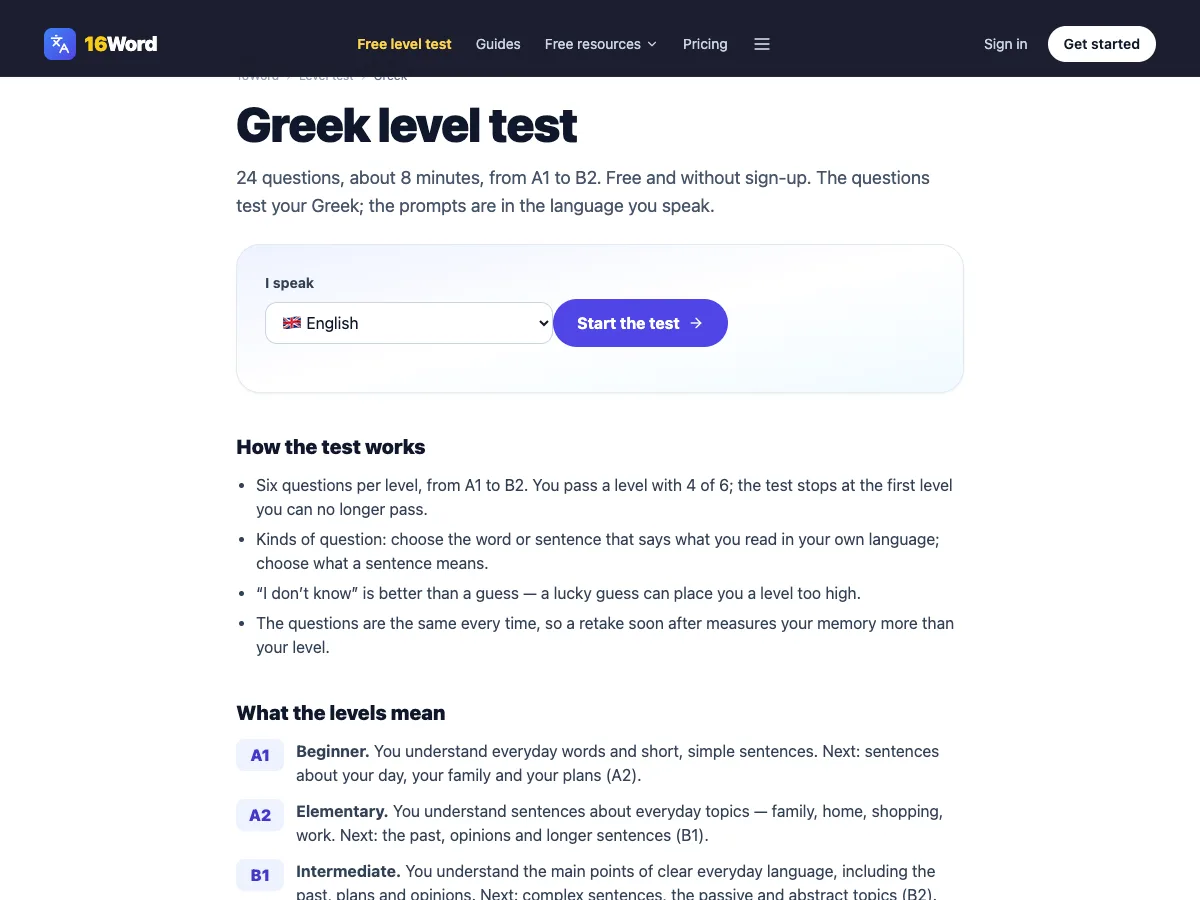
The Certificate of Attainment in Greek (Πιστοποιητικό Ελληνομάθειας) is Greece's state certificate of Modern Greek as a foreign language. It is awarded by the Centre for the Greek Language in Thessaloniki, at six levels from A1 to C2, and exams are held every year in Greece and abroad. This guide gathers what the Centre's own pages say about the levels, the 2026–2027 dates and fees, registration and exam day. To find your starting level first, take the free Greek level test — A1 to B2 in a few minutes.
Updated · 5 min read
Who awards the certificate
The certificate was created by Presidential Decree 363/1998, and the Centre for the Greek Language (KEG) was named the official body that awards it, working through approved exam centres. Exams have been held every year since 1999, at centres in Greece and abroad, as the Centre's page on the certificate explains.
The certificate shows your level for study and for work. The Centre points out, for example, that people whose professional qualifications are recognised in Greece under Presidential Decree 38/2010 need Greek to receive a licence to practise.
The six levels, A1 to C2
Since Presidential Decree 60/2010, the levels match the six levels of the Common European Framework of Reference (CEFR). In Greek, C1 and C2 are written Γ1 and Γ2, because Γ is the third letter of the Greek alphabet:
| Level | Greek name | Meaning |
|---|---|---|
| A1 | στοιχειώδης γνώση | elementary knowledge (one exam for children aged 8–12, one for teenagers and adults) |
| A2 | βασική γνώση | basic knowledge (also a version for special professional purposes) |
| B1 | μέτρια γνώση | moderate knowledge |
| B2 | καλή γνώση | good knowledge |
| C1 (Γ1) | πολύ καλή γνώση | very good knowledge |
| C2 (Γ2) | άριστη γνώση | excellent knowledge |
Before 2010 there were four levels, called A, B, Γ and Δ. They were renamed A2, B1, B2 and C1, and the Centre's general information page confirms that certificates issued for the old levels are still valid.
Exam dates and fees
The main session is in May, in Greece and abroad. The dates page lists the May 2027 session as follows; the oral exam takes place straight after the written one.
| Level | Written exam | Fee |
|---|---|---|
| A1 (children 8–12; teenagers and adults) | Tuesday 11 May 2027, morning | 90 € |
| A2 and A2 for professional purposes | Tuesday 11 May 2027, midday | 90 € |
| B1 | Thursday 13 May 2027, morning | 90 € |
| B2 | Wednesday 12 May 2027, morning | 100 € |
| C1 | Wednesday 12 May 2027, afternoon | 100 € |
| C2 | Thursday 13 May 2027, afternoon | 100 € |
Registration for May 2027 runs from 1 February to 14 March 2027. There is also a smaller autumn session: in 2026 it was held on Friday 23 October, only in Greece and only for B1 and A2 for professional purposes, at 90 €, with registration from 1 to 15 September.
How to register
- Find an exam centre near you on the Centre for the Greek Language's list of approved centres in Greece and abroad.
- Apply to the exam centre, not to the Centre itself, during the registration period; the online application gives you a candidate number.
- Note your candidate number, the dates, times and room — you will need them on exam day.
Results reach candidates through their exam centre in the second half of July, and the centres hand out the certificates at the end of September, according to the candidates' page.
Exam-day rules worth knowing
- Be in the exam room at least 15 minutes before the start. Once the listening test has begun, latecomers cannot take part.
- Bring a valid identity document — ID card, passport or driving licence.
- No dictionaries, books or papers: only a pen, a pencil and an eraser.
- Write your answers in blue or black pen; pencil is for rough notes only, and correction fluid is not allowed.
- Do not write your answers in capital letters only.
- There are two booklets: one for listening and reading, one for writing.
How the writing is marked
The assessment criteria give each piece of writing a mark out of 25 at A1, A2 and B1, and out of 20 at B2, C1 and C2. A text must reach at least 60% of its mark to count as successful. The Centre publishes sample papers and the structure of each level's exam, so look at the tasks for your level before you start preparing.
The Greek alphabet slows many beginners down. Read and copy short texts by hand from your first week, so writing in Greek letters is automatic by exam day.
Learn the everyday words every level is built on
16 words a day, about five minutes, with spaced repetition and a Blocks break between answers. 16Word is free to start.
Other official language certificates
If you are comparing exams, our guides cover other state certificates too: the Czech A2 exam for permanent residence, Finland's YKI test, Spain's DELE A2 and CCSE, Italy's B1 requirement, Portugal's CIPLE, the Dutch naturalisation test, Belgium's A2 requirement, the Luxembourgish level for citizenship and Japan's JLPT levels.
Keep learning
- Free Greek level test
- Level tests in 36 languages
- JLPT levels N5 to N1
- 16Word plans and prices
- All guides
Questions about the Greek certificate
Who issues the Certificate of Attainment in Greek?
The Centre for the Greek Language, which was named the official awarding body after the certificate was created by Presidential Decree 363/1998. The exams are held at centres it has approved in Greece and abroad.
How much does the Greek certificate exam cost?
For the May 2027 session the Centre lists 90 € for A1, A2 and B1, and 100 € for B2, C1 and C2.
When is the next Greek certificate exam?
The May 2027 exams are on 11, 12 and 13 May 2027, depending on the level, with registration from 1 February to 14 March 2027. An autumn session in Greece only is offered for B1 and A2 for professional purposes.
What do Γ1 and Γ2 mean?
They are the Greek names for C1 and C2 — Γ is the third letter of the Greek alphabet. Since 2010 the certificate's six levels match the CEFR from A1 to C2.
Is my old level B or Γ certificate still valid?
Yes. The old levels A, B, Γ and Δ were renamed A2, B1, B2 and C1 in 2010, and the Centre says certificates issued for them remain valid.
When will I get my results?
For the May session, exam centres give candidates their results in the second half of July and hand out the certificates at the end of September.
Was this guide useful?
Official sources
- Centre for the Greek Language — Establishment and uses of the certificate
- Centre for the Greek Language — General information on the exams
- Centre for the Greek Language — Exam dates and fees
- Centre for the Greek Language — I am a candidate (registration and exam rules)
- Centre for the Greek Language — Assessment criteria
Keep going
- /level-test/greek
- /level-test
- TOPIK levels explained: TOPIK I and II, scores, IBT and speaking
- The Dutch inburgering exam in 2026: routes, parts, fees and FAQ
- Sproochentest speaking (A2): topics, picture description and how to prepare
- Sproochentest listening (B1): the three recordings and how to practise
- A 60-day Sproochentest preparation plan, week by week
- Luxembourgish levels A1 to B2: what each CEFR level means in practice
- What level of Luxembourgish do you need for citizenship?
- The inburgering reading exam (A2 and B1): format, question types and tips
- All guides