Portuguese nationality: the A2 requirement and the CIPLE exam
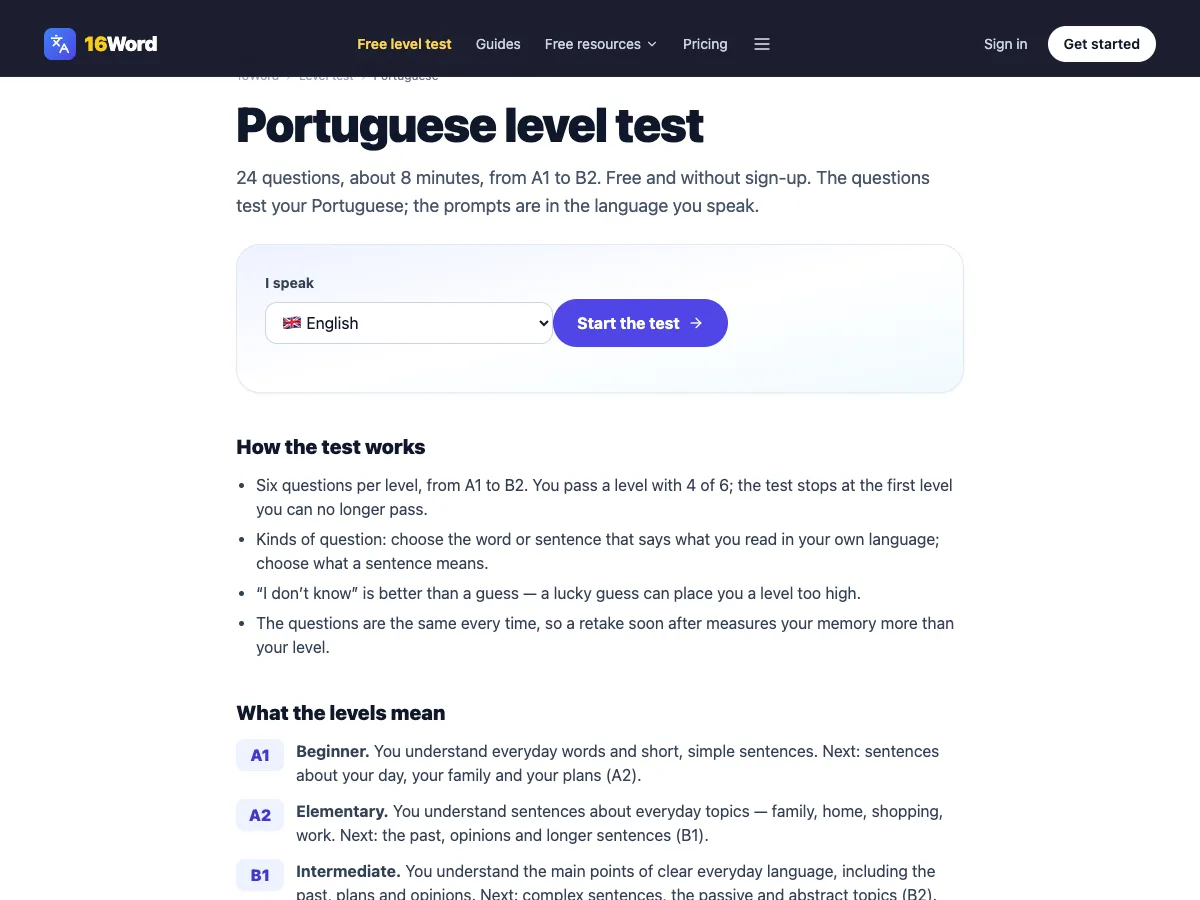
Portugal asks applicants for nationality by residence to know Portuguese "sufficiently", and the University of Lisbon's exam centre CAPLE states that, under current law, the minimum is the CIPLE, its A2 exam. This guide covers the CIPLE A2 requirement for Portuguese nationality: the accepted proofs, who is exempt, and what the exam looks like. Start with the free Portuguese level test to see whether A2 is already in reach.
Updated · 5 min read
The conditions, as the Justice Ministry lists them
For people who live in Portugal, Justiça.gov.pt (page updated 28 July 2026) lists three conditions: you are over 18 (or emancipated), you have lived legally in Portugal for at least five years, and you know Portuguese sufficiently. You must not have been sentenced to three or more years in prison for a crime punishable in Portugal, nor be involved in terrorism-related activities. The application costs 250 euros.
The ministry's nationality guide is marked "em atualização" (being updated). Check the conditions on Justiça.gov.pt, or with a lawyer or solicitor, on the day you apply.
Three ways to prove your Portuguese
The ministry accepts any one of these documents:
- a certificate of studies from a Portuguese public, private or cooperative school;
- a certificate of passing a Portuguese language test;
- a certificate of Portuguese as a foreign language, from a test at an exam centre recognised by the Ministry of Education through CAPLE — in practice the CIPLE or a higher CAPLE exam.
According to the CAPLE FAQ, "under the Portuguese legislation in force" the CIPLE (A2) is the minimum level for acquiring Portuguese nationality.
Who does not need to prove Portuguese
You need no language document if you were born in a country whose official language is Portuguese and hold that country's nationality — both conditions together. Someone born in Brazil who is not Brazilian, or a Brazilian born elsewhere, does not qualify on this ground.
If the applicant cannot read or write, the test must be adapted to show their knowledge of the language in another way. The CAPLE FAQ explains that the oral-only route of the CIPLE is for people with a disability that prevents the written parts, and for people aged 60 or over who cannot read or write, including in their own language (Decree-Law 26/2022, article 25(6)).
The CIPLE exam at a glance
The CIPLE (Certificado Inicial de Português Língua Estrangeira) is A2 on the Council of Europe scale: a basic ability to interact in a limited number of predictable everyday situations.
| Part | What you do | Time | Weight |
|---|---|---|---|
| Reading and written production | Part I: notices in public places and short texts (multiple choice, matching). Part II: write two short texts | 1 h 15 min | 45% |
| Listening | Short everyday spoken exchanges and information | 30 min | 30% |
| Speaking | Speaking and interacting, with candidates examined in pairs | 15 min per pair | 25% |
In all it takes about two hours plus a 15-minute break. The scale runs from 55% to 100%: Suficiente 55–69%, Bom 70–84%, Muito Bom 85–100%. The fee is €95, and CAPLE says it cannot be refunded.
The reading tasks are everyday ones: notices in streets and public services, timetables and opening hours, a menu, the instructions on a medicine, a hotel or bank form, a postcard or a short message to a colleague. Learn the words for those situations first.
Dates, registration and results
- Sessions: international sessions in May, July and November, plus extra national sessions in Portugal called CIPLE-P.
- Registration: online, all year, up to 21 days before the first exam of the session (FAQ). Only one Portuguese-as-a-foreign-language exam per session (exam rules).
- Results: published on CAPLE's website with your candidate code; you can ask for a review within 5 working days.
- Certificate: collected at the centre where you sat the exam, 15–20 working days after the results.
There is also a school version of the CIPLE for young people aged 12 to 15, with tasks adapted to their age.
Build your A2 vocabulary
16Word teaches Portuguese 16 words a day with active recall, spaced repetition and a short Blocks game between answers. Free to start.
How to prepare
- Test yourself. The Portuguese level test shows whether you pass A1 and how far A2 is.
- Learn the exam's situations. Signs, timetables, shops, health, housing, banks — words you recall in a second, not just recognise.
- Write two short texts a week. Part II asks for exactly that: a message, a postcard, a short note.
- Listen daily. Thirty minutes of listening count for almost a third of the grade.
- Book early. Registration closes 21 days before the session.
Neighbouring countries
Portugal's A2 matches Spain's DELE A2, which also requires a civics test; Portuguese nationals may apply in Spain after two years but still take the DELE. Italy asks for B1. See also Luxembourg, the Netherlands and Belgium.
Keep learning
- Free Portuguese level test
- Level tests in 36 languages
- Spanish nationality: DELE A2 and CCSE — and the Spanish level test
- Italian citizenship: the B1 requirement — and the Italian level test
- All 16Word guides
Questions about the CIPLE and Portuguese nationality
What level of Portuguese do I need for nationality?
A2. CAPLE states that under the legislation in force the CIPLE, its A2 exam, is the minimum level for Portuguese nationality. A school certificate from a Portuguese school or a pass in a Portuguese language test are also accepted by the Justice Ministry.
How much does the CIPLE cost?
CAPLE lists the fee as €95.00, and its FAQ says it cannot be refunded. The nationality application itself costs 250 euros, according to Justiça.gov.pt.
What is the pass mark of the CIPLE?
The classification scale starts at 55%: Suficiente is 55–69%, Bom 70–84% and Muito Bom 85–100%.
Are Brazilians exempt from the language proof?
Only if they were born in a country whose official language is Portuguese and hold that country's nationality — for example, born in Brazil and Brazilian. Both conditions must be met.
When can I take the CIPLE?
In the international sessions of May, July and November, and on extra national dates in Portugal (CIPLE-P). Registration is online and closes 21 days before the first exam of the session.
Can older applicants take only the oral part?
The CAPLE FAQ says the oral-only route applies to people aged 60 or over who cannot read or write, and to people with a disability that prevents the written parts.
Was this guide useful?
Official sources
Keep going
- /level-test/portuguese
- /level-test
- Finnish citizenship: the language requirement and the YKI test
- The Czech A2 exam for permanent residence: format, points and fee
- JLPT levels N5 to N1: sections, times and pass marks
- Polish citizenship: the B1 Polish certificate and how to get it
- The Greek Certificate of Attainment: levels, dates and fees
- TOPIK levels explained: TOPIK I and II, scores, IBT and speaking
- The Dutch inburgering exam in 2026: routes, parts, fees and FAQ
- Sproochentest speaking (A2): topics, picture description and how to prepare
- All guides