Polish citizenship: the B1 Polish certificate and how to get it
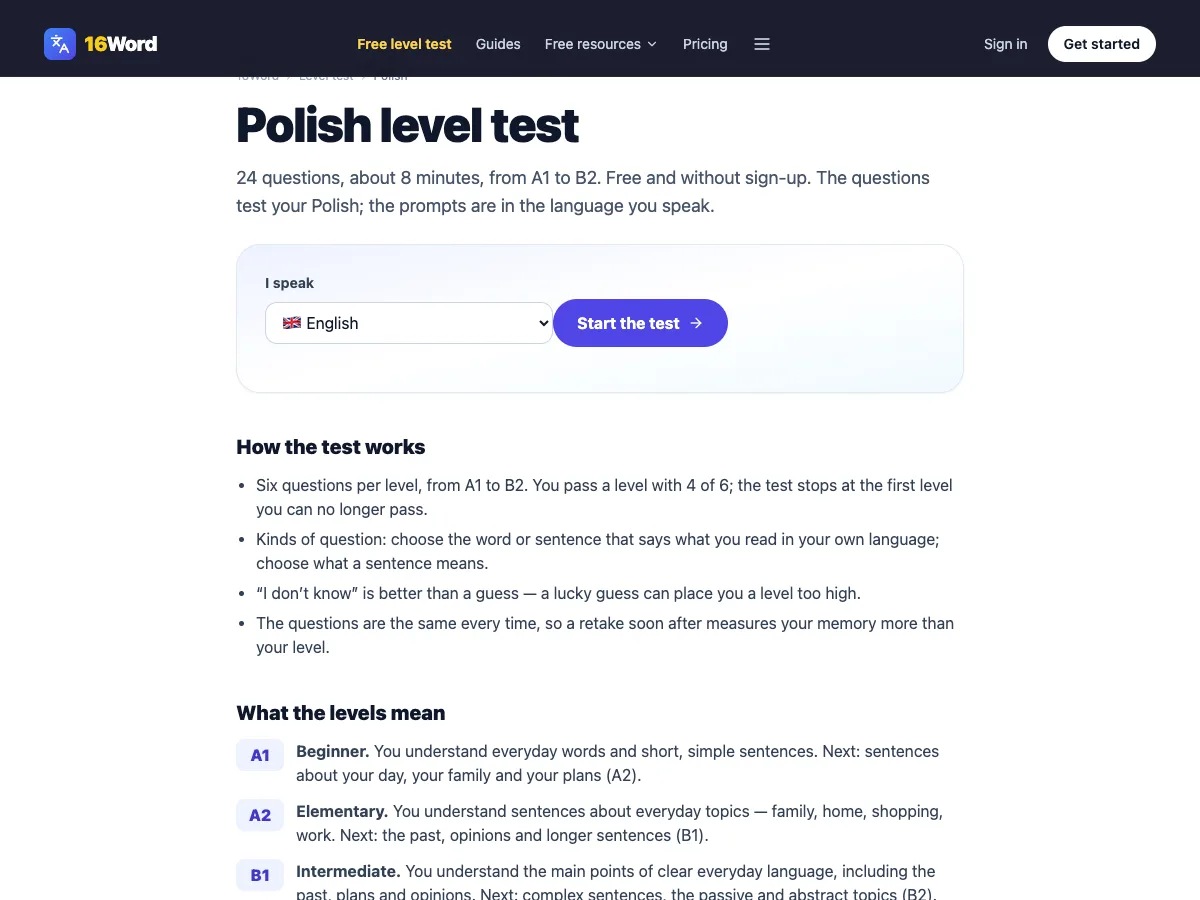
To be recognised as a Polish citizen by the voivode of the region where you live, you need the B1 Polish certificate for citizenship, an official state certificate in Polish as a foreign language. This guide sums up what the Ministry of the Interior and the State Commission that runs the exams say: who can apply, how the B1 exam works, what it costs, the 2027 dates and the government's plan to raise the level to B2. Before you book, see where you stand with the free Polish level test — it covers A1 to B2.
Updated · 6 min read
Who can be recognised as a Polish citizen
The Ministry of the Interior's application page lists the cases in article 30(1) of the 2009 Polish Citizenship Act. The main ones for adults are a foreigner who has lived in Poland continuously:
- for at least 3 years on a permanent residence permit, an EU long-term resident permit or the right of permanent residence, with a stable and regular income and a legal title to a home;
- for at least 2 years on such a permit and has been married to a Polish citizen for at least 3 years, or has no citizenship at all;
- for at least 2 years on a permanent residence permit granted with refugee status in Poland;
- for at least 10 years continuously and legally, holding such a permit, with an income and a home;
- for at least 1 year on a permanent residence permit granted for Polish origin or the Karta Polaka.
Minors can also be recognised in some cases, for example when one parent is Polish and the other agrees. In every case the ministry adds one condition in bold: you must know Polish at at least level B1, confirmed by an official certificate.
The B1 exam: four written modules and a speaking test
The certificate exams are run by the State Commission for the Certification of Proficiency in Polish as a Foreign Language, through approved centres. Anyone who is a foreigner — or a Polish citizen living permanently abroad — may sit them, however they prepared. Adults must be 18 on the exam day; there is a separate exam for 14- to 17-year-olds. The B1 exam for adults looks like this:
| Module | Time | Points |
|---|---|---|
| Listening | 25 minutes | 30 |
| Reading | 45 minutes | 30 |
| Grammatical accuracy | 45 minutes | 30 |
| Writing | 75 minutes | 30 |
| Speaking (oral part) | up to 15 minutes | 40 |
The written part takes 190 minutes in all. In listening you hear each recording once or twice; in the grammar module you choose or write the correct form in short texts; in writing you pick one set of tasks, on topics that need no specialist knowledge. For the oral part you draw one of three sets of two or three tasks, based on texts and pictures, and do them in front of the examiners, as the exam structure page explains.
The pass rule: 50% in every module
At B1 you must score at least 50% in each module of the written part and at least 50% in speaking. A strong reading score does not make up for a weak grammar module. From B2 upwards the threshold is 60% in each part, and the B2 written part is longer: 240 minutes.
Because each module has its own pass mark, find your weakest skill early. Many learners who read well lose the certificate in grammatical accuracy — Polish cases and verb aspect deserve daily practice.
Fees: set by each centre, within a cap
Each centre sets its own price, but never above the legal maximum listed on the fees page: 150 € for B1 or B2 for adults (120 € for A1–A2, 180 € for C1–C2, 90 € for the youth exams). Issuing the certificate costs the equivalent in złoty of 20 €.
2027 exam dates and how to register
B1 for adults is offered at every session. The State Commission's 2027 calendar lists five weekends (the last 2026 session, with B1 for adults, is on 5–6 December 2026):
| Session | Levels for adults |
|---|---|
| 6–7 March 2027 | B1, B2 |
| 24–25 April 2027 | B1, B2, C1 |
| 12–13 June 2027 | B1, B2 (also B1 and B2 for young people) |
| 2–3 October 2027 | B1, C2 |
| 27–28 November 2027 | B1, C1 (also B2 for young people) |
- Choose a centre. The list of centres holding each session is published about two months before it, and registration opens then.
- Register on the centre's own website before the deadline it sets.
- Pay the centre — the bank details are on its site.
The registration page has the current list of centres.
Applying for citizenship: fee, time and appeal
You apply to the voivode (the regional governor) of the region where you live, in person or by post, at any time. The fee is 1,000 PLN for the decision, and the voivode has six months to decide, which can be extended. Before deciding, the office asks the police and the security services whether your citizenship would be a risk. If you disagree with the decision you can appeal in writing to the Ministry of the Interior within 14 days, and then to an administrative court within 30 days. Documents in a foreign language must be translated by a sworn translator or a Polish consul.
A government plan, not yet law: draft bill UD491, published on gov.pl on 27 October 2026, would raise the required Polish level from B1 to B2 and add a citizenship test on knowledge of Poland, a loyalty declaration, a longer minimum residence, a minimum income and a centre of life in Poland. The Council of Ministers plans to adopt the draft in the fourth quarter of 2026; Parliament would still have to pass it. Check the current rules before you apply.
The draft's page lists these points in full. If you are close to B1 now, it may be worth aiming a little higher in your preparation.
Build the vocabulary B1 is made of
16 words a day, about five minutes, with spaced repetition and a Blocks break between answers. 16Word is free to start.
How other countries compare
Poland's B1 is in the middle of Europe's range. Neighbouring Czechia asks for A2 for permanent residence and B1 for citizenship; Finland wants YKI level 3; Italy also asks for B1 Italian, while Spain asks for DELE A2 and the CCSE, Portugal for A2 Portuguese, the Netherlands for A2 Dutch, Belgium for A2 in a national language and Luxembourg for Luxembourgish.
Keep learning
- Free Polish level test
- Free Czech level test
- Level tests in 36 languages
- The Czech A2 exam for permanent residence
- 16Word plans and prices
- All guides
Questions about Polish for citizenship
What level of Polish do I need for Polish citizenship?
At least B1, confirmed by an official certificate, according to the Ministry of the Interior's page on recognition as a Polish citizen. A government draft published in October 2026 would raise this to B2, but it is not law yet.
How much does the B1 Polish exam cost?
Each centre sets its own fee, up to a legal maximum of 150 € for B1 or B2 for adults. The certificate itself costs the złoty equivalent of 20 €.
What is the pass mark for the B1 Polish exam?
At least 50% in every written module — listening, reading, grammatical accuracy and writing — and at least 50% in speaking. From B2 upwards it is 60% in each part.
When are the Polish certificate exams in 2027?
6–7 March, 24–25 April, 12–13 June, 2–3 October and 27–28 November 2027; B1 for adults is held at all five. The list of centres for each session appears about two months before.
How long does the citizenship decision take?
The voivode has six months to decide, and this can be extended in justified cases. The fee for the decision is 1,000 PLN.
Can I take the exam outside Poland?
The exams are held at centres approved by the State Commission; each session's list of centres is published on certyfikatpolski.pl two months before the exam, so check there which centres take part.
Was this guide useful?
Official sources
- gov.pl (Ministry of the Interior) — Apply to be recognised as a Polish citizen
- gov.pl (Chancellery of the Prime Minister) — Draft amendment to the Polish Citizenship Act (UD491)
- certyfikatpolski.pl — Who can take the exam (and the B1/B2 exam structure)
- certyfikatpolski.pl — Exam structure and pass thresholds
- certyfikatpolski.pl — Exam fees
- certyfikatpolski.pl — Exam sessions in 2027
- certyfikatpolski.pl — Registering for the exam
Keep going
- /level-test/polish
- /level-test
- The Greek Certificate of Attainment: levels, dates and fees
- TOPIK levels explained: TOPIK I and II, scores, IBT and speaking
- The Dutch inburgering exam in 2026: routes, parts, fees and FAQ
- Sproochentest speaking (A2): topics, picture description and how to prepare
- Sproochentest listening (B1): the three recordings and how to practise
- A 60-day Sproochentest preparation plan, week by week
- Luxembourgish levels A1 to B2: what each CEFR level means in practice
- What level of Luxembourgish do you need for citizenship?
- All guides