A short history of Chinese: from oracle bones to pinyin
Chinese is one of the oldest written languages still in use: inscriptions from more than three thousand years ago can largely be read today. Six moments shaped the language you are learning — and they explain why its characters look the way they do, why its spoken varieties differ so much, and where pinyin comes from. Facts here are from Britannica and China’s State Council.
Updated · 4 min read
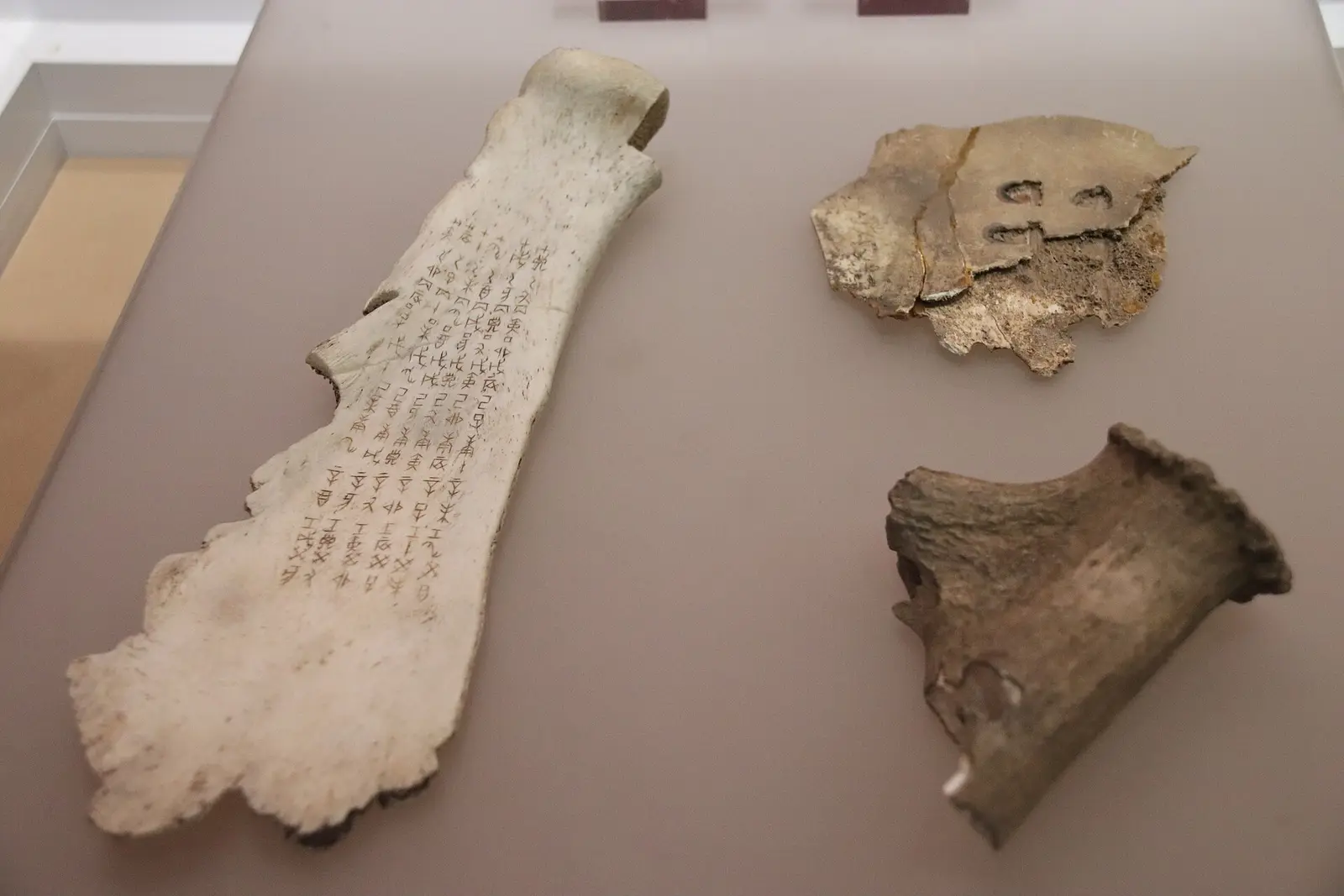
1. Oracle bones: the oldest Chinese writing
The earliest known Chinese inscriptions — 10 to 60 characters cut into pieces of bone and tortoiseshell used for divination — date from the Shang dynasty. Even then the script was highly developed, and by 1400 BCE it had some 2,500 to 3,000 characters, most of which can be read to this day (Britannica). The picture at the top shows oracle bones from Yinxu; the left piece is a table of the sixty-day cycle used to date divinations. What this long history means for learners today is in Why learn Chinese?
2. From pictures to sound-and-meaning characters
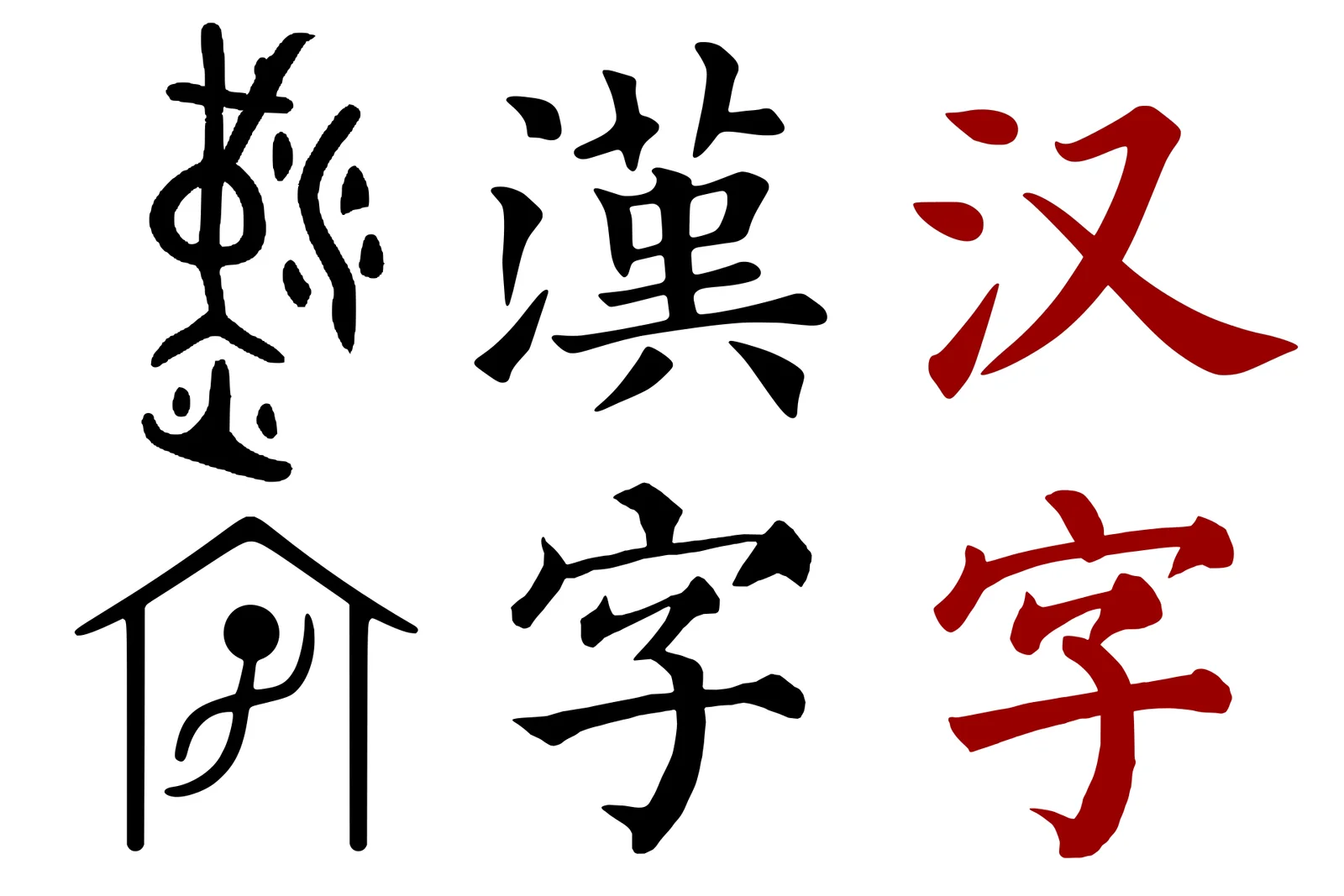
The earliest graphs were schematic pictures — the graph for man looked like a standing figure. But many words cannot be drawn, so a picture was borrowed for another word that sounded alike. To avoid ambiguity, about 213 BCE, under the first Qin emperor, a second element was added to give a clue to the meaning: most characters since then have one part suggesting the sound and another the meaning (Britannica).
3. The Qin standard and the brush
After the Zhou dynasty’s “great seal” script, the writing was fixed in its present form during the Qin period (221–207 BCE). Before the Common Era it came to be written with brush and ink on paper, and the graphs lost their pictorial look (Britannica). Until the 18th century, more than half of the world’s books were written in Chinese.
4. Old, Middle and Modern Chinese
Some scholars divide the spoken language into Proto-Sinitic (until 500 BC), Archaic or Old Chinese (8th–3rd century BC), Ancient or Middle Chinese (to AD 907) and Modern Chinese (from about the 10th century). Much of what we know of Middle Chinese sounds comes from a pronouncing dictionary published in AD 601 by Lu Fayan (Britannica). Meanwhile the spoken varieties drifted apart — today Mandarin, Wu, Min, Gan, Hakka, Xiang and Cantonese are not mutually intelligible (Where is Chinese spoken?).
5. One written language: from wenyan to baihua
All the varieties shared one literary language, wenyan, written in characters; each region read it with its own pronunciation. Before 1917 it was used for almost all writing; since then writing in the vernacular style, baihua, has become accepted, and wenyan survives mainly in literary and scholarly circles (Britannica).
6. The 20th century: a national standard, pinyin and simplified characters
In the early 1900s a programme to unify the national language, based on Mandarin, produced Modern Standard Chinese. Pinyin, based on Beijing pronunciation, was adopted in 1956 as a teaching tool, modified in 1958 and prescribed in 1979 for diplomatic documents (Britannica). A second reform simplified characters by reducing their strokes (Britannica). In 2013 China’s State Council published the Table of General Standard Chinese Characters, in three levels, which replaced earlier character lists and includes a comparison with traditional and variant forms (State Council). Learning them goes faster in small daily steps — 16 words a day.
| Date | What happened |
|---|---|
| Shang dynasty | Oracle-bone inscriptions, the earliest known Chinese writing |
| by 1400 BCE | Some 2,500–3,000 characters, most still readable |
| c. 213 BCE | Characters with a sound part and a meaning part standardised |
| 221–207 BCE | The script fixed in its present form (Qin) |
| AD 601 | Lu Fayan’s pronouncing dictionary |
| 1917 onwards | Writing in the vernacular (baihua) accepted |
| 1956 / 1958 | Pinyin adopted / modified |
| 2013 | Table of General Standard Chinese Characters |
What this history means for you: learn characters through their parts — the meaning part and the sound part — and learn every word with its pinyin and tone. Start at your level with the free Chinese level test; the grammar is in Chinese grammar basics.
Learn Chinese words with their sound
16Word gives you 16 words a day with audio, active recall, spaced repetition and a short Blocks game between answers — about five minutes, free to start.
Keep learning
- Why learn Chinese? 7 reasons
- Where is Chinese spoken? — dialect groups on a map
- Chinese grammar basics · Chinese tenses: time and aspect
- Learn Chinese with 16Word · Learn Japanese · Level tests in 36 languages · All guides · Plans
Frequently asked questions
How old is Chinese writing?
The earliest known inscriptions, on oracle bones, date from the Shang dynasty; by 1400 BCE the script already had some 2,500 to 3,000 characters, most of which can still be read.
Are Chinese characters pictures?
Only the earliest were. Most characters combine a part that suggests the sound with a part that suggests the meaning, a principle standardised around 213 BCE.
When was pinyin introduced?
Pinyin was adopted in 1956 as a tool for teaching the standard language, modified in 1958 and prescribed in 1979 for diplomatic documents.
What is the difference between wenyan and baihua?
Wenyan is the old literary language shared by all varieties; baihua is writing in the vernacular style, accepted since 1917 and the norm today.
Why are there simplified and traditional characters?
A 20th-century reform simplified many characters by reducing their strokes. China’s 2013 standard character table includes a comparison of the standard forms with traditional and variant forms.
Was this guide useful?
Official sources
Keep going
- Free Chinese level test — A1 to B2, no sign-up
- Learn Chinese 16 words a day
- Where is Chinese spoken? Mandarin, the dialect groups and a map
- A short history of Japanese: from the Kojiki to kana and kanji
- Where is Japanese spoken? Dialects, the Ryukyuan languages and a map
- Endangered languages: why they disappear, how they come back, and what 16Word is building
- Is Latin a dead language? Where Latin lives today — and how to learn it
- Luxembourgish: how a small language keeps growing
- Is Luxembourgish a language or a German dialect? History, law and the differences
- What language is spoken in Luxembourg? Luxembourgish, French and German explained
- All guides