Luxembourgish: how a small language keeps growing
Fewer than 300,000 people speak it as their main language — and their number is rising. How Luxembourgish became a national language, entered the Constitution and keeps growing in a country of newcomers, and what it takes to keep a small language alive.
Updated · 6 min read
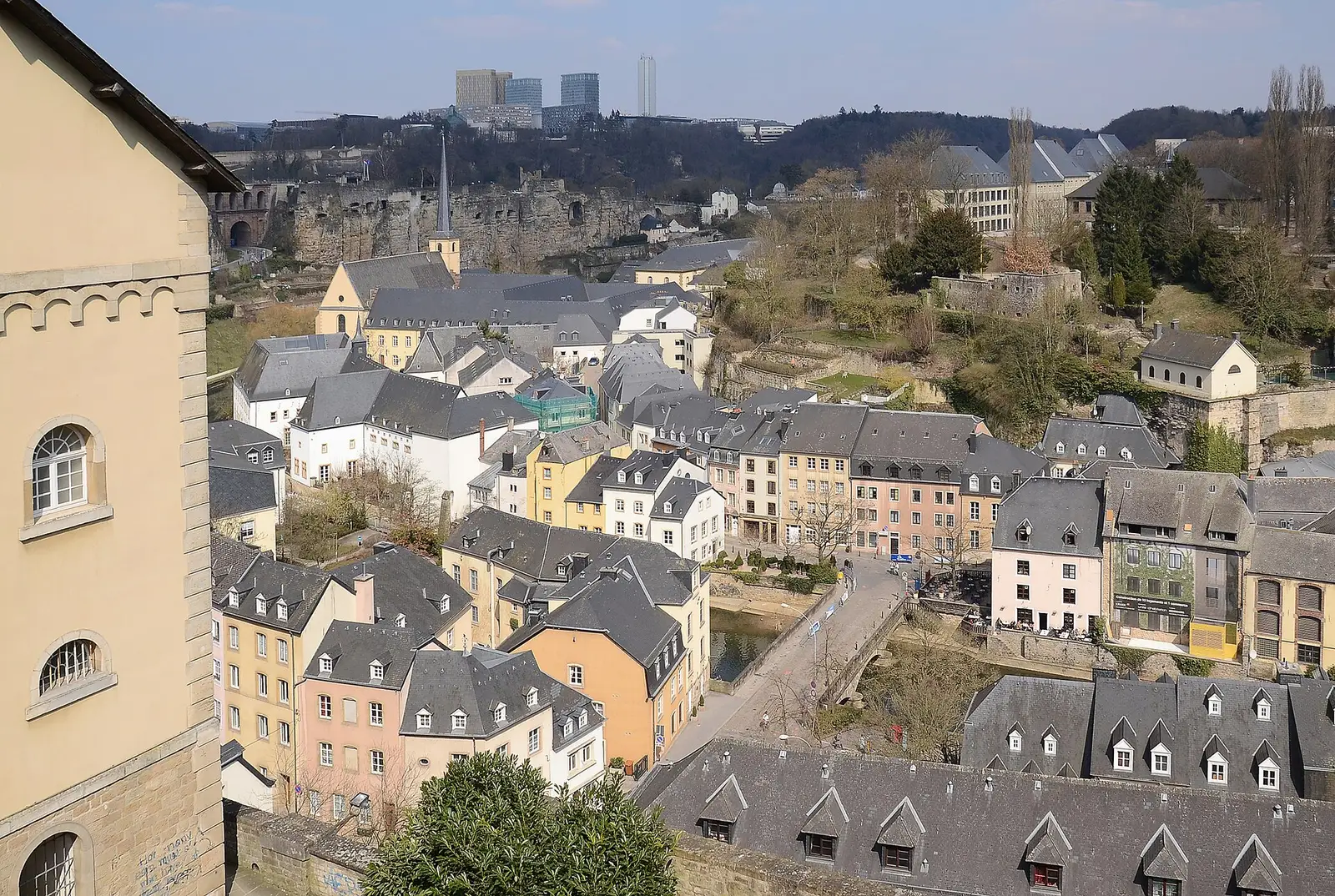
Luxembourgish — Lëtzebuergesch — is spoken by fewer people than live in many European cities. By the numbers it should be fragile: a small country, three languages in daily use, and a population that grew by a quarter in ten years, mostly through immigration. Yet it is doing something many small languages are not: gaining speakers. Its story shows what keeps a small language alive.
At a glance: national language by the law of 24 February 1984; named in Article 4 of the Constitution since 1 July 2023. In the 2021 census 275,361 people (48.9%) gave it as their main language — 3.6% more than in 2011 — and 61.2% use it at home, work or school, more than any other language (STATEC).
A national language since 1984
The law of 24 February 1984 on the language regime made Luxembourgish the national language and set out the roles of the country's three languages: laws are drafted in French, and citizens may write to the administration in French, German or Luxembourgish (Government of Luxembourg).
Since 1 July 2023, the language is also in the Constitution. Article 4 reads: "La langue du Grand-Duché de Luxembourg est le luxembourgeois. La loi règle l'emploi des langues luxembourgeoise, française et allemande." — the language of the Grand Duchy is Luxembourgish, and the law regulates the use of Luxembourgish, French and German (Chamber of Deputies; Venice Commission013-f)).
How many people speak Luxembourgish?
| 2021 census (STATEC) | People | Share |
|---|---|---|
| Luxembourgish as main language | 275,361 | 48.9% |
| … in 2011 | 265,731 | 55.8% |
| Speak Luxembourgish at home, work or school | 292,025 | 61.2% |
| … French, for comparison | 50.8% | |
| … English | 25.7% | |
| … German | 22.5% |
The share fell while the number rose. Between 2011 and 2021 Luxembourg's population grew by 25.7%, from 512,353 to 643,941, mostly through immigration — and STATEC warns that a falling percentage does not mean people are using the language less (STATEC). Among Luxembourgers whose parents were both born in the country, 99% have Luxembourgish as their main language.
Is Luxembourgish endangered?
No. UNESCO's 2010 Atlas does not list Luxembourgish by name: it groups it under Moselle Franconian, which it calls "vulnerable" across its whole area in Belgium, Germany, France and Luxembourg — but it adds that in Luxembourg the language does "not easily qualify even as vulnerable, given its] extremely strong position as [a] spoken language" ([UNESCO Atlas 2010, p. 37). Across the border, where it has no official role, it is much weaker.
The lesson for other small languages: Luxembourgish is strong because children still learn it at home, newcomers learn it to belong (and for nationality — see our Sproochentest guide), and the state gives it real work to do: in Parliament, on the radio, in schools and in the Constitution.
The institutions behind it
- 2017 — a strategy. The government adopted a Strategy for the Promotion of the Luxembourgish Language with 40 measures and a 20-year action plan (MENJE; gouvernement.lu).
- 2018 — a law. The law of 20 July 2018 on the promotion of the Luxembourgish language created a Commissioner for the Luxembourgish language and the Zenter fir d'Lëtzebuerger Sprooch (ZLS), the Centre for the Luxembourgish Language, alongside the Permanent Council (CPLL, created in 1998).
- 2022 — a new action plan with 50 measures in three pillars, adopted on 14 December 2022 (MENJE).
- 2023 — the Constitution names Luxembourgish as the language of the Grand Duchy.
One spelling, one dictionary: LOD
A small language needs one written standard. Official spelling rules date from 1975, were revised in 1999 and completed in 2019, when the Permanent Council adopted them (20 March) and the ZLS published D'Lëtzebuerger Orthografe (Government of Luxembourg; MENJE).
At the centre is the Lëtzebuerger Online Dictionnaire (lod.lu) — free, translating into German, French, English and Portuguese, and "the official reference for correct spelling". Its data, including recordings of example sentences by native speakers, is published as open data under CC0 (data.public.lu). That openness is what lets apps, researchers and teachers build on it.
Listen: six everyday sentences
Every sentence below is an example from LOD, read by a native speaker.
Moien, wéi geet et?
Meaning: Hello, how are you?
Ech komme vu Lëtzebuerg.
Meaning: I come from Luxembourg.
Schwätz méi lues, ech hunn näischt matkritt!
Meaning: Speak more slowly, I didn't catch a thing!
Ech sinn an engem Cours, fir Lëtzebuergesch ze léieren.
Meaning: I'm taking a course to learn Luxembourgish.
Villmools merci!
Meaning: Thank you very much!
Awar a bis geschwënn!
Meaning: Goodbye and see you soon!
What 16Word does for Luxembourgish
- From LOD, and only LOD. Every Luxembourgish word, sentence and saying in 16Word comes from the national dictionary or is built from word forms it lists — checked word by word and marked for native review.
- Every word recorded by a person. All 6,373 Luxembourgish words in 16Word have a human recording — from LOD, from Wikimedia Commons, or from our own recorders. No robot voice.
- Eight tracks, from any of 28 languages: words, 436 sentences from beginner to B2, 436 dialogues, 100 travel situations, 196 proverbs and idioms with native audio, expressions, phrasal verbs and tongue twisters — plus a 33-set vocabulary path for the Sproochentest.
- Our own speech technology, on the device. The big speech platforms cover the large languages first and small ones late or never. We are building our own speech recognition and voices for the languages they leave out — starting with Luxembourgish — designed to run on the learner's own phone or computer, so a learner's voice is never sent to a third-party cloud.
- Native speakers record and correct. Every track has an editor's desk: native speakers join as audio editors for their language, record words, sentences and sayings in their own voice, and correct what is wrong. Each recording is kept with its source, so you always know whose voice you hear.
Behind the app sits something larger. 16Word has gathered hundreds of thousands of words, expressions, sentences and proverbs — from old books, from literature and from people's memories. We are curating and preserving them, and adding them to 16Word step by step, to build a trustworthy, human-verified repository of language data: the kind of record that learners, researchers — and the AI systems of the future — will need, and that disappears with the last people who remember it if nobody writes it down.
More rare and small languages are on the way, built the same way: human sources first, native voices, every track. Open to collaboration. Universities, schools, cultural institutions, archives and language communities who want to bring a language back into daily use can work with us — on recordings, on texts, on courses. Write to partnerships@16word.com.
Moien! Start Luxembourgish today
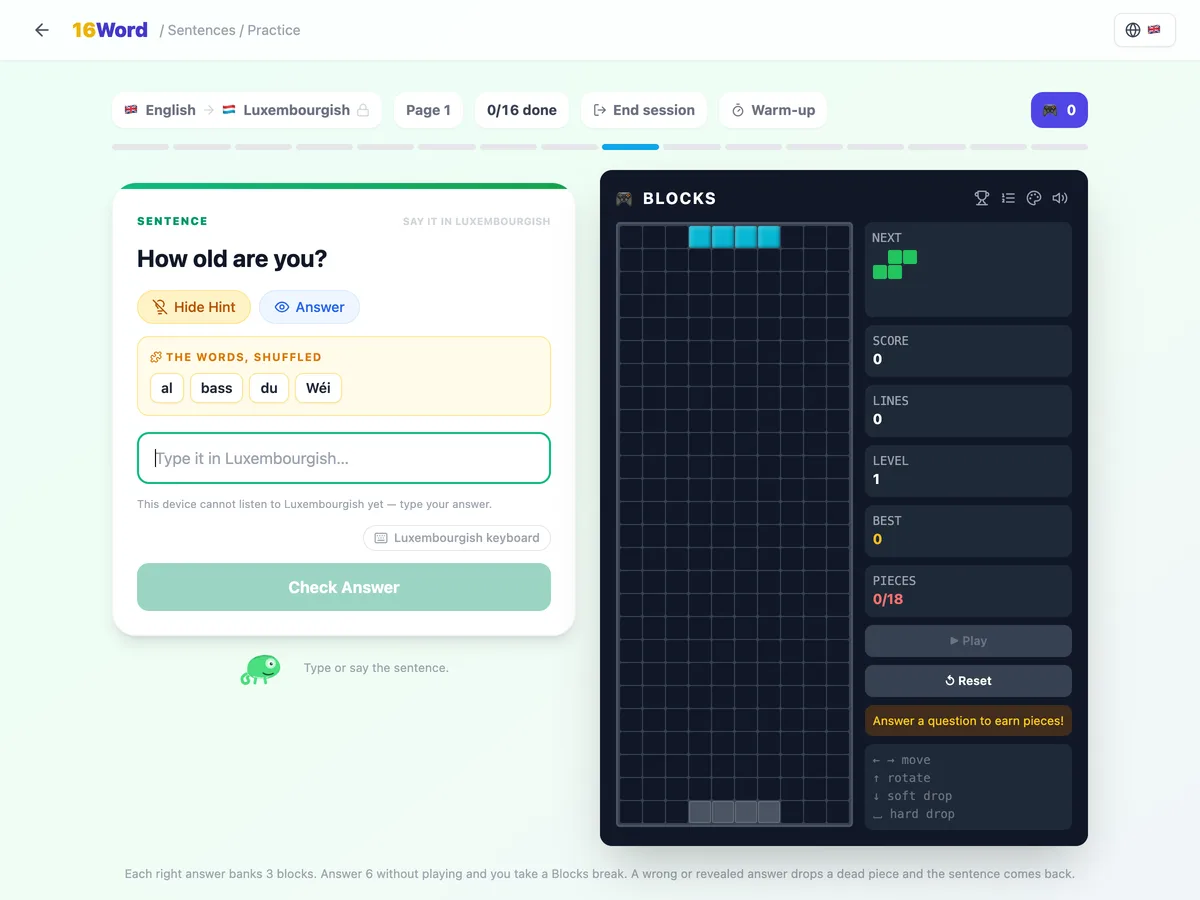
Five minutes a day, 16 at a time, with native LOD audio and a game of Blocks between answers. Every track has a free first page.
Frequently asked questions
Is Luxembourgish an official language?
Yes. The law of 24 February 1984 made Luxembourgish the national language, and French, German and Luxembourgish share administrative and legal use. Since 1 July 2023, Article 4 of the Constitution states that the language of the Grand Duchy is Luxembourgish.
How many people speak Luxembourgish?
In the 2021 census, 275,361 residents (48.9%) gave Luxembourgish as their main language, and 292,025 (61.2%) said they usually speak it at home, at work or at school — more than any other language in the country, ahead of French.
Is Luxembourgish dying?
No. The number of people with Luxembourgish as their main language rose 3.6% between 2011 and 2021; its share fell only because the population grew by about a quarter through immigration. UNESCO's Atlas says that in Luxembourg it barely qualifies even as "vulnerable" because it is so widely spoken.
What is the ZLS?
The Zenter fir d'Lëtzebuerger Sprooch is the national Centre for the Luxembourgish Language, created by the law of 20 July 2018. It publishes the official spelling and grammar rules, builds language tools, answers questions on usage and runs the LOD online dictionary.
What is LOD?
The Lëtzebuerger Online Dictionnaire (lod.lu) is the free official dictionary of Luxembourgish and the official reference for correct spelling. It translates into German, French, English and Portuguese, and its data — including native recordings — is published as open data under CC0.
Did Luxembourgish spelling change in 2019?
Yes. The Permanent Council for the Luxembourgish Language adopted the completed spelling rules on 20 March 2019, and the ZLS published them as D'Lëtzebuerger Orthografe in November 2019. They build on the official systems of 1975 and 1999.
Where can I learn Luxembourgish with native audio?
16Word teaches Luxembourgish from any of 28 languages, with every word recorded by a person and all sentences and proverbs taken from LOD with its native recordings. The first page of every track is free.
Official sources
- STATEC / University of Luxembourg — Census 2021: linguistic diversity (PDF)
- Government of Luxembourg — About… Languages in Luxembourg (PDF)
- Chamber of Deputies — the revised Constitution
- Ministry of Education (MENJE) — Promotion of the Luxembourgish language
- gouvernement.lu — Luxembourgish language policy
- UNESCO — Atlas of the World's Languages in Danger (2010, PDF)
- data.public.lu — LOD linguistic data (CC0)
- Lëtzebuerger Online Dictionnaire
Keep going
- Learn Luxembourgish with native LOD audio
- The Sproochentest vocabulary path — 33 sets
- Sproochentest : déroulement, niveau requis et questions fréquentes
- The Dutch inburgering exam and Belgian nationality: levels, parts, fees and FAQ
- Luxembourgish proverbs: 16 sayings, what they mean, with native audio
- Working for the Luxembourg government: nationality, the three languages and the 2026 rules
- Working for the Dutch government: nationality, the Dutch level you need and screening
- Working for the Belgian government: nationality, language roles and certificates
- Endangered languages: why they disappear, how they come back, and what 16Word is building
- Is Latin a dead language? Where Latin lives today — and how to learn it