Icelandic citizenship: the A2 Icelandic test and who is exempt
Most people who apply for Icelandic citizenship must first pass the Icelandic citizenship test, a pass-or-fail exam at A2 level. This guide sets out what the official pages say about the test, who is exempt, how long you must live in Iceland first, and one thing to know right now: Iceland is changing the test's provider, so the next dates have not been announced. Start with a free Icelandic level test to see where you stand.
Updated · 7 min read
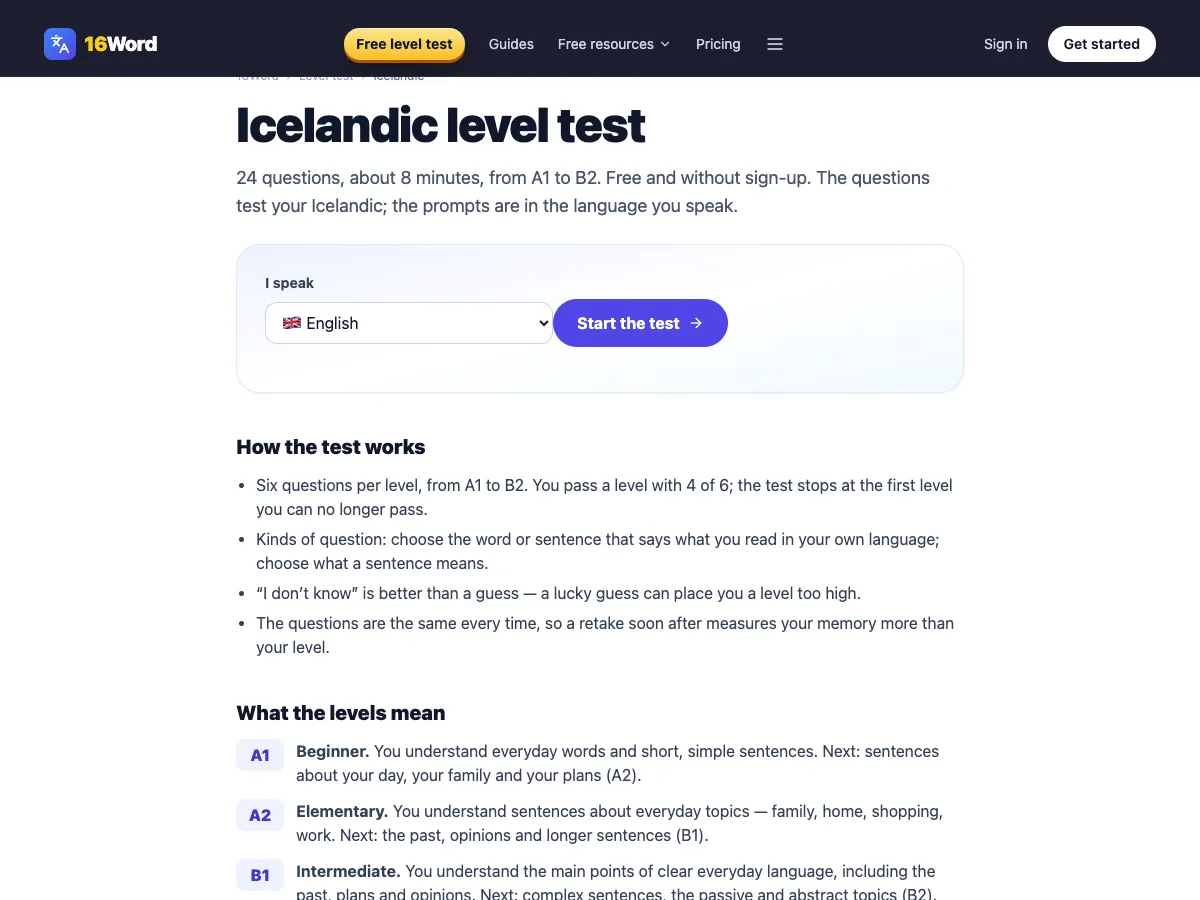
Status in November 2026: the Ministry of Justice says it is securing a new provider for the tests and that it is not yet clear when the next tests will take place. The Ministry and the Directorate of Immigration will announce the dates (Ísland.is — Icelandic test for citizenship). Older pages that send you to a previous organiser's website may be out of date.
Who needs the Icelandic citizenship test?
Under Regulation No. 1129/2008, anyone who applies for citizenship under Article 7 of the Icelandic Nationality Act must have passed the test. The Directorate of Immigration lists a passed Icelandic test among the conditions every applicant must meet, next to permanent residence, proof of identity, not being in arrears, the ability to support yourself and a clean record (Ísland.is — Conditions). If you are comparing countries, our overview of language exams for citizenship across Europe puts Iceland next to its neighbours.
What level is the test? A2, built on a 240-hour course
The official information page says the qualification is A2 of the European language framework (Ísland.is — Information about the test). The regulation ties the content to the final objective of the curriculum for basic Icelandic for foreigners, a 240-hour course, leaving out that course's objective on Icelandic customs and habits. The curriculum and a self-assessment framework are published as PDFs, in Icelandic only.
In practice, the official pages say you need to show that you can:
- manage everyday situations at school, at work and in private life;
- cope with unforeseen or unexpected situations;
- take part in discussions on familiar topics;
- understand simple conversations;
- read short texts in simple language;
- write a short text in plain language;
- pick out the main points of television, radio and newspapers on familiar topics.
The four parts
| Part | What it checks (official wording, shortened) |
|---|---|
| Listening | Understanding simple conversations and the main points of broadcasts |
| Reading | Reading short texts in simple language |
| Writing | Writing a short text in plain language on a familiar topic |
| Speaking | Coping in everyday and unexpected situations; joining a conversation on familiar topics |
The official pages read for this guide do not give the length of each part or a minimum mark per part, so we do not quote any. When the new provider publishes its practical rules, those are the ones that count.
Pass or fail — and no limit on retakes
- No grade. The result is only pass or fail (Ísland.is — Results), and under the regulation the provider's decision is final; you may ask for an explanation within 15 days.
- When: results come about six weeks after the last test of the cycle.
- The certificate: if you pass, a confirmation document is sent by e-mail. You send it with your citizenship application, and it does not expire.
- Retakes: the regulation says there is no limit on how often you may sit the test. If you fail or miss it, you wait until the next time it is held.
The regulation also says tests are held at least twice a year, in or near Reykjavík and possibly elsewhere, and are announced at least eight weeks in advance. Only registered candidates who have paid the fee may sit, and you must show photo ID. Help for dyslexia or disability follows the same rules as Iceland's national school tests. The fee amount is not in the regulation or on the pages we read; check it when registration opens.
How many pass? In the cycle held from 18 November to 2 December 2024, 492 people took the test and 84% met the requirement, in 24 sessions in Reykjavík, Akureyri, Egilsstaðir and Ísafjörður (Ísland.is news, 24 January 2025).
Who is exempt from the Icelandic test?
The Directorate of Immigration may grant an exemption where requiring the test would be unfair. The regulation and the conditions page give these examples:
- applicants aged 65 or over who have had legal domicile in Iceland for the 7 years before applying;
- applicants who attend an Icelandic primary school, or are below primary-school age;
- applicants who can show with a medical certificate that serious physical or mental reasons prevent them from taking a test;
- applicants with a certificate from an Icelandic school showing that their Icelandic meets the level the regulation sets.
These are examples, and the wording is may: the exemption is a decision, not an automatic right.
How long must you live in Iceland first?
| Your situation | Residence before you can apply |
|---|---|
| General rule | 7 years of legal domicile and continuous residence |
| Spouse of an Icelandic citizen | 4 years since the marriage (spouse a citizen for at least 5 years) |
| Registered cohabiting partner of a citizen | 5 years (partner a citizen for at least 5 years) |
| Child of an Icelandic citizen | 2 years (parent a citizen for at least 5 years) |
| Nordic citizen | 4 years |
| Refugee or humanitarian permit | 5 years after the status or permit was granted |
| Stateless person | 5 years |
| Former Icelandic citizen | 1 year |
Source: Ísland.is — When can I apply?. Continuous means no more than 90 days abroad in total in each 12-month period, with some exemptions for study, illness or temporary work. You also need to support yourself: the conditions page sets a minimum of ISK 259,951 a month for one person and ISK 415,922 for a married couple, and no municipal financial assistance in the past three years.
Build the A2 vocabulary first
The test asks for everyday Icelandic: work, school, shops, the news. 16Word teaches 16 words a day with active recall, spaced repetition and a short Blocks game between answers. Free to start.
A realistic plan while you wait for the dates
Our advice, not an official requirement: the dates are not out, so use the time to reach a comfortable A2 rather than a borderline one.
- Take the free Icelandic level test to see whether you are near A1 or A2.
- Go through the official can-do list above and mark each line yes, almost or not yet; the self-assessment framework on the information page does the same in more detail.
- Work on listening every day: short radio or TV news items on familiar topics are exactly what the test describes.
- Write a short text each week on a familiar topic (your job, your town, your weekend) and have it corrected.
- Practise speaking aloud, ideally with a person; unexpected situations are part of the test.
- Check Ísland.is for the announcement; with at least eight weeks' notice you will have time to register.
How Iceland compares with its neighbours
Iceland asks for A2, a lower level than some Nordic neighbours: see Finnish citizenship and the YKI test (with our YKI test guide) and the Swedish citizenship language requirement. Elsewhere in Europe, compare the Polish B1 certificate, the Czech A2 exam, Dutch citizenship, the Luxembourgish level for citizenship, Italian B1, Spanish DELE A2 + CCSE, Portuguese A2 CIPLE, the Ukrainian citizenship exam and the Greek Certificate of Attainment.
Keep learning
- Free Icelandic level test — A1 to B2 in a few minutes
- Free Swedish level test and Finnish level test
- All free level tests — 36 languages
- Language exams for citizenship across Europe
- All guides
- 16Word plans and prices
Questions about the Icelandic citizenship test
What level of Icelandic do I need for citizenship?
A2 of the European framework. The test is based on the final objective of the 240-hour course in basic Icelandic for foreigners, as set out in Regulation 1129/2008.
When is the next Icelandic citizenship test?
Not yet announced. In November 2026 the Ministry of Justice says it is securing a new test provider and will share the dates with the Directorate of Immigration as soon as they are known. The regulation requires at least eight weeks' notice.
Is the Icelandic test graded?
No. The result is pass or fail only. If you pass, you get a confirmation document by e-mail that you send with your citizenship application, and it is valid indefinitely.
How many times can I take the test?
As many times as you need: the regulation says there is no limit. After a fail or a missed test, you wait for the next time the test is held.
Am I exempt from the Icelandic test if I am over 65?
You may be. The Directorate of Immigration may exempt applicants aged 65 or over who have had legal domicile in Iceland for the 7 years before applying. Other examples are school-age children in Icelandic schools, serious health reasons with a medical certificate, and a school certificate showing the required level.
How long do I have to live in Iceland before I can apply?
Seven years as a general rule, with shorter periods for spouses (4 years), cohabiting partners (5), children of citizens (2), Nordic citizens (4), refugees (5), stateless people (5) and former Icelandic citizens (1).
Was this guide useful?
Official sources
- Ísland.is — Icelandic test for citizenship (Ministry of Justice)
- Ísland.is — Information about the test
- Ísland.is — Results of the Icelandic test
- Regulation No. 1129/2008 on Icelandic tests for citizenship applicants (in Icelandic)
- Ísland.is — Conditions for Icelandic citizenship (Directorate of Immigration)
- Ísland.is — When can I apply for Icelandic citizenship?
- Ísland.is — 492 Icelandic language proficiency tests for citizenship (news, 24 January 2025)
Keep going
- /level-test/icelandic
- /level-test
- The Dutch inburgering exam in 2026: routes, parts, fees and FAQ
- Sproochentest speaking (A2): topics, picture description and how to prepare
- Sproochentest listening (B1): the three recordings and how to practise
- A 60-day Sproochentest preparation plan, week by week
- Luxembourgish levels A1 to B2: what each CEFR level means in practice
- What level of Luxembourgish do you need for citizenship?
- The inburgering reading exam (A2 and B1): format, question types and tips
- The inburgering listening exam (A2 and B1): what to expect and how to train
- All guides