Swedish citizenship: the language requirement and the new tests
Since 6 June 2026 the Swedish citizenship language requirement is law: most adult applicants must show that they know Swedish and know Swedish society. The surprise is that the official Swedish test does not exist yet, and on 30 September 2026 the body building it recommended postponing it. This guide sets out what the Swedish Migration Agency accepts today, how the society test works, and how to plan while the rules settle. You can check where you stand with our free Swedish level test.
Updated · 6 min read
What changed on 6 June 2026
Parliament tightened the Citizenship Act, and the new rules came in without transitional arrangements: every case not decided before 6 June 2026 is judged under them, even if the application was filed before that date. An adult applicant must now:
- hold a permanent residence permit, a right of residence, a residence card or residence status (since 12 July 2026, certain groups are exempt from the permanent-permit condition);
- prove their identity, which includes appearing in person at the Migration Agency;
- have lived in Sweden for long enough;
- have lived, and be expected to live, an orderly life in and outside Sweden;
- be able to support themselves;
- know Swedish and know Swedish society, if aged 16 to 66.
How long you must have lived in Sweden
The general rule rose from five to eight years. The Migration Agency's overview lists these periods:
| Your situation | Years of residence |
|---|---|
| General rule | 8 |
| Citizen of Denmark, Finland, Iceland or Norway | 2 |
| Living with a Swedish citizen (together for at least 5 years) | 7 |
| Granted refugee status | 7 |
| Stateless | 5 |
| Unable to prove your identity | 10 |
There is also an income condition: long-term income of your own from work or self-employment, of at least three income base amounts a year, which the Agency puts at just over SEK 20,000 a month before tax. A partner's income cannot be added. Parental and sickness benefit count; unemployment benefit, new-start jobs and start-up support do not. People on certain pensions, full-time students with satisfactory results and people who cannot meet it because of a disability may be exempt.
Who has to show knowledge of Swedish
The knowledge requirement applies to applicants aged 16 to 66. The Agency may grant an exemption where a disability or other circumstances make the requirement unreasonable or impossible to meet. Children no longer join a parent's application: each child needs one of their own, and from the age of 12 must consent to it.
The Agency's pages speak of a "functional level of Swedish" but the ones we read do not put a CEFR level on it. Be wary of any site that tells you the requirement is exactly A2 or B1 without quoting the Agency.
What counts as proof of Swedish today
In its notice of 30 September 2026 the Agency lists these ways of showing your Swedish, as examples:
- a passing grade in Swedish or Swedish as a second language in Year 9 of compulsory or adapted compulsory school, or Years 9–10 of special school;
- a passing grade in Swedish or Swedish as a second language at upper secondary school, adapted upper secondary school or a folk high school;
- a passing grade in Swedish or Swedish as a second language in municipal adult education;
- a passing grade in the highest course of Swedish for Immigrants (SFI);
- a passing grade in Swedish at compulsory or upper secondary school in another Nordic country;
- a result from Tisus, the test of Swedish for higher education;
- the result of another Swedish proficiency test that shows "with a high degree of certainty" a functional level of Swedish.
The July overview names Swedex as an example of a test that may be accepted during a transitional period. The Agency decides each case, so if your certificate is not on the list above, ask it before you pay for a test.
SFI: the route most newcomers already know
Skolverket, the national agency for education, describes SFI as municipal adult education for people over 16 who need basic Swedish. It has four courses, A, B, C and D, and the Migration Agency names course D. New rules from 1 January 2026 introduced, among other things, a three-year time limit for SFI, so ask your municipality how that applies to you and keep your grade certificates safe.
The Swedish test that does not exist yet
The citizenship test is being introduced in stages. In July the Agency expected the language part no earlier than autumn 2027. On 30 September it reported that the Swedish Council for Higher Education (UHR) recommends postponing it, and that the Government will decide when it can be introduced. No date has been set on the pages we read. The requirement itself stays, so for now you need one of the proofs above.
The test on Swedish society
The society test is separate and goes ahead. According to UHR, it is:
| Question | What UHR says |
|---|---|
| Who can sit it | Only people who received a letter from the Migration Agency |
| Language | Swedish only |
| Format | On paper; multiple choice with four options, one correct |
| First sitting | 15 August 2026, a try-out with 60 questions, of which 40 counted |
| Next sitting | Planned for April–May 2027; date and place to be announced |
| Registration | Closed for now |
| Result | In your UHR account, and sent automatically to the Migration Agency |
You only need the test if you cannot show your knowledge of society another way, for example through school or adult-education grades. The UHR questions and answers say the pass mark appears with your result, that the time and number of questions for the next sitting are still to come, and that after a fail you may be able to show your knowledge again: contact the Migration Agency to find out.
UHR's study material on Swedish society was made with Skolverket on the Government's assignment. You can print it or listen to its chapters as MP3 files. UHR warns that practice tests made by others online are not checked by any authority.
Build the Swedish you will need
16 words a day, about five minutes, with spaced repetition and a game break between answers. 16Word is free to start.
A plan while the rules settle
- Collect every Swedish grade and certificate you already have: you may already meet the requirement.
- If you have none, finish the highest SFI course, or ask the Migration Agency which test it would accept in your case.
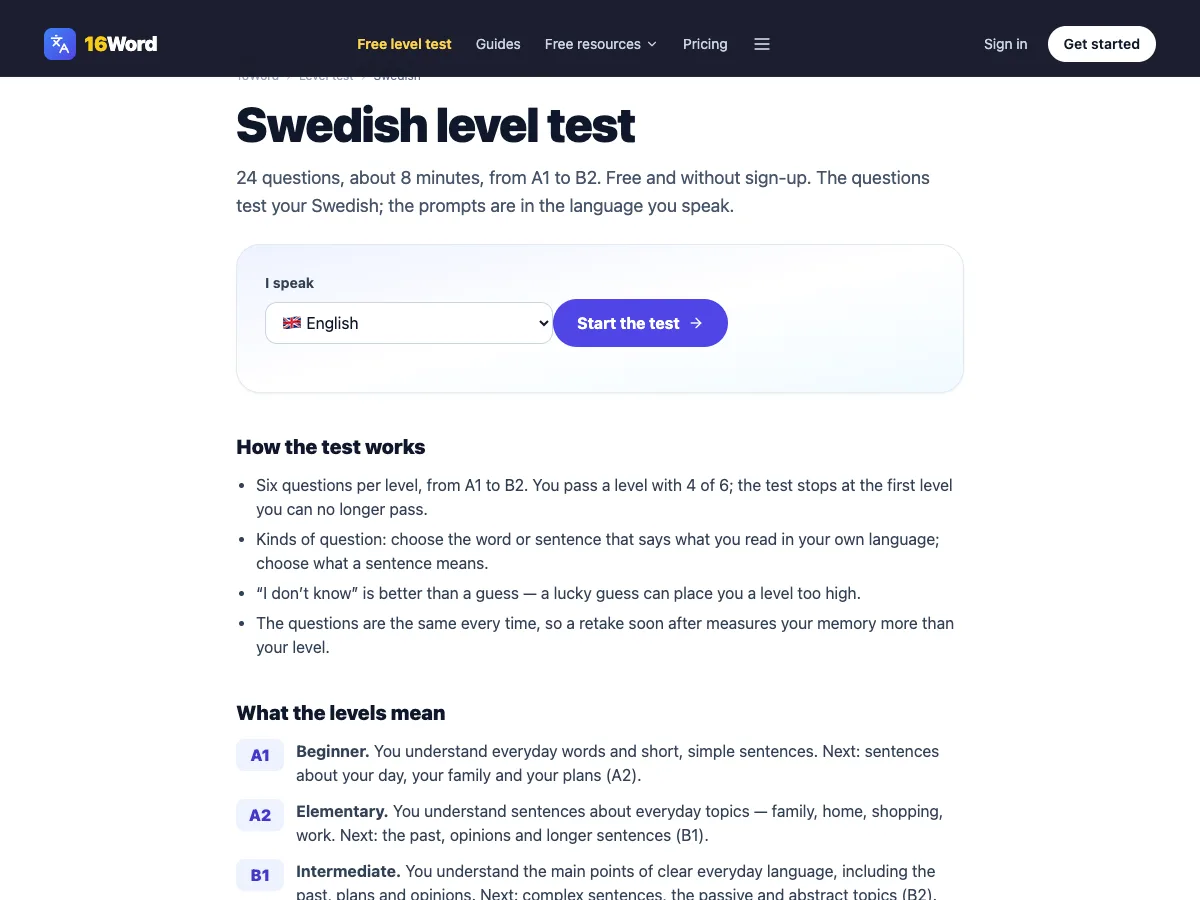
- Take our free Swedish level test (A1–B2, no account) to see how far you are. It is not a certificate and does not test speaking.
- Read UHR's society material, or listen to its MP3 chapters, well before the next sitting.
- Re-read the Migration Agency's pages before you apply, because this area is still moving.
Keep learning
- Finnish citizenship and the YKI test, and our free Finnish level test
- Polish citizenship and the B1 certificate
- The Czech A2 exam for permanent residence
- Spanish nationality: DELE A2 and CCSE
- Italian citizenship: the B1 requirement
- Portuguese nationality: A2 and the CIPLE
- The Luxembourgish level for citizenship
- Dutch citizenship: A2 and the naturalisation test
- Belgian nationality: the A2 language requirement
- Free level tests in 36 languages, all our guides and 16Word plans
Swedish citizenship language requirement: questions
Do I need to speak Swedish to become a Swedish citizen?
Since 6 June 2026, applicants aged 16 to 66 must show knowledge of Swedish and of Swedish society, unless the Migration Agency grants an exemption because of a disability or other circumstances.
Is there a Swedish language test for citizenship?
Not yet. The Migration Agency expected it no earlier than autumn 2027, and on 30 September 2026 reported that UHR recommends postponing it. The Government will decide. Until then, grades, the highest SFI course, Tisus or another accepted test can show your Swedish.
Is SFI enough for Swedish citizenship?
A passing grade in the highest SFI course (course D) is on the Migration Agency's list for showing your Swedish. The knowledge of Swedish society has to be shown as well.
Does the new requirement apply if I applied before June 2026?
Yes. There are no transitional arrangements: any case not decided before 6 June 2026 is assessed under the new rules.
Can I register for the society test myself?
Only if you have received a letter from the Migration Agency. Registration was closed when we checked on 9 November 2026, and the next sitting is planned for April–May 2027.
Can I take the citizenship test in English?
No. UHR says the test can only be taken in Swedish.
Was this guide useful?
Official sources
- Swedish Migration Agency — New rules for Swedish citizenship from 6 June 2026
- Swedish Migration Agency — How do you become a Swedish citizen?
- Swedish Migration Agency — The Swedish language test for citizenship may be postponed
- Swedish Council for Higher Education (UHR) — About the citizenship test (in Swedish)
- UHR — Questions and answers on the citizenship test (in Swedish)
- UHR — Study material on Swedish society (in Swedish)
- Skolverket — Komvux in Swedish for immigrants, SFI (in Swedish)
Keep going
- /level-test/swedish
- /level-test
- The TYS Turkish Proficiency Exam: format, levels, fees and dates
- The Ukrainian language exam for citizenship: B1, format and fee
- IELTS explained: the 0–9 band, test options and how to prepare
- TOEFL iBT explained: the 1–6 score scale and how to prepare
- Cambridge English exams: from A2 Key to C2 Proficiency
- PTE Academic explained: the 10–90 score and how to prepare
- IELTS, TOEFL, PTE or Cambridge: which English exam should you take?
- DELF explained: levels A1 to B2, pass mark and preparation
- All guides