The Kurmanji Kurdish alphabet: 31 Latin letters and how to read them
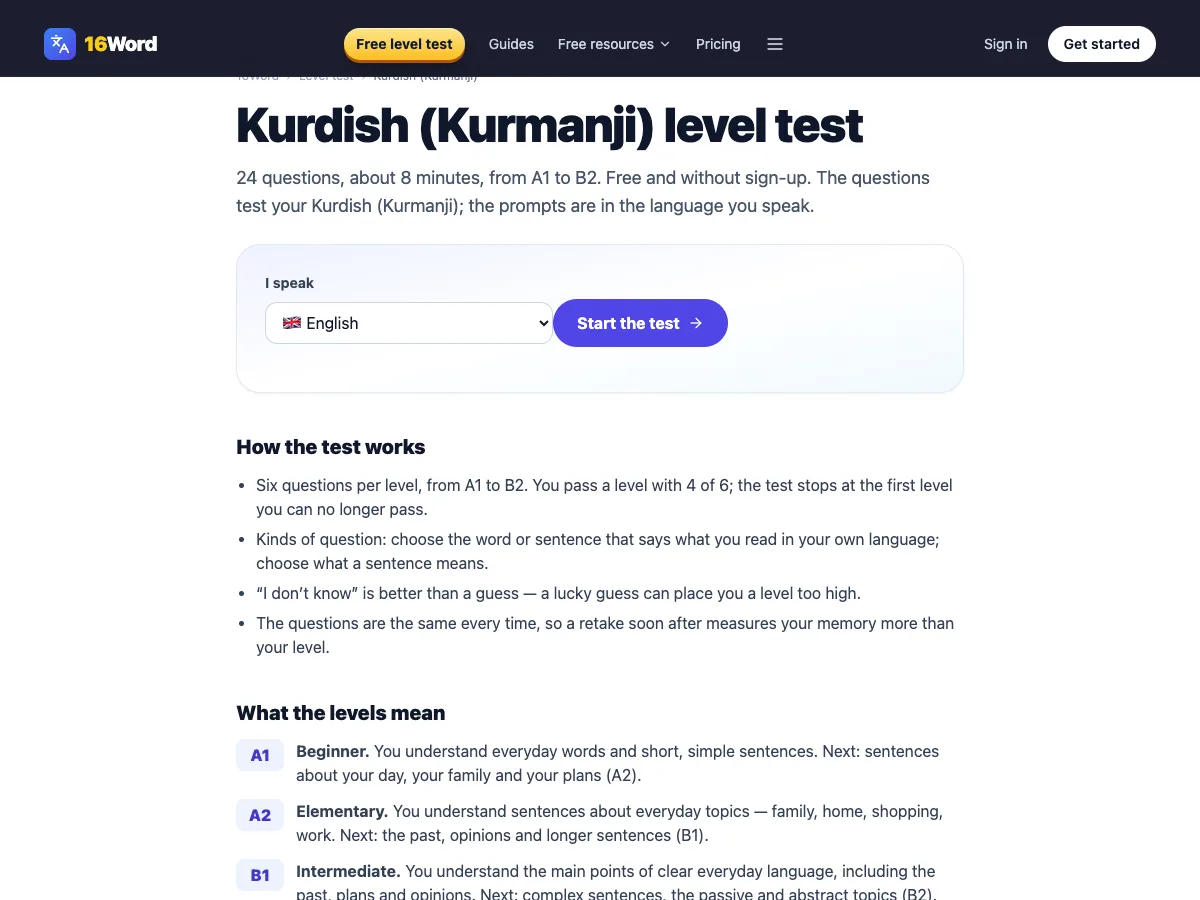
Kurmanji (Northern Kurdish) is written in a Latin alphabet of 31 letters. If you can read Turkish, many letters will look familiar — ç, ş, c — but Kurmanji adds the long vowels ê, î and û and the sounds q, x and w. This guide goes through every letter with words checked in Wiktionary. To see where you stand, try the free Kurmanji level test.
Updated · 5 min read
Kurmanji and Sorani: one language, two scripts
Kurdish comes in more than one form, and they are not written alike. Sorani is written in an Arabic-based alphabet — see our guide to the Sorani Kurdish alphabet. Kurmanji (Northern Kurdish) is the subject of this guide. In Iraq, Article 4 of the 2005 Constitution makes Arabic and Kurdish the two official languages. Wiktionary even gives Arabic-script spellings for some Kurmanji words: av (water) is also written ئاڤ.
All 31 letters
Wiktionary's list of Kurmanji letters gives them in this order:
A B C Ç D E Ê F G H I Î J K L M N O P Q R S Ş T U Û V W X Y Z
The list also shows two letters in brackets, Ḧ and Ẍ. Wiktionary explains what they are for: ḧ is used to tell Arabic ح apart from ه in loanwords, and ẍ (/ɣ/) to tell غ apart from خ.
Consonants that differ from English
| Letter | Sound (IPA) | Rough guide | Example |
|---|---|---|---|
| c | /d͡ʒ/ | the j in “jam” | ciwan /d͡ʒɪˈwɑːn/ — young |
| ç | /t͡ʃ/ | the ch in “church” | çav /t͡ʃˤɑːv/ — eye |
| j | /ʒ/ | the s in “pleasure” | roj /roːʒ/ — sun; day |
| ş | /ʃ/ | the sh in “ship” | şev /ʃɛv/ — night |
| x | /x/ | the ch in Scottish “loch” | xwişk /xʷɪʃk/ — sister |
| q | /q/ | a k made far back, near the uvula | qelem /qɛˈlɛm/ — pencil |
| r | /ɾ/ | a quick tapped r | erê /ɛˈɾeː/ — yes |
| w | /w/ | the w in “water” | xwişk — sister |
Sounds and examples come from Wiktionary's word entries, such as kurdî /kʰʊɾˈdiː/; the entry for ş confirms it is the 23rd letter, between S and T. The English comparisons are our own rough guide. The big trap for English speakers is c: it is always the sound of English j, never k or s.
If you read Turkish, c, ç, ş and j work the same way. Readers of Azerbaijani will recognise them too — but take care with q, which does not stand for the same sound there. Compare the Turkish and Azerbaijani level tests to see how far that head start takes you.
Vowels: the hat means long
Kurmanji has eight vowel letters. The circumflex — the little “hat” on ê, î, û — marks the long vowels. Wiktionary's transcriptions show the pattern clearly:
| Letter | Sound (IPA) | Example |
|---|---|---|
| a | /ɑː/ | av /ɑːv/ — water; nan /nɑːn/ — bread |
| e | /ɛ/ | şev /ʃɛv/ — night |
| ê | /eː/ | dê /deː/ — mum |
| i | /ɪ/ | ziman /zɪˈmɑːn/ — language |
| î | /iː/ | şîr /ʃiːɾ/ — milk |
| o | /oː/ | roj /roːʒ/ — sun; day |
| u | /ʊ/ | kurdî /kʰʊɾˈdiː/ — Kurdish |
| û | /uː/ | dûr /duːɾ/ — distant |
Two warnings. Plain a is already long, and plain i is short and relaxed, close to the i in “bit” — so ziman is not “zee-man”. And the hat changes meaning: learn e and ê, i and î, u and û as different letters, not as accents you may leave out.
First words to practise reading
| Kurmanji | IPA (Wiktionary) | English |
|---|---|---|
| erê | /ɛˈɾeː/ | yes |
| spas | — | thanks, thank you |
| av | /ɑːv/ | water |
| nan | /nɑːn/ | bread; food |
| mal | — | home; family |
| bav | /bɑːv/ | father |
| dê | /deː/ | mum |
| heval | /hɛˈvɑːl/ | friend |
| ziman | /zɪˈmɑːn/ | language; tongue |
| û | — | and |
Ziman is worth remembering: it means both “language” and “tongue”, and kurdî (with the variety name kurmancî) is how you say “Kurdish”.
Coming from Arabic or Persian?
Wiktionary gives Arabic-script spellings for many Kurmanji words — زمان for ziman, چاڤ for çav — so readers of the Persian script can compare the two spellings word by word. If you read the Arabic alphabet, the Sorani guide will feel familiar, while Kurmanji asks you to learn a Latin key instead. Try the Persian, Arabic or Sorani level tests if you are learning more than one.
A short plan of our own: day 1, learn the eight vowels and say each example aloud; day 2, the consonant table, especially c, x and q; day 3, read the word list without looking at the IPA, then take a level test.
Learning Kurmanji with 16Word
Kurmanji is one of the newest languages in 16Word and is marked New: its word lists were prepared with machine help and are waiting for review by native speakers, and most words have no recording yet. You can already practise 16 words a day with spaced repetition and a short game of Blocks between answers. Start with the Kurmanji level test. 16Word is free to start; see the plans for more.
Learn Kurmanji 16 words a day
Now that you can read the letters, build the vocabulary: 16Word teaches 16 words a day with active recall, spaced repetition and a short Blocks game between answers. Free to start.
Keep learning
- Free level tests in 36 languages
- The Sorani Kurdish alphabet
- The Azerbaijani alphabet
- The Pashto alphabet
- All guides
Questions about the Kurmanji alphabet
How many letters does the Kurmanji alphabet have?
31, from A to Z, as Wiktionary lists them. Two more, ḧ and ẍ, are shown in brackets; they are used for some Arabic loanwords.
How do you pronounce c in Kurdish?
Like the English j in “jam” (/d͡ʒ/), as in ciwan (young). The letter ç is the ch of “church”.
What does the circumflex (ê, î, û) mean?
It marks a long vowel: dê /deː/, şîr /ʃiːɾ/, dûr /duːɾ/. Without the hat the vowel is short (e, i, u), so the mark changes the word.
Is Kurmanji the same as Sorani?
They are two forms of Kurdish. Kurmanji is written in Latin letters in this guide, Sorani in an Arabic-based alphabet; our Sorani guide compares words in both.
Is Kurdish an official language?
In Iraq, yes: Article 4 of the 2005 Constitution makes Arabic and Kurdish the two official languages of the country.
Can I learn Kurmanji if I read Turkish?
The alphabet will be easy: c, ç, ş and j work as in Turkish. The vowels ê, î, û and the letters q, w and x are the new part — and the vocabulary has to be learned on its own.
Was this guide useful?
Official sources
Keep going
- /level-test/kurdish-kurmanji
- /level-test
- The Sorani Kurdish alphabet: 34 letters and its own vowel letters
- The Ukrainian alphabet: 33 letters, ґ є і ї and how to read them
- Luxembourgish personal pronouns: ech, du, hien, hatt, si, mir, dir — with audio
- How to conjugate Luxembourgish verbs in the present tense
- Luxembourgish irregular verbs: sinn, hunn, goen, kommen and the modals
- Luxembourgish word order: verb second, verb last and separable verbs
- The Luxembourgish n-rule (Eifeler Regel) explained with examples
- Negation in Luxembourgish: net, keen, keng, näischt, ni and dach
- All guides