What language is spoken in Serbia? Serbian and more
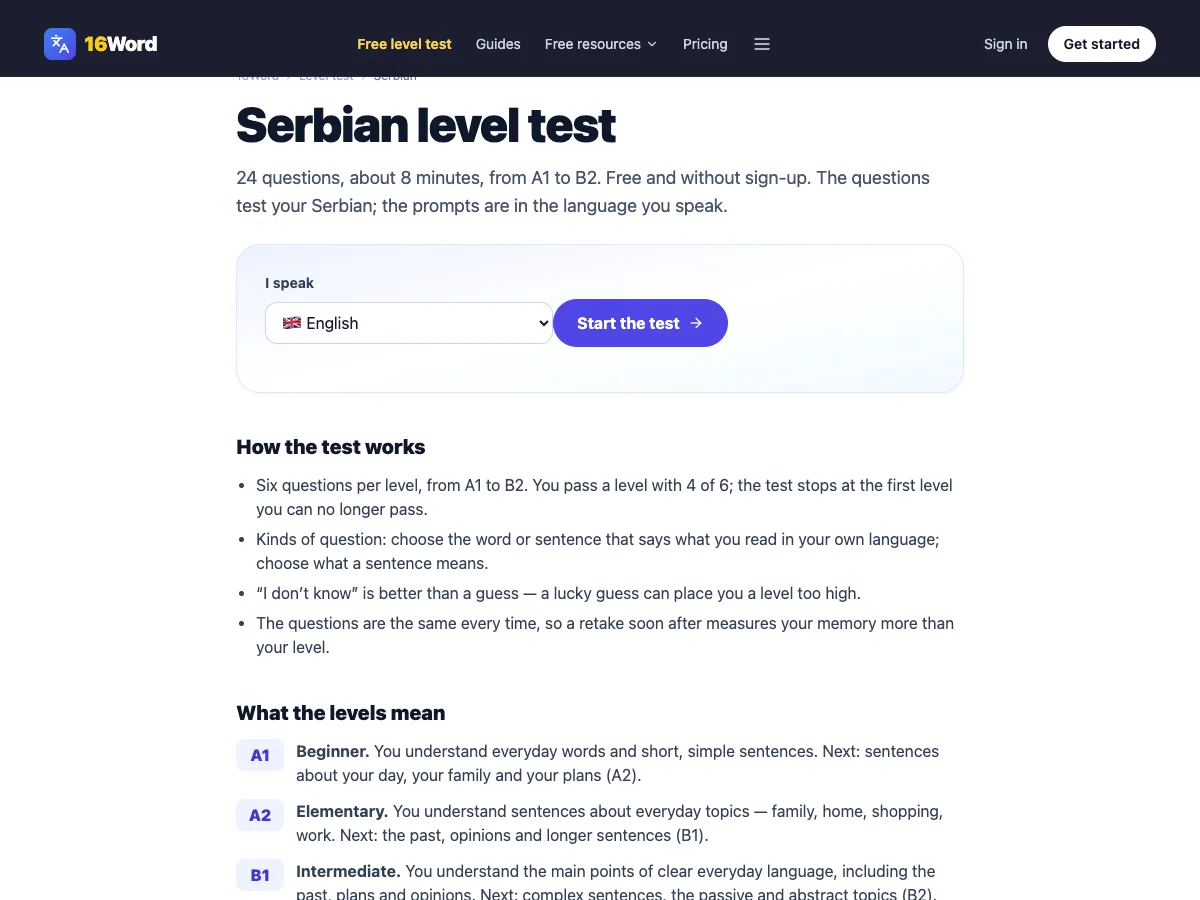
What language is spoken in Serbia? Serbian. Article 10 of the Constitution of Serbia puts the Serbian language and the Cyrillic script in official use, and the 2022 census counted Serbian as the mother tongue of 84.4% of the people it covered (Statistical Office). But Serbia is not a one-language country: Hungarian, Bosnian, Roma, Albanian, Slovak, Romanian and others are spoken at home by tens of thousands, and in the northern province of Vojvodina six languages are in official use. This guide explains who speaks what, how the two alphabets fit in, and the first Serbian words to learn — then you can check where you stand with the free Serbian level test.
Updated · 8 min read
What language is spoken in Serbia? The short answer
The legal answer fits in two sentences. Article 10 of the Constitution of the Republic of Serbia, adopted in 2006, says: "Serbian language and Cyrillic script shall be in official use in the Republic of Serbia." It adds that the official use of other languages and scripts "shall be regulated by the law based on the Constitution". So Serbian is the language of the state everywhere in the country, and other languages are official only where a law or a statute says so.
| Language | Mother tongue in the 2022 census | Official status |
|---|---|---|
| Serbian | 5,607,558 (84.4%) | Official in the whole country (Constitution, Art. 10) |
| Hungarian | 170,875 (2.6%) | Also official in the authorities of Vojvodina (Statute, Art. 24) |
| Bosnian ("Bosniak language" in the census) | 145,329 (2.2%) | Official locally where a municipality has introduced it under the law |
| Roma | 79,687 (1.2%) | Official locally where a municipality has introduced it under the law |
| Albanian | 65,475 (1%) | Official locally where a municipality has introduced it under the law |
| Slovak | 38,584 | Also official in the authorities of Vojvodina |
| Romanian | 21,477 | Also official in the authorities of Vojvodina |
| Croatian | 12,048 | Also official in the authorities of Vojvodina |
| Ruthenian (Rusyn) | 8,725 | Also official in the authorities of Vojvodina |
Serbia's languages in numbers: the 2022 census
The Statistical Office of the Republic of Serbia published the mother-tongue results of the 2022 census on 16 June 2023 (Statistical Office). Of 6,647,003 people counted, 5,607,558 gave Serbian as their mother tongue. In its own words: "the most spoken mother tongues are Hungarian (2.6%), Bosnian (2.2%), Roma language (1.2%) and Albanian (1%)." The same table lists smaller communities too — among them Slovak (38,584), Vlach (23,216), Romanian (21,477), Croatian (12,048), Russian (11,255), Ruthenian (8,725), Macedonian (8,375), Bulgarian (7,939), Bunjevac (3,319), Montenegrin (1,981), Ukrainian (1,527), German (1,389) and Slovenian (1,302).
Two things to keep in mind when you read these figures. First, 88,122 people chose not to declare a mother tongue and 303,179 are listed as "unknown", which the Statistical Office says includes people for whom no data were collected or whose data came from administrative sources (Statistical Office). Second, the census has no data for Kosovo and Metohija: the Office says that in 2002, 2011 and 2022 "there were no conditions for conducting the census" there (Statistical Office, censuses 1948–2022).
One language, two alphabets
Serbian is written in two alphabets that match letter for letter: Cyrillic (здраво) and Latin (zdravo), both meaning "hello". The Constitution names Cyrillic as the script in official use. The Law on the Official Use of Languages and Scripts repeats this in its first article and adds that the Latin script is used "in the manner set out by this law" (our translation of latinično pismo na način utvrđen ovim zakonom). In daily life you will see both, so a learner needs both — and because the match is exact, learning the second one is quick once you know the first.
We have a separate guide that sets out all 30 letters side by side, the false friends and how to type them: Serbian Cyrillic and Latin alphabets. If you already read Russian Cyrillic or the Ukrainian alphabet, many shapes will look familiar, but a few Serbian letters (Ђ, Ћ, Љ, Њ, Џ, Ј) are not in the Russian or Ukrainian alphabets, so do not skip the table.
Where minority languages are official
The Constitution gives members of national minorities, in Article 79, the right to use their language and script, to have proceedings "also conducted in their languages" before public bodies, and to see place and street names "also written in their languages" — in each case "in areas where they make a significant majority of population" (Constitution). It also guarantees, in Article 199, that everyone may use their language in proceedings before a court or another state body when their rights are decided.
The detail is in the Law on the Official Use of Languages and Scripts, Article 11. A municipality where a national minority traditionally lives may put its language in equal official use; it must do so in its statute when that minority reaches 15% of the population at the last census. Where the language is official, it is used in administrative and court proceedings, public documents, ballots and the local assembly, and place, square and street names are written in it too. Members of a minority that makes up at least 2% of Serbia's population may write to the national authorities in their own language and get an answer in it (our summary of the Serbian text).
Vojvodina: six languages in official use
The Autonomous Province of Vojvodina, in the north, goes further. Article 24 of its Statute reads: "In addition to Serbian language and Cyrillic script, Hungarian, Slovak, Croatian, Romanian and Ruthenian languages and their scripts shall be in official use in authorities of the AP Vojvodina." Article 7 calls multilingualism and multiculturalism "values of particular interest" to the province. You can see it on the provincial assembly's own website, which offers the Statute in Serbian Cyrillic, Serbian Latin, Hungarian, Slovak, Croatian, Romanian, Ruthenian and English.
If you are interested in how a small region lives with several official languages, compare Switzerland or Luxembourg. Romanian, one of Vojvodina's six, has its own alphabet guide and a Romanian level test.
Serbian, Croatian, Bosnian and Montenegrin
You will often read that these are "the same language" or "four languages". Rather than take a side, here is what the sources do. Serbia's census records them as separate mother tongues: Serbian, "Bosniak language", Croatian and Montenegrin each have their own line (Statistical Office), and Croatian is one of Vojvodina's official languages (Statute). Wiktionary, the dictionary we used for the words below, lists them together under the heading Serbo-Croatian, with Cyrillic and Latin spellings of the same entry — see srpski, "the Serbian language". Which name a speaker uses is a matter of their own identity and of each country's law; in this guide we use the names Serbia's institutions use.
Your first words in Serbian
Every word below was checked on Wiktionary today, in its Serbo-Croatian entry. Learn both spellings from the start; the IPA is Wiktionary's.
| Cyrillic | Latin | Meaning |
|---|---|---|
| здраво | zdravo /zdrâʋo/ | hello, hi; also bye — from zdrav, "healthy" |
| хвала | hvala /xʋǎːla/ | thank you, thanks |
| молим | molim | please; also "you're welcome" (please, you're welcome) |
| нема на чему | nema na čemu | you're welcome (Wiktionary) |
| да | da | yes |
| не | ne | no; not |
| добар дан | dobar dan | good day, good afternoon |
| довиђења | doviđenja | goodbye |
| — | ćao | (informal) hi; bye — borrowed from Italian ciao |
| — | izvinite | sorry |
Where to hear them: Wiktionary's entry for srpski has a recording made by a speaker from Central Serbia, but most of the entries above give IPA only, and 16Word has no Serbian recordings it may play here. The surest way to get the sounds right is a person: on Edluxio you can book live one-to-one lessons with teachers and professionals in many fields, with a trial lesson and a full refund if it is not right for you.
Learn 16 Serbian words a day
16Word teaches Serbian with active recall and spaced repetition, with a short Blocks game between answers so the words stick. Free to start — about five minutes a day.
How to start learning Serbian
- Learn to read first. Spend your first sessions on the Cyrillic and Latin alphabets — everything else gets easier once signs and menus stop being a puzzle.
- Find your level. The Serbian level test takes a few minutes, needs no sign-up and tells you whether to start at A1 or higher.
- Build vocabulary every day. Short daily reviews beat long weekly ones — see how to memorise vocabulary and the easiest way to memorise vocabulary.
- Pick a method you will keep. Our guide to the best way to learn a language compares the options honestly.
- Know a related language? If you read Russian, our guides to saying hello in Russian and thank you in Russian show how close — and how different — Slavic greetings are; the Russian level test and Ukrainian level test work the same way as the Serbian one.
What languages are spoken in other countries?
Serbia is one of many countries with one national language and several protected minority languages. Our other guides in this series: Ukraine, Georgia, Austria, Cyprus and Switzerland.
Keep learning
- Serbian Cyrillic and Latin alphabets
- Free Serbian level test
- Free level tests in 36 languages
- How to memorise vocabulary
- What language is spoken in Ukraine?
- All guides
- Plans and prices
Questions about the languages of Serbia
Is Serbian written in Cyrillic or Latin?
Both. The Constitution puts the Cyrillic script in official use, and the Law on the Official Use of Languages and Scripts allows the Latin script in the ways it sets out. The two alphabets match letter for letter, so you can learn them together — our alphabet guide shows how.
Is Serbian the same as Croatian?
Serbia's 2022 census lists Serbian, Croatian, Bosnian and Montenegrin as separate mother tongues, and Croatian is one of Vojvodina's official languages. Dictionaries such as Wiktionary group their words under one heading, Serbo-Croatian. Which name to use is a matter of the speaker's identity and of each country's law.
What is the second most spoken language in Serbia?
Hungarian. In the 2022 census it was the mother tongue of 2.6% of the people counted (170,875), followed by Bosnian (2.2%), Roma (1.2%) and Albanian (1%). Hungarian is also one of the languages in official use in the authorities of Vojvodina.
Which languages are official in Vojvodina?
Article 24 of the Statute of Vojvodina lists Serbian in Cyrillic script plus Hungarian, Slovak, Croatian, Romanian and Ruthenian, each with its own script, in official use in the province's authorities. Municipalities can add further languages under the national law.
How do you say hello and thank you in Serbian?
Hello is zdravo (здраво) and thank you is hvala (хвала). Zdravo also works as goodbye; a more formal greeting is dobar dan, "good day", and a formal goodbye is doviđenja.
Is Serbian hard to learn for English speakers?
It depends on what you already know: if you read another Cyrillic alphabet or another Slavic language, you start ahead. For everyone, the two alphabets match letter for letter, so reading comes quickly; grammar and vocabulary take steady daily practice. Start with the Serbian level test to see where you are.
Was this guide useful?
Official sources
- Constitution of the Republic of Serbia (2006), English text — National Assembly
- Statistical Office of the Republic of Serbia — 2022 Census: mother tongue, religion and ethnic affiliation (16 June 2023)
- Statistical Office of the Republic of Serbia — Comparative overview of population by censuses 1948–2022
- Assembly of AP Vojvodina — The Statute of the Autonomous Province of Vojvodina (Official Gazette of AP Vojvodina 20/2014), English
- Law on the Official Use of Languages and Scripts (Zakon o službenoj upotrebi jezika i pisama), consolidated Serbian text — Standing Conference of Towns and Municipalities
- Wiktionary — zdravo
- Wiktionary — здраво
- Wiktionary — hvala
- Wiktionary — хвала
- Wiktionary — please (translations)
- Wiktionary — you're welcome (translations)
- Wiktionary — да (da)
- Wiktionary — не (ne)
- Wiktionary — dobar dan
- Wiktionary — doviđenja
- Wiktionary — ćao
- Wiktionary — izvinite
- Wiktionary — srpski
- Edluxio — live 1-to-1 lessons with teachers and professionals
Keep going
- /level-test/serbian
- /articles/serbian-cyrillic-latin-alphabets
- Ikigai meaning: a reason for living, in Japanese
- What is Advent? The four weeks before Christmas
- What language is spoken in Somalia? Somali, Arabic and more
- Endangered languages: why they disappear, how they come back, and what 16Word is building
- Is Latin a dead language? Where Latin lives today — and how to learn it
- Luxembourgish: how a small language keeps growing
- Is Luxembourgish a language or a German dialect? History, law and the differences
- What language is spoken in Luxembourg? Luxembourgish, French and German explained
- All guides