TÖMER Turkish exam: levels, five parts, the 60% rule and preparation
If a university, an employer or an office in Türkiye has asked you for a Turkish certificate, the name you will hear most is TÖMER. This guide explains what Ankara University TÖMER’s Turkish exam contains, how it is marked, how the online exam works and how to prepare, using only what TÖMER itself publishes. For a step-by-step route, open our TÖMER preparation page.
Updated · 8 min read
What TÖMER is
TÖMER is Ankara University’s centre for teaching Turkish and foreign languages (Türkçe ve Yabancı Dil Uygulama ve Araştırma Merkezi). It has taught Turkish since 1984, and its courses and exams follow the Common European Framework of Reference (CEFR) from A1 to C1. TÖMER says it is a member of ALTE, the Association of Language Testers in Europe, and that it holds institutional accreditation from YÖKAK, Türkiye’s higher-education quality council.
Other Turkish universities run their own Turkish centres and exams, and the Yunus Emre Institute has its own Turkish Proficiency Exam: see our TYS guide. If the place you are applying to names a specific exam, follow its wording; this guide covers Ankara University’s.
Levels: certificate or diploma?
TÖMER’s course levels map onto the CEFR, and the exam you can sit depends on the level you aim for. Candidates who pass at A1, A2, B1 or B2 receive a certificate; at C1 they receive a diploma. Here is how TÖMER lists it on its course page and in its exam guide:
| TÖMER level | CEFR | Document |
|---|---|---|
| Temel 2 | A1 | Certificate |
| Temel 4 | A2 | Certificate |
| Orta 4 | B1 | Certificate |
| Yüksek 2 | B2 | Certificate |
| Yüksek 4 | C1 | Diploma |
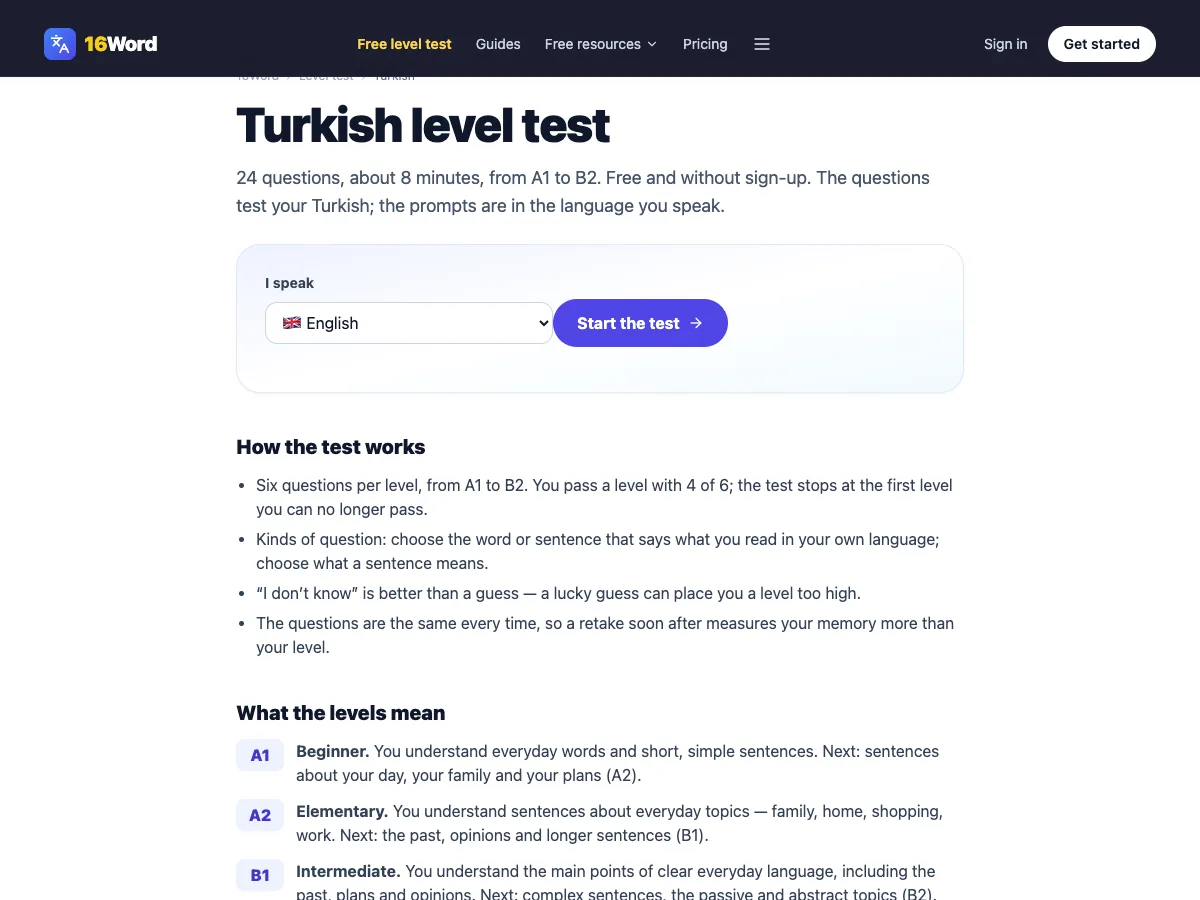
Not sure where you stand? Take the free Turkish level test first: it places you between A1 and B2 in a few minutes, so you know which TÖMER exam is realistic.
The five parts of the exam
According to TÖMER’s e-YADİS exam guide, every certificate and diploma exam has the same five parts:
- Reading (Okuma-Anlama): 25 multiple-choice questions on written texts, 50 minutes. You can move between question groups and change earlier answers.
- Listening (Dinleme-Anlama): 25 multiple-choice questions on five recordings. Each recording is played twice, with 60 seconds before it, 60 seconds after the first play and 60 seconds after the second. You cannot go back to a previous group.
- Writing (Yazma): you choose one of three topics and write your view. 45 minutes, no word limit.
- Interactive speaking (Karşılıklı Konuşma): recorded questions about everyday matters such as yourself, your family and where you live; you answer into the microphone within a set time. About 15 minutes.
- Spoken production (Sözlü Anlatım): you talk about an event, topic or situation shown as a picture or text. One minute to prepare, two minutes to speak; the part takes about 10 minutes.
How it is marked: 60% in every part
Reading and listening are marked automatically. Your recorded speaking answers are heard by at least two trained raters and a referee rater who checks their marks and gives the final one; your essay is marked by raters too. The guide gives these maximums and pass marks:
| Part | Maximum | Pass mark |
|---|---|---|
| Reading | 25 | 15 |
| Listening | 25 | 15 |
| Writing | 25 | 15 |
| Interactive speaking | 15 | 9 |
| Spoken production | 10 | 6 |
You must pass every part. A strong reading score does not make up for a weak speaking part, so train all four skills, not only the ones you enjoy.
How the online exam works
TÖMER runs its Turkish exams online through its e-YADİS system. Its exam page says online exams are held every week on Fridays, in Turkish working hours, and that results are announced within five working days. From the guide and the 2025 exam rules:
- Use a computer or laptop with a microphone and speakers, and Google Chrome — not a phone.
- Before the real exam you get a demo exam (tanıtım sınavı) with sample questions. It is not marked; use it to test your sound and the system.
- A teacher supervises you over Zoom. Two cameras are required: your computer’s camera showing your face and upper body, and a second device showing the room and your desk.
- You sit alone in a quiet, well-lit room and may not leave it. Notes, books, other devices, other websites and help from anyone are forbidden.
- You show two identity documents, such as your passport and a Turkish ID card or another official ID.
Do the demo exam on the same computer, in the same room and at the same time of day as your real exam. Most technical problems show up there, when they still cost nothing.
Registering, results and retakes
You apply through TÖMER’s application form, then create an e-YADİS account and choose the Turkish exams and your level. Results appear in your e-YADİS account; the result documents can be downloaded through e-Devlet (turkiye.gov.tr), or are emailed if you have no e-Devlet account. If you fail, the 2025 rules say you can sit the exam again at least 15 days later, as a new paid application. Fees are listed on TÖMER’s site and change, so we do not repeat them here.
TÖMER also offers UTYS, an International Turkish Proficiency Exam it developed. TÖMER says some universities and public bodies in Türkiye ask for it, but UTYS does not lead to a certificate or diploma. Check which of the two your institution wants before you register.
A preparation plan that fits real life
- Take the free Turkish level test and pick the TÖMER level you can reach.
- Read the exact requirement of the institution asking for your certificate: which level, which exam, and how recent.
- Learn words every day: about 16 in five minutes, with spaced repetition so they stay.
- Move from words to full sentences and dialogues — interactive speaking asks about yourself, your family and where you live, so build answers on those topics first.
- Practise listening with short recordings played twice, as in the exam, and write one short opinion text a week.
- Do TÖMER’s demo exam, then book the real one when you can pass every part, not just the total.
Start your Turkish path
Tell us your level and your goal. 16Word builds a personal plan with the right words, sentences and dialogues in Turkish, from A1 to B2.
Where 16Word helps, and where it doesn’t
16Word trains the vocabulary and active recall underneath all five parts, with recordings and a microphone for speaking, up to B2. We do not offer TÖMER mock exams, and our paths stop before C1, so for the diploma you will need texts and teaching beyond the app. For live 1-to-1 practice with a teacher, especially for the speaking parts, look at a tutor platform such as Edluxio.
Comparing exams for a move or a degree abroad? Read language exams for studying abroad, which certificates expire, exams you can take at home and free official sample papers.
Keep exploring
Every exam below has its own preparation page on 16Word.
The other language exams
- Sproochentest (Luxembourgish)
- Inburgeringsexamen (Dutch)
- Staatsexamen NT2 (Dutch)
- TOEFL iBT (English)
- IELTS (English)
- Cambridge English (English)
- PTE Academic (English)
- DELF (French)
- DALF (French)
- TCF (French)
- TEF (French)
- Goethe-Zertifikat (German)
- TestDaF (German)
- telc Deutsch (German)
- DELE (Spanish)
- CILS (Italian)
- CAPLE (Portuguese)
- HSK (Chinese)
- JLPT (Japanese)
- TOPIK (Korean)
- YKI (Finnish)
- Ellinomatheia (Greek)
- Certyfikat polski (Polish)
More guides on language exams
- Sproochentest speaking (A2): topics, picture description and how to prepare
- Sproochentest listening (B1): the three recordings and how to practise
- A 60-day Sproochentest preparation plan, week by week
- Luxembourgish levels A1 to B2: what each CEFR level means in practice
- What level of Luxembourgish do you need for citizenship?
- Spanish nationality: the DELE A2 and CCSE requirement explained
- Italian citizenship: the B1 Italian language requirement
- Portuguese nationality: the A2 requirement and the CIPLE exam
- Finnish citizenship: the language requirement and the YKI test
- The Czech A2 exam for permanent residence: format, points and fee
- JLPT levels N5 to N1: sections, times and pass marks
- Polish citizenship: the B1 Polish certificate and how to get it
- The Greek Certificate of Attainment: levels, dates and fees
- TOPIK levels explained: TOPIK I and II, scores, IBT and speaking
- Swedish citizenship: the language requirement and the new tests
- The Ukrainian language exam for citizenship: B1, format and fee
- IELTS explained: the 0–9 band, test options and how to prepare
- TOEFL iBT explained: the 1–6 score scale and how to prepare
- Cambridge English exams: from A2 Key to C2 Proficiency
- PTE Academic explained: the 10–90 score and how to prepare
- IELTS, TOEFL, PTE or Cambridge: which English exam should you take?
- DELF explained: levels A1 to B2, pass mark and preparation
- DALF C1 and C2: what the advanced French diplomas require
- The TCF French test: five skills, levels and validity
- The TEF French test: the 0–699 score, uses and preparation
- DELF, TCF or TEF: which French exam do you need?
- Goethe-Zertifikat explained: levels A1 to C2 and how to prepare
- TestDaF explained: TDN 3 to 5 and studying in Germany
- telc Deutsch explained: exams, skills and how to prepare
- Goethe, TestDaF or telc: which German exam should you take?
- The DELE Spanish diplomas: levels and how to get ready
- CILS Italian certificate: levels, skills and how to pass
- CAPLE Portuguese exams: levels A1 to C2 and who needs them
- HSK explained: levels 1 to 9 and the five skills tested
- How to prepare for the JLPT: a plan from N5 to N1
- How to prepare for TOPIK: a study plan for levels 1 to 6
- The YKI Finnish test: levels 1 to 6 and how to prepare
- How to prepare for the Greek Certificate of Attainment
- How to pass the Polish language certificate exam
- Language exams for work and visas: which certificate you need
- Language exams for citizenship: which certificates are used
Level tests and word lists
- English level test
- German level test
- French level test
- Spanish level test
- Italian level test
- Portuguese level test
- Dutch level test
- Chinese level test
- Japanese level test
- Korean level test
- Finnish level test
- Greek level test
TÖMER Turkish exam: frequently asked questions
What is the pass mark for the TÖMER Turkish exam?
60% in every part: 15 out of 25 in reading, listening and writing, 9 out of 15 in interactive speaking and 6 out of 10 in spoken production. You must pass all five parts.
Is the TÖMER exam online?
Yes. Ankara University TÖMER runs its Turkish certificate and diploma exams online through e-YADİS, with Zoom supervision and two cameras. You need a computer with a microphone, speakers and Google Chrome.
What is the difference between a TÖMER certificate and diploma?
Passing at A1, A2, B1 or B2 gives a certificate; passing at C1 gives a diploma.
How long does a TÖMER certificate stay valid?
TÖMER’s exam pages do not state an expiry date. Institutions can set their own rule, so check with the one that asked for your certificate.
How soon do I get my result?
TÖMER says results are announced within five working days, in your e-YADİS account; the result documents are available through e-Devlet or by email.
Can 16Word prepare me for TÖMER?
16Word builds the Turkish vocabulary, sentences and listening you need up to B2, with a free level test to start. Use TÖMER’s demo exam for the exam format.
Was this guide useful?
Official sources
Keep going
- /certifications/tomer
- The TYS Turkish Proficiency Exam: format, levels, fees and dates
- The Dutch inburgering exam in 2026: routes, parts, fees and FAQ
- Sproochentest speaking (A2): topics, picture description and how to prepare
- Sproochentest listening (B1): the three recordings and how to practise
- A 60-day Sproochentest preparation plan, week by week
- Luxembourgish levels A1 to B2: what each CEFR level means in practice
- What level of Luxembourgish do you need for citizenship?
- The inburgering reading exam (A2 and B1): format, question types and tips
- All guides