The easiest way to learn Arabic: alphabet, roots and one dialect
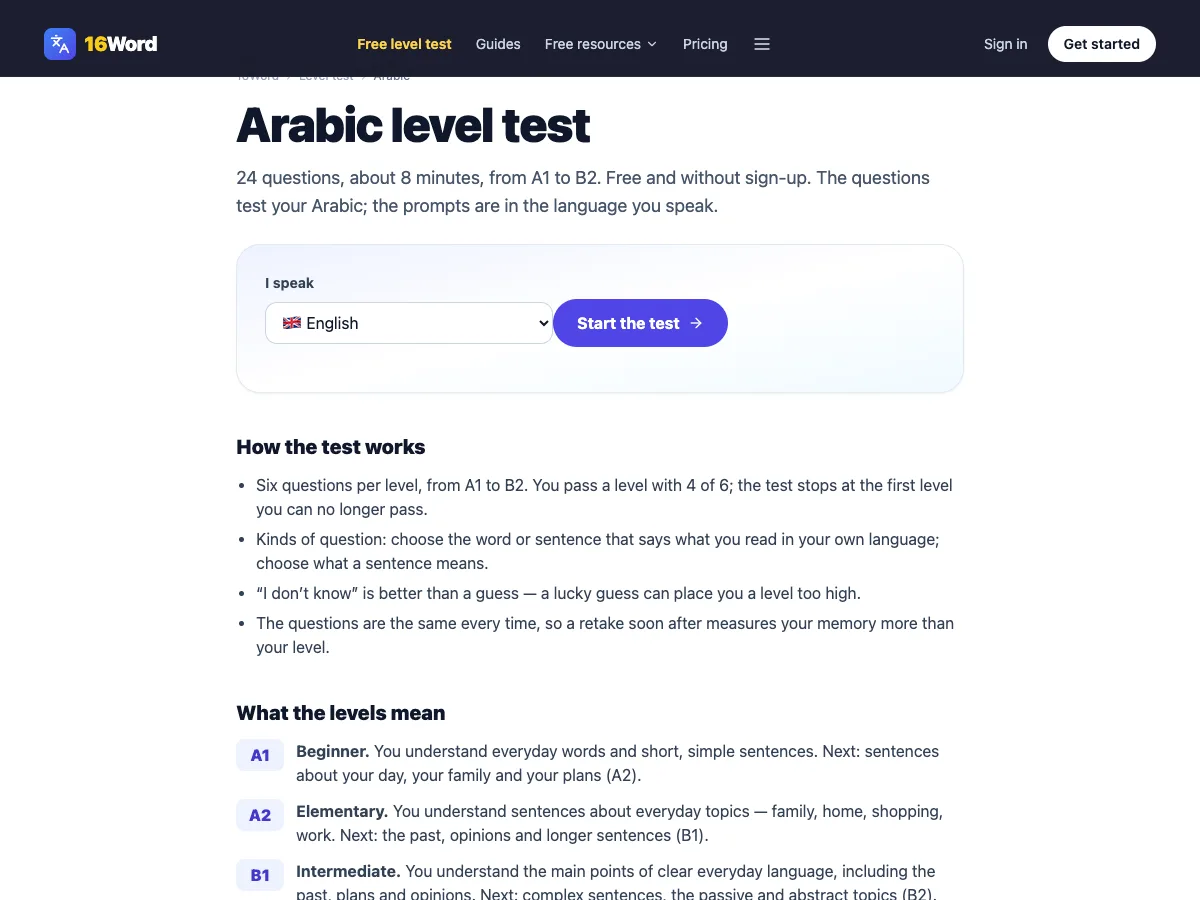
What is the easiest way to learn Arabic? Use the shortcuts the language itself gives you. Arabic builds most words from a root of three consonants, so one root opens a whole family of words; its verbs are regular; it has only three short and three long vowels. The hard parts — a new alphabet, sounds English doesn't have, and the gap between written and spoken Arabic — get easier when you take them in the right order. This guide gives you that order. To see where you stand, take the free Arabic level test.
Updated · 5 min read
First decision: which Arabic?
Modern Standard Arabic (MSA), close to Classical Arabic, is used in most publications, from newspapers to novels, and in formal broadcasts such as the news and political speeches. Everyday conversation happens in spoken varieties — dialects — which differ significantly and are sometimes mutually unintelligible; the chief dialect groups are those of Arabia, Iraq, Syria, Egypt and North Africa (Britannica).
| Your goal | Start with | Then |
|---|---|---|
| Reading, news, religion, study | MSA | a dialect if you travel or live there |
| Living in one country, family, work | MSA basics (alphabet, core words) | that country's dialect for speaking |
| Travel in several countries | MSA for signs and reading | polite phrases in the dialect of each place |
The right-hand columns are our advice. For North Africa, our guide to what language is spoken in Morocco shows how Arabic sits beside Amazigh there.
The easiest way to learn Arabic, step by step
1. The alphabet, before any vocabulary
Arabic is written in its own script, from right to left, with letters that join. Spend your first one or two weeks on it (our advice): our Arabic alphabet guide takes you through the 28 letters, their joining forms and the short-vowel marks.
2. Learn words in families, by their root
An Arabic word is a root — usually three consonants carrying the basic meaning — plus a pattern of vowels giving its grammatical meaning. The root k-t-b with one pattern gives kitāb (كتاب), "book"; with another, kātib (كاتب), "one who writes, clerk" (Britannica). Learn new words next to others from the same root and each one gets easier to remember.
3. Vowels are few — the consonants need practice
There are only three short and three long vowels (a, i, u and ā, ī, ū). The work is in the consonants: Arabic has distinctive throat sounds and a series of "emphatic" consonants said with the back of the tongue raised (Britannica). Hear them, copy them, and ask a teacher to correct you early.
4. Regular verbs, two tenses
Arabic verbs are regular in conjugation, with two tenses: the perfect, formed with endings and often used for the past, and the imperfect, formed with prefixes and often used for present or future (Britannica). Learn the pattern once and it repeats.
5. Don't let case endings stop you speaking
Standard Arabic has three cases, but they have largely disappeared from the spoken dialects and are often omitted in spoken MSA (Britannica). Learn them for reading and writing; don't wait for them before you start talking.
How long will it take?
The US Foreign Service Institute puts Arabic in its hardest group for English speakers — 88 weeks of full-time training for professional speaking and listening, together with Chinese, Japanese and Korean (FSI). If you read Persian or Urdu, you already know a script built on the Arabic one; see the Persian and Urdu alphabet guides.
A simple week
| When | What | Time |
|---|---|---|
| Every day, first weeks | letters: a few new ones and a review | 10 minutes |
| Every day | 16 words, grouped by root where you can | about 5 minutes |
| Every day | listening — news in MSA or speech in your dialect | 10 minutes |
| Once a week | a conversation with a teacher or partner | 30 minutes |
| Once a month | the Arabic level test | 10 minutes |
The weekly conversation is where the sounds and the dialect come together. On Edluxio you can book live 1-to-1 lessons with teachers and professionals in many fields, starting with a trial lesson with a full refund if it is not right for you.
Arabic on 16Word
On 16Word you learn Arabic words from any of our 36 languages, 16 at a time in about five minutes: type or say each word from its meaning — an on-screen keyboard has the Arabic letters — and see it again before you forget it, with a short Blocks game between answers. Answers are compared without the short-vowel marks, so you can type the way Arabic is usually written. Free to start.
Your first 16 Arabic words
Take the level test, then learn 16 words — about five minutes.
Words you'll hear in every Arabic-speaking country
Some expressions travel everywhere — read inshallah meaning for in shāʾ Allāh and its neighbours. And if Arabic is your first language and you are learning English or Turkish instead, see English for Arabic speakers and Turkish word lists for Arabic speakers.
Keep learning
- The easiest way to learn a language · the best way to learn a language
- The easiest way to memorize vocabulary · the best vocabulary builder
- Other scripts: Hebrew alphabet · level tests in Persian, Urdu, Hebrew and Turkish
- The easiest way to learn Korean · all guides
Questions about learning Arabic
What is the easiest way to learn Arabic?
Learn the alphabet first, choose Modern Standard Arabic or the dialect you need, learn words in families by their three-letter root, practise the throat and emphatic consonants early and use the regular verb patterns. Daily words plus a weekly conversation keep it moving.
Should I learn Modern Standard Arabic or a dialect?
MSA if you want to read, follow the news or study; a dialect if you will live or work in one country. Many learners start with MSA basics and add a dialect for speaking.
Is Arabic hard to learn for English speakers?
The US Foreign Service Institute places it in its hardest group, at 88 weeks of full-time training. Its regular verbs and root system make vocabulary easier once you know the alphabet and the sounds.
How long does it take to learn the Arabic alphabet?
It depends on your daily time. Learn the letters in their joining forms and read real words from the start; our alphabet guide goes letter by letter.
Do Arabic speakers understand each other's dialects?
Not always: some spoken varieties are mutually unintelligible. Modern Standard Arabic is the shared written and formal language.
Was this guide useful?
Official sources
Keep going
- /level-test/arabic
- The easiest way to learn Korean: Hangul first, then everyday words
- The easiest way to learn German: der, die, das from day one
- The easiest way to learn French: use what English already gave you
- The easiest way to memorize vocabulary: 5 minutes, no willpower
- How to learn Luxembourgish online: free and paid options compared
- Is Luxembourgish hard to learn? An honest guide for beginners
- Which language should you learn first when moving to Luxembourg?
- Best apps to learn Luxembourgish (and is it on Duolingo?)
- All guides