Ojalá meaning: "I hope" in Spanish, and the subjunctive after it
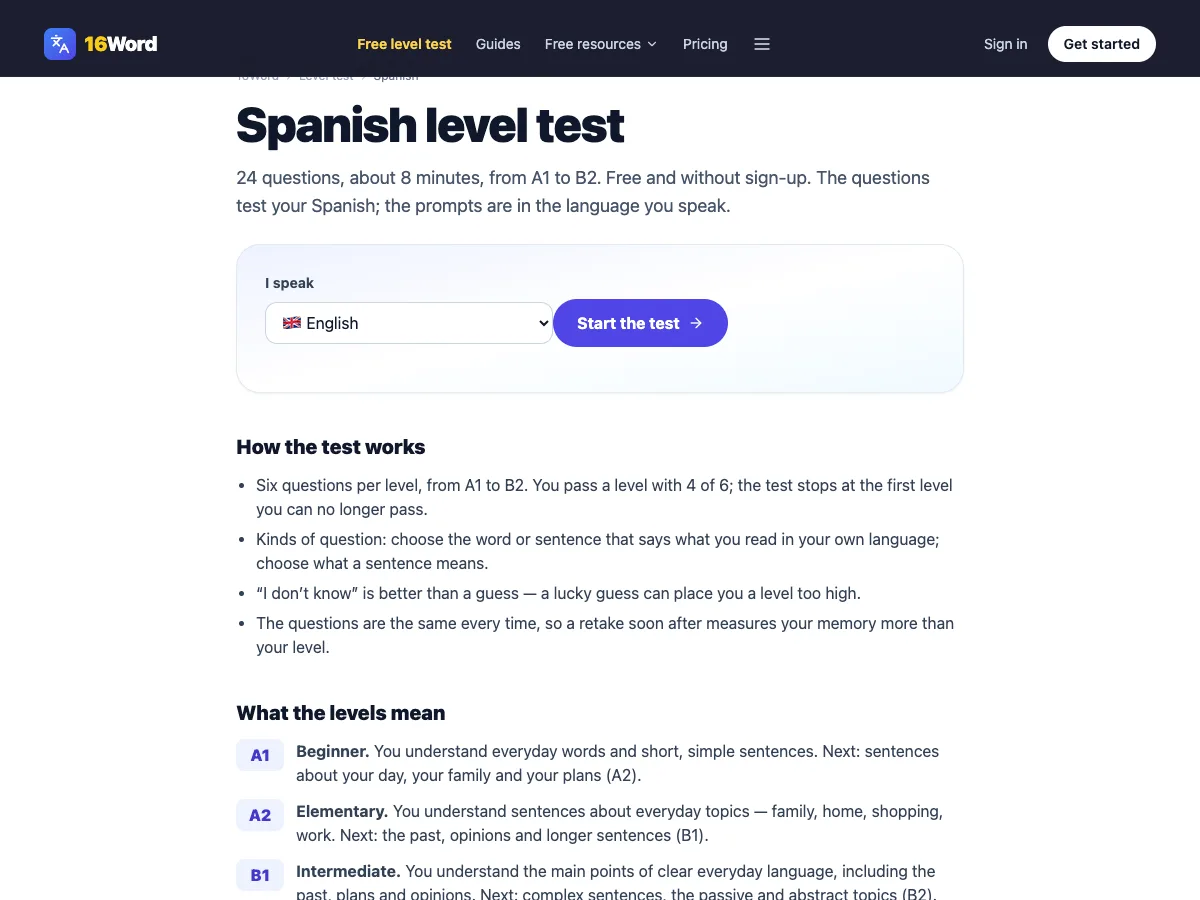
Ojalá meaning, in short: ojalá is how Spanish speakers say "I hope so" or "if only" — a single word for a wish. ¡Ojalá apruebes! is "I hope you pass!". It comes from Arabic, it never changes form, and it is one of the most common reasons learners meet the subjunctive. This guide explains what it means, the grammar that follows it, and the slips the Real Academia Española tells you to avoid. Check your own Spanish with the free Spanish level test.
Updated · 5 min read
Ojalá meaning: what does ojalá mean?
The Real Academia Española's dictionary, the DLE, defines ojalá as an interjection that expresses a strong wish for something to happen. Its example is ¡Ojalá apruebes! — "I hope you pass!". It lists amalaya, así and quienquita as synonyms, though in everyday Spanish ojalá is by far the word you will hear.
In English, ojalá becomes "I hope", "hopefully", "let's hope", "I wish" or "if only", depending on the tense of the verb after it. On its own, as an answer, it means "I hope so".
Short answer: ojalá = "I hope / I wish / if only". It is followed by the subjunctive, it never changes for person or tense, and you can use it alone: —¿Vendrá mañana? —¡Ojalá! ("Will she come tomorrow?" "I hope so!")
Where ojalá comes from
The DLE gives its origin as Hispanic Arabic wa šá lláh, "and God has willed (it)". Wiktionary traces it through Old Spanish oxala and compares it with Arabic in shāʼ Allāh, "if God wills". Today Spanish speakers use it with no religious sense at all — an atheist says ojalá as naturally as anyone. Portuguese borrowed the same word as oxalá.
If you are learning Arabic too, it is a nice bridge between the two languages: see the Arabic alphabet and the free Arabic level test.
Ojalá + subjunctive: the grammar
The Diccionario panhispánico de dudas is clear: when ojalá is followed by a clause, the verb is in the subjunctive, and que in between is optional. Which subjunctive you choose changes the meaning:
| After ojalá | Meaning | Example (Wiktionary) | English |
|---|---|---|---|
| present subjunctive | a hope that may come true | Ojalá (que) puedan dormir bien. | I hope they're able to sleep well. |
| present perfect subjunctive | a hope about something just past | Ojalá (que) hayan podido dormir bien. | I hope they were able to sleep well. |
| imperfect subjunctive | a wish that is unlikely or contrary to fact | Ojalá yo pudiera hacer lo mismo. | I wish I could do the same. |
| pluperfect subjunctive | a regret about the past | Ojalá (que) hubieran podido dormir bien. | I wish they could have slept well. |
So ojalá venga is a real hope ("I hope he comes"), while ojalá viniera is closer to "if only he would come" — you are less sure, or you know he won't. The RAE's own examples: Ojalá sea para bien ("I hope it's for the best") and Ojalá no lo hubiera hecho ("I wish I hadn't done it").
Ojalá que
Ojalá que means exactly the same as ojalá. The DPD gives Ojalá que la democracia sea duradera ("Let's hope democracy lasts") as an example. Use whichever sounds natural to you.
Three mistakes the RAE warns about
- No infinitive after ojalá. The DPD marks Ojalá sacar el libro a fin de año as wrong; say Ojalá saquemos or Ojalá podamos sacar el libro a fin de año ("I hope we get the book out by the end of the year").
- No indicative. After ojalá the verb is subjunctive, so not ojalá viene but ojalá venga.
- Write the stress on the last syllable. The usual and etymological form is ojalá. The DPD also accepts ójala, documented for centuries, but says the pronunciation ojála, heard in popular speech in some American countries, should not be written.
Ojalá y
You may hear ojalá y instead of ojalá que: Ojalá y encuentren a los culpables ("I hope they find the culprits"). The DPD says this is used above all in Mexico, Central America and the Caribbean; in Spain it is now limited to popular speech in some areas. Understand it, but in writing ojalá or ojalá que is the safe choice.
Make Spanish words stick
16Word teaches 16 words a day with active recall and spaced repetition, and a short Blocks game between answers. Free to start.
Ojalá in conversation
These short exchanges are 16Word's own model sentences, built on the patterns above:
- —Mañana hay examen. —¡Ojalá apruebes! — "There's an exam tomorrow." "I hope you pass!"
- —¿Crees que va a llover? —Ojalá que no. — "Do you think it will rain?" "I hope not."
- Ojalá tuviera más tiempo. — "I wish I had more time."
- Ojalá me hubieras llamado. — "I wish you had called me."
Want to hear yourself say these with a real person? Edluxio offers live 1-to-1 lessons with teachers and professionals in many fields, with a trial lesson and a full refund if it is not the right fit. You can hear Spanish on 16Word in the Spanish level test.
If you are learning Spanish
- Spanish nationality asks for the DELE A2 and the CCSE: Spanish nationality explained.
- All the DELE levels in one place: the DELE Spanish diplomas and the DELE path.
- Spanish speakers learning English: English word lists in Spanish.
- Words that do more than one job in other languages: doch in German, gezellig and lekker in Dutch.
Keep learning
- Free Spanish level test
- Free Portuguese level test — oxalá is waiting for you there
- How to memorize vocabulary
- Free level tests in 36 languages
- All guides
Questions about ojalá
What does ojalá mean in English?
"I hope", "hopefully", "I wish" or "if only", depending on the verb after it. Alone, ¡Ojalá! means "I hope so!".
Is ojalá followed by the subjunctive?
Yes, always. Present subjunctive for a hope (ojalá venga), imperfect subjunctive for an unlikely wish (ojalá viniera), pluperfect subjunctive for a regret (ojalá hubiera venido).
Is it ojalá or ojalá que?
Both are correct and mean the same; que is optional, says the RAE's Diccionario panhispánico de dudas.
Does ojalá come from Arabic?
Yes. The RAE gives Hispanic Arabic wa šá lláh, "and God has willed (it)". In modern Spanish it has no religious meaning.
Is ojalá formal or informal?
Neither: the RAE's dictionaries give it no register mark. Only ojalá y is described by the RAE as popular speech in Spain.
How do you pronounce ojalá?
o-ha-LA, with the stress on the last syllable (the j is the Spanish throat sound, like the ch in Scottish loch). The RAE also accepts ójala, stressed on the first syllable.
Was this guide useful?
Official sources
Keep going
- /level-test/spanish
- /certifications/dele
- Toch meaning: the Dutch word for "still", "after all" and "right?"
- Luxembourgish personal pronouns: ech, du, hien, hatt, si, mir, dir — with audio
- How to conjugate Luxembourgish verbs in the present tense
- Luxembourgish irregular verbs: sinn, hunn, goen, kommen and the modals
- Luxembourgish word order: verb second, verb last and separable verbs
- The Luxembourgish n-rule (Eifeler Regel) explained with examples
- Negation in Luxembourgish: net, keen, keng, näischt, ni and dach
- How to ask questions in Luxembourgish: wat, wien, wéini, wou, wéi, firwat
- All guides