IELTS explained: the 0–9 band, test options and how to prepare
IELTS is one of the English exams that universities, employers and immigration offices ask for most often. It tests all four skills and reports a band from 0 to 9. This guide sets out what the official IELTS site states, what that means for your preparation, and where to begin. For a step-by-step route, open our IELTS preparation path.
Updated · 6 min read
What IELTS measures
IELTS is delivered by the British Council and IDP. It has one part for each skill: reading, listening, writing and speaking. Because all four count, a strong reader with hesitant speech cannot hide the gap. The test types are described one by one on the official site, so check which type your university or authority names before you book.
How the band works
Your result is a band from 0 to 9. There is no general pass mark to aim at: the number that matters is the one written in the requirements of the place you are applying to. Find that number first. It decides how long you need to prepare, and it may differ between a course, a job and a visa.
Write your target band at the top of your study plan, with the name of the institution that asked for it. If the requirement mentions a minimum per skill, write that down too.
Test centre or at home
The official site offers IELTS at a test centre and at home. Before you choose the home option, confirm that the organisation receiving your result accepts it. You can look for a centre on the official test centre page.
How long a result counts
IELTS gives two years as the recommended limit for using a result. If you plan to apply later than that, take the test closer to your application. An institution may also set its own rule, so read its page rather than assuming.
A preparation plan that fits real life
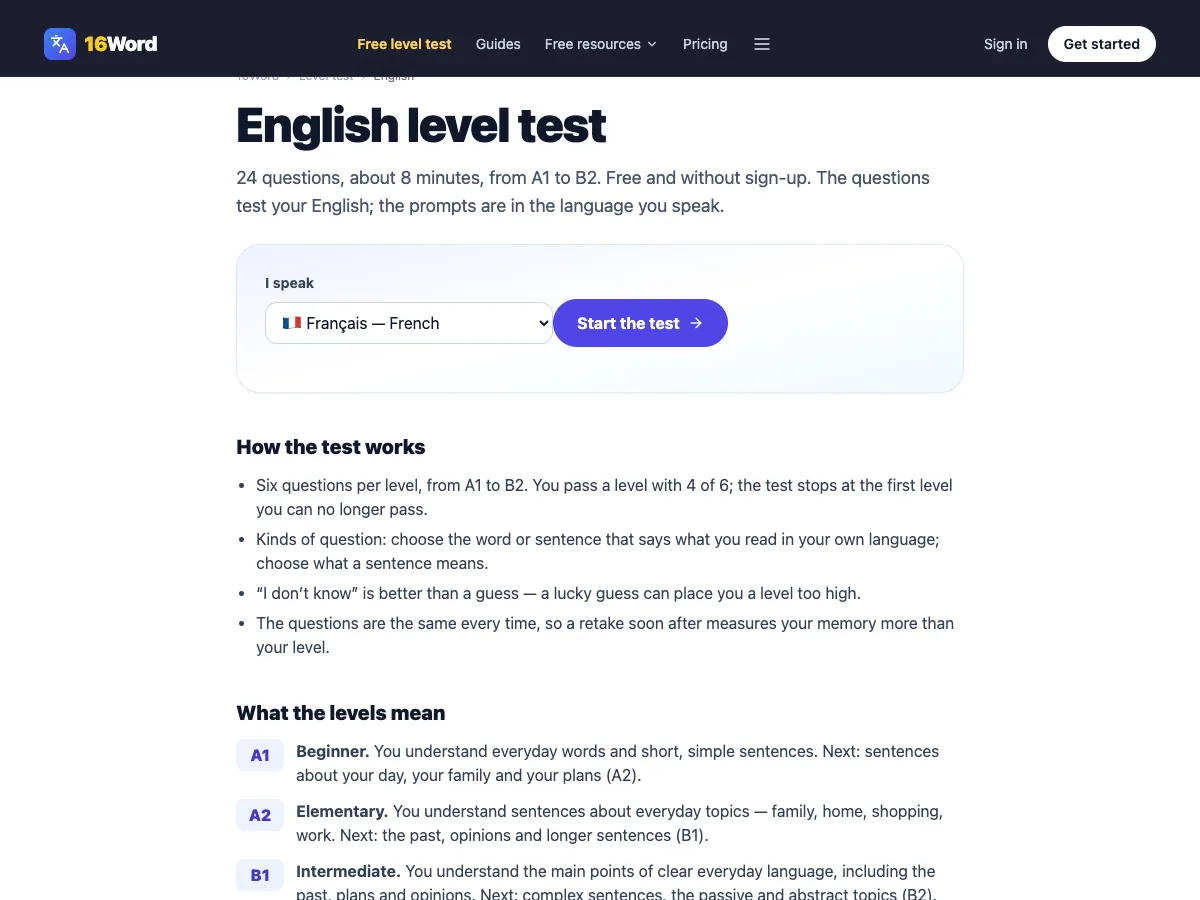
- Take a free English level test to see where you stand between A1 and B2.
- Decide your target band and read the requirement of the institution that set it.
- Build vocabulary every day: 16 words in about five minutes, with spaced repetition so that they stay.
- Move from words to whole sentences and dialogues, where grammar and word order show up.
- Work through the official sample questions and time yourself.
- Book the test only when your timed practice is close to the band you need.
What to practise for each skill
- Reading: read a little every day and note the words that stop you. Those are your next vocabulary set.
- Listening: listen to the same short recording twice, the second time checking every word you missed.
- Writing: write full answers by hand or on screen, whichever you will use on the day.
- Speaking: say your answers aloud. Being able to recognise a word and being able to produce it are different skills.
Start with your own path
Tell us your goal and your level. 16Word builds a personal plan that points you to words, sentences and dialogues at the right level.
16Word's paths go up to B2, and we do not offer IELTS mock tests. Use the app for vocabulary and active recall, and the official samples for the exam format.
Comparing exams before you commit? Read IELTS, TOEFL, PTE or Cambridge, and check how long language certificates stay valid. If you are preparing to study abroad, see language exams for studying abroad.
Keep exploring
Every exam below has its own preparation page on 16Word.
The other language exams
- Sproochentest (Luxembourgish)
- Inburgeringsexamen (Dutch)
- Staatsexamen NT2 (Dutch)
- TOEFL iBT (English)
- Cambridge English (English)
- PTE Academic (English)
- DELF (French)
- DALF (French)
- TCF (French)
- TEF (French)
- Goethe-Zertifikat (German)
- TestDaF (German)
- telc Deutsch (German)
- DELE (Spanish)
- CILS (Italian)
- CAPLE (Portuguese)
- HSK (Chinese)
- JLPT (Japanese)
- TOPIK (Korean)
- YKI (Finnish)
- Ellinomatheia (Greek)
- Certyfikat polski (Polish)
More guides on language exams
- TOEFL iBT explained: the 1–6 score scale and how to prepare
- Cambridge English exams: from A2 Key to C2 Proficiency
- PTE Academic explained: the 10–90 score and how to prepare
- IELTS, TOEFL, PTE or Cambridge: which English exam should you take?
- DELF explained: levels A1 to B2, pass mark and preparation
- DALF C1 and C2: what the advanced French diplomas require
- The TCF French test: five skills, levels and validity
- The TEF French test: the 0–699 score, uses and preparation
- DELF, TCF or TEF: which French exam do you need?
- Goethe-Zertifikat explained: levels A1 to C2 and how to prepare
- TestDaF explained: TDN 3 to 5 and studying in Germany
- telc Deutsch explained: exams, skills and how to prepare
- Goethe, TestDaF or telc: which German exam should you take?
- The DELE Spanish diplomas: levels and how to get ready
- CILS Italian certificate: levels, skills and how to pass
- CAPLE Portuguese exams: levels A1 to C2 and who needs them
- HSK explained: levels 1 to 9 and the five skills tested
- How to prepare for the JLPT: a plan from N5 to N1
- How to prepare for TOPIK: a study plan for levels 1 to 6
- The YKI Finnish test: levels 1 to 6 and how to prepare
- How to prepare for the Greek Certificate of Attainment
- How to pass the Polish language certificate exam
- Staatsexamen NT2: how scoring works and how to prepare
- Language exams for studying abroad: which certificate to take
- Language exams for work and visas: which certificate you need
- Language exams for citizenship: which certificates are used
- Do language certificates expire? Validity of the main exams
- Language exams you can take at home: what to check first
- Free official sample papers for 17 language exams
Related guides and free level tests
- The Dutch inburgering exam in 2026: routes, parts, fees and FAQ
- Sproochentest speaking (A2): topics, picture description and how to prepare
- Sproochentest listening (B1): the three recordings and how to practise
- A 60-day Sproochentest preparation plan, week by week
- Luxembourgish levels A1 to B2: what each CEFR level means in practice
- What level of Luxembourgish do you need for citizenship?
- The inburgering reading exam (A2 and B1): format, question types and tips
- The inburgering listening exam (A2 and B1): what to expect and how to train
- The inburgering writing exam (A2 and B1): tasks, model messages and mistakes
- The inburgering speaking exam (A2 and B1): format and model answers
- The KNM exam (Knowledge of Dutch Society): format, themes and how to prepare
- Staatsexamen NT2: programme I (B1) or programme II (B2)?
- A2 or B1 Dutch: which level do you need for inburgering, nationality or study?
- Inburgering exemptions and dispensation: when you take fewer or no exams
- What inburgering costs: exam fees, free attempts and the DUO loan
- The 3-year inburgering deadline: letters, fines and extra time
- How to register for the inburgering exams and the Staatsexamen NT2
- Dutch citizenship: the A2 language requirement and the naturalisation test
- Belgian nationality: the A2 language requirement and the Flemish Dutch test
- Inburgering in Flanders: the integration pathway and A2 Dutch
- The three inburgering routes: B1, education and Z route explained
- A 12-week plan to prepare for the inburgering exams
- Spanish nationality: the DELE A2 and CCSE requirement explained
- Italian citizenship: the B1 Italian language requirement
- Portuguese nationality: the A2 requirement and the CIPLE exam
- Finnish citizenship: the language requirement and the YKI test
- The Czech A2 exam for permanent residence: format, points and fee
- JLPT levels N5 to N1: sections, times and pass marks
- Polish citizenship: the B1 Polish certificate and how to get it
- The Greek Certificate of Attainment: levels, dates and fees
IELTS: frequently asked questions
What is a good IELTS band?
The right band is the one your university, employer or immigration office asks for. IELTS reports 0 to 9 and has no general pass mark.
Can I take IELTS at home?
The official site lists both a test centre option and a home option. Confirm that the organisation receiving your result accepts the one you choose.
How long is an IELTS result valid?
The recommended limit is two years. An institution may set its own rule, so check its requirements.
Which skills does IELTS test?
Reading, listening, writing and speaking. All four are part of the result.
Does 16Word prepare me for IELTS?
16Word builds the vocabulary and recall behind all four skills, up to B2. For the exam format, use the official sample questions.
Was this guide useful?
Official sources
Keep going
- /certifications/ielts
- TOEFL iBT explained: the 1–6 score scale and how to prepare
- Cambridge English exams: from A2 Key to C2 Proficiency
- PTE Academic explained: the 10–90 score and how to prepare
- IELTS, TOEFL, PTE or Cambridge: which English exam should you take?
- DELF explained: levels A1 to B2, pass mark and preparation
- DALF C1 and C2: what the advanced French diplomas require
- The TCF French test: five skills, levels and validity
- The TEF French test: the 0–699 score, uses and preparation
- All guides