The easiest way to learn English: 10 small daily habits
What is the easiest way to learn English? Not one big effort but ten small habits, each taking a few minutes, that fit into a day you already have. English helps you: it has very few word endings, and you already hear it around you. This guide gives you the ten habits, with recordings of the words you will use most and word lists with meanings in your own language. Start by finding your level with the free English level test.
Updated · 5 min read
Why English can be easy
Modern English is "relatively uninflected": the verb ride has five forms — ride, rides, rode, riding, ridden — where German reiten has sixteen, and only nouns, pronouns, some adjectives and verbs change form at all (Britannica). About 1.5 billion people speak English, and it is the first choice of foreign language in most countries — so films, songs, games and websites in English are all around you. The harder parts are the spelling, which "does not always accurately reflect the pronunciation", and the size of the vocabulary. The habits below aim straight at those two.
The easiest way to learn English: 10 habits
1. Sixteen words a day
Five minutes, every day, the most useful words first. Lists with meanings, IPA and a recording, in your own language: for Turkish, Arabic, French, Spanish and Portuguese speakers. Paul Nation estimated that comfortable reading takes about 8,000–9,000 word families (Nation, 2006) — but you can use English long before that, starting with the most frequent words.
2. The polite core first
A few words do more work than any others when you start — please, thank you, sorry, excuse me. Listen and repeat:
please
Literally: please
thank
Literally: thank (as in thank you)
sorry
Literally: sorry
3. Say every word aloud
Because English spelling and sound often disagree, learn each word with its sound and say it back (our advice). Silent learning gives you words you can read but not say.
4. Switch on the English you already have
Set your phone to English, watch a series you know with English subtitles, read the English menu (our advice). You are not adding time to your day, just changing what you hear.
5. Test yourself on the bus
Look at the meaning, say the English word, then check. In a study in Science, testing yourself after learning had a large effect on recall a week later; re-reading had none (Karpicke & Roediger, 2008).
6. Learn the words of your own life
| Situation | Lists for Turkish · Arabic · French · Spanish · Portuguese speakers |
|---|---|
| Greetings and small talk | TR · AR · FR · ES · PT |
| Work and the office | TR · AR · FR · ES · PT |
| Phones, apps and the internet | TR · AR · FR · ES · PT |
| Travel | TR · AR · FR · ES · PT |
7. Two minutes of copying a voice
Play a short sentence, pause, say it exactly as you heard it — the rhythm too (our advice). It trains pronunciation and listening at once.
8. Have your rescue questions ready
Sorry, I don't understand. Could you say that again, please? With that ready, every conversation becomes a lesson instead of a test.
understand
Literally: understand
question
Literally: question
answer
Literally: answer
9. Write three sentences a day
What you did, what you will do, what you think. Three short sentences use the tenses you are learning — English tenses explained and English grammar basics help.
10. Check your level once a month
Cambridge English estimates about 200 guided learning hours to move up one level (Cambridge English) — so small daily habits add up over months, not days. Take the level test monthly and watch it move.
easy
Literally: easy
minute
Literally: minute
The one habit that needs another person
Speaking. A friend, a colleague, a teacher — someone who answers back. On Edluxio you can book live 1-to-1 lessons with teachers and professionals in many fields, starting with a trial lesson with a full refund if it is not right for you.
English on 16Word
Habits 1, 3 and 5 are what 16Word does: 16 English words in about five minutes, with meanings in your language, typed or said from memory, heard, and brought back just before you forget them, with a short Blocks game between answers. Pages for Turkish speakers and Arabic speakers; the level test also runs in Turkish and in Arabic. Free to start.
Habit 1, today
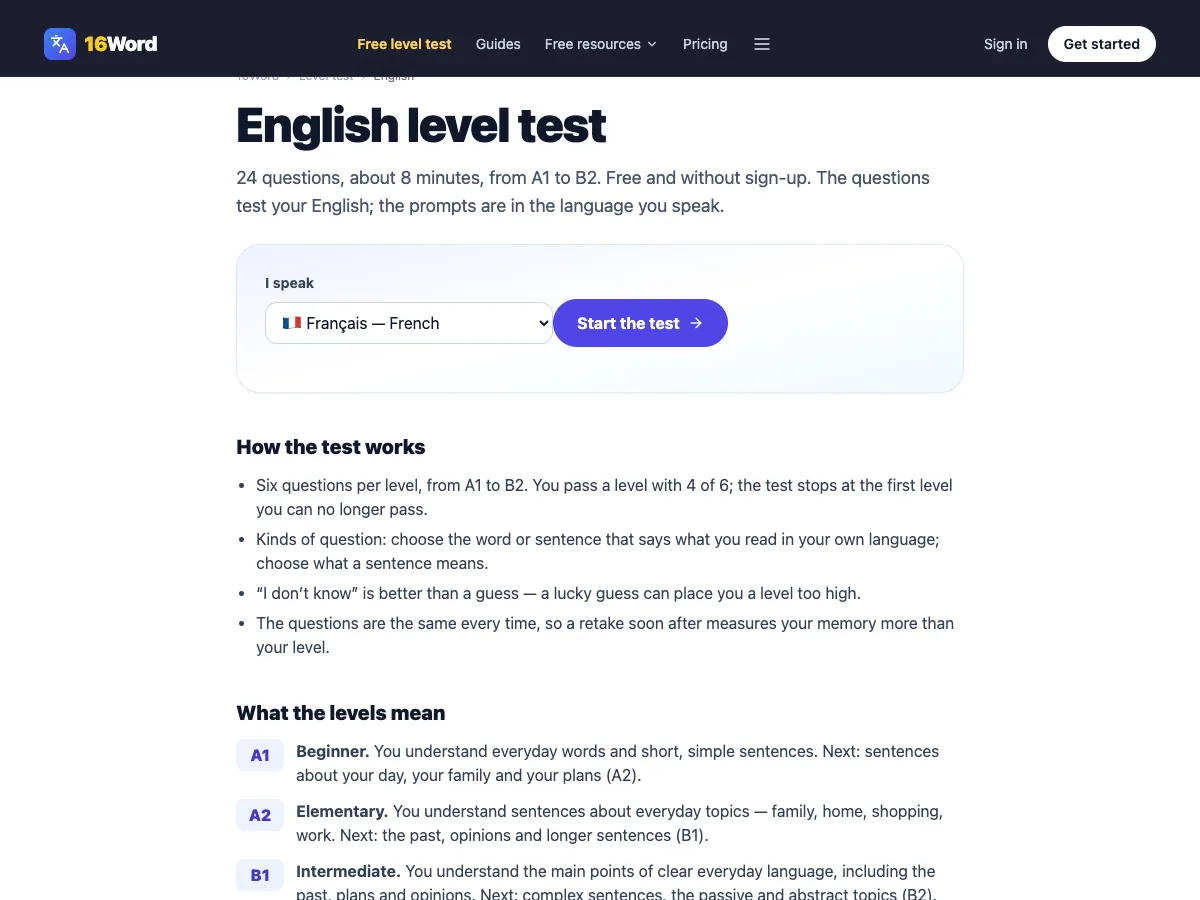
Take the level test and learn your first 16 English words — about five minutes.
When you want a certificate
Habits get you speaking; an exam proves it. See IELTS, TOEFL iBT, Cambridge English and PTE Academic, or the four compared.
Keep learning
- The best way to learn English: a level-by-level plan
- Weather words in English · body parts in English
- Why learn English? · where English is spoken
- The easiest way to memorize vocabulary · how to memorize vocabulary
- The easiest way to learn a language · all guides
Recordings (Wikimedia Commons, MP3 versions): thank — Dvortygirl, CC BY-SA 3.0; please — Dvortygirl, CC BY-SA 3.0; sorry — Dvortygirl, CC BY-SA 3.0; understand — Dvortygirl, CC BY-SA 3.0; question — No machine-readable author provided. Dvortygirl assumed (based on copyright claims)., CC BY-SA 3.0; answer — Dvortygirl, CC BY-SA 3.0; easy — Dvortygirl, CC BY-SA 3.0; minute — Dvortygirl, Public domain.
Questions about the easiest way to learn English
What is the easiest way to learn English?
Build small daily habits: 16 words a day with their sound, saying words aloud, English subtitles and phone settings, testing yourself instead of re-reading, and a weekly conversation. Each takes minutes; together they add up.
Can I learn English by myself at home?
You can learn most vocabulary, listening and reading at home with an app, word lists and subtitles. For speaking, add a person — a teacher, a colleague or an exchange partner.
How long does it take to learn English the easy way?
Cambridge English estimates about 200 guided learning hours per level, so even easy daily habits need months for each level. Take a level test every month to see your own pace.
What English words should I learn first?
The most frequent ones, the polite core — please, thank you, sorry — and the words of your own life: your job, your family, your city. Our word lists are sorted by topic with meanings in several languages.
Is English grammar easy?
Easier than many languages in its endings: a verb like ride has only five forms. Spelling and pronunciation are harder, which is why saying every word aloud helps.
Was this guide useful?
Official sources
- Britannica — English language
- Cambridge English — Guided learning hours
- Nation (2006), How large a vocabulary is needed for reading and listening?, Canadian Modern Language Review 63(1)
- Karpicke & Roediger (2008), The critical importance of retrieval for learning, Science 319
- Wikimedia Commons — English pronunciation (recordings, credited per word below)
- Edluxio — live 1-to-1 lessons with teachers and professionals
Keep going
- Free English level test — A1 to B2, no sign-up
- /ar/learn-english
- /ingilizce
- Why learn English? 7 reasons, with the numbers behind them
- The best way to learn English: a level-by-level plan from A1 to C1
- The easiest way to learn Japanese: kana first, then words you hear
- The easiest way to learn Arabic: alphabet, roots and one dialect
- The easiest way to learn Korean: Hangul first, then everyday words
- The easiest way to learn German: der, die, das from day one
- The easiest way to learn French: use what English already gave you
- The easiest way to memorize vocabulary: 5 minutes, no willpower
- All guides