The best way to learn English: a level-by-level plan from A1 to C1
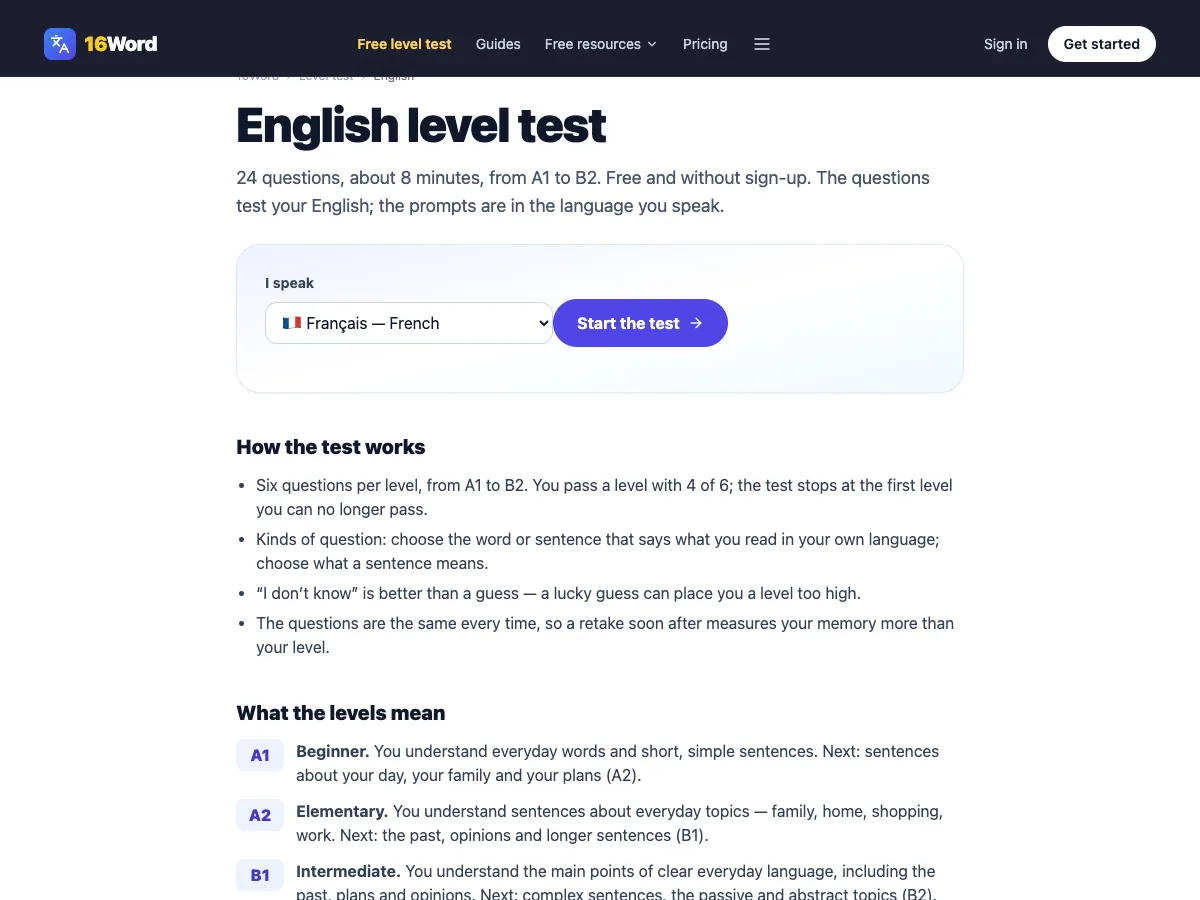
What is the best way to learn English? Follow the levels. At each one — A1, A2, B1, B2, C1 — you need different words, different listening and a different kind of practice, and Cambridge English publishes how many hours each level usually takes. This guide gives you a plan for every stage, word lists in your own language, the four skills with their sound, and which exam to aim for. Begin with the free English level test so you start at the right step.
Updated · 5 min read
Why English is easy — and where it is hard
The easy part: Modern English has very few endings. Britannica's example: the verb ride has five forms (ride, rides, rode, riding, ridden), where German reiten has sixteen, and only nouns, pronouns, some adjectives and verbs change form at all (Britannica). The hard parts: a spelling that "does not always accurately reflect the pronunciation of words", and a huge vocabulary — English has taken words from more than 350 languages. So the best way to learn English puts vocabulary and pronunciation at the centre, with grammar in support.
pronunciation
Literally: pronunciation — how a word is said
dictionary
Literally: dictionary
How long each level takes
| Level | Guided learning hours from zero (Cambridge English) | What you can do (CEFR) |
|---|---|---|
| A1 | 90–100 | introduce yourself, ask and answer simple personal questions |
| A2 | 180–200 | routine exchanges: family, shopping, work |
| B1 | 350–400 | main points of clear speech; most travel situations; give reasons |
| B2 | 500–600 | complex texts in your field; conversation without strain |
| C1 | 700–800 | demanding texts, implicit meaning; flexible use for study and work |
Hours from Cambridge English (about 200 per level; your background, intensity, age and exposure outside lessons change them); level descriptions from the CEFR global scale.
How many English words do you need?
Paul Nation estimated that comfortable reading — knowing about 98% of the words on the page — takes about 8,000–9,000 word families for written English and 6,000–7,000 for spoken English (Nation, 2006). You can use English long before that: the most frequent words cover most daily situations. So learn by frequency and by your own needs, level by level.
The plan: what to learn at each level
| Level | Words to focus on | Lists for Turkish · Arabic · French · Spanish · Portuguese speakers |
|---|---|---|
| A1 | the most common words, greetings | TR · AR · FR · ES · PT |
| A1–A2 | numbers and time | TR · AR · FR · ES · PT |
| A2 | common verbs | TR · AR · FR · ES · PT |
| A2–B1 | everyday nouns and adjectives | TR · AR · FR · ES · PT |
| B1 | work and the office | TR · AR · FR · ES · PT |
| B2 | school, study and technology | TR · AR · FR · ES · PT |
A1 and A2: words, sounds and simple sentences
Learn 16 words a day from the lists above, always with their sound. Read English grammar basics once, then come back to it. Listen to slow English every day; say your first sentences aloud from week one.
listen
Literally: listen
speak
Literally: speak
B1: tenses, longer listening, real conversations
Now the tenses matter — English tenses explained covers them with examples. Watch series and videos with English subtitles, write short messages, and have a conversation every week about your own life and opinions.
read
Literally: read
write
Literally: write
B2 and C1: your field, your exam
Add the vocabulary of your work or studies, read long articles, practise presentations and emails — and pick the exam you need: IELTS, TOEFL iBT, Cambridge English or PTE Academic. Not sure which? Read IELTS, TOEFL, PTE or Cambridge compared and our paths for IELTS, TOEFL, Cambridge and PTE.
grammar
Literally: grammar
lesson
Literally: lesson
Speaking: the skill you can't build alone
Apps and lists build words and listening; speaking needs someone who answers back and corrects you. On Edluxio you can book live 1-to-1 lessons with teachers and professionals in many fields — useful for job interviews or the speaking part of IELTS — starting with a trial lesson with a full refund if it is not right for you.
Learning English on 16Word
16Word gives you 16 English words a day in about five minutes, with meanings in your own language: type or say each word from memory, hear it, and see it again just before you forget it, with a short Blocks game between answers. There are pages for Turkish speakers and Arabic speakers, and the level test also runs in Turkish and in Arabic. It is free to start.
Your first 16 English words
Take the level test, then learn 16 words at your level — about five minutes.
More English word lists
- All lists: for Turkish, Arabic, French, Spanish and Portuguese speakers
- Travel: TR · AR · FR · ES · PT
- Topic guides: weather words, body parts
Keep learning
- The easiest way to learn English: 10 small daily habits
- Why learn English? · the history of English · where English is spoken
- How to memorize vocabulary · the best vocabulary builder
- Language exams for studying abroad · for work and visas
Recordings (Wikimedia Commons, MP3 versions): listen — Dvortygirl, CC BY-SA 3.0; speak — Dvortygirl, Public domain; read — Dvortygirl, Public domain; write — Dvortygirl, CC BY-SA 3.0; grammar — Dvortygirl, CC BY-SA 3.0; pronunciation — Dvortygirl, CC BY-SA 3.0; dictionary — Dvortygirl, Public domain; lesson — Dvortygirl, CC BY-SA 3.0.
Questions about learning English
What is the best way to learn English?
Learn by level: frequent words and simple sentences at A1–A2, tenses and real conversations at B1, your field and an exam at B2–C1. Every day, recall words and listen; every week, speak with a person; every month, take a level test.
How long does it take to learn English?
Cambridge English estimates about 200 guided learning hours per CEFR level: roughly 350–400 hours from zero to B1 and 500–600 to B2. Independent study and exposure outside lessons speed things up.
How many English words do I need?
For comfortable reading, Paul Nation estimated about 8,000–9,000 word families; for following speech, about 6,000–7,000. You can get by in daily life with far fewer if they are the most frequent ones.
Is English grammar hard?
Less than many languages: English has few endings — the verb ride has only five forms. The harder parts are spelling, which doesn't always match the sound, and the size of the vocabulary.
Which English exam should I take?
The one your university, employer or visa asks for — check their page first. Our guides cover IELTS, TOEFL iBT, Cambridge English and PTE Academic, and a comparison shows the differences.
Can I learn English for free?
You can go far with free level tests, word lists and official sample papers. 16Word is free to start; live speaking lessons are the part that usually costs money.
Was this guide useful?
Official sources
- Britannica — English language
- Council of Europe — CEFR global scale (Table 1)
- Cambridge English — Guided learning hours
- Nation (2006), How large a vocabulary is needed for reading and listening?, Canadian Modern Language Review 63(1)
- Wikimedia Commons — English pronunciation (recordings, credited per word below)
- Edluxio — live 1-to-1 lessons with teachers and professionals
Keep going
- Free English level test — A1 to B2, no sign-up
- /ar/learn-english
- /ingilizce
- The easiest way to learn English: 10 small daily habits
- Why learn English? 7 reasons, with the numbers behind them
- The easiest way to learn a language (without burning out)
- The easiest way to learn Japanese: kana first, then words you hear
- The easiest way to learn Arabic: alphabet, roots and one dialect
- The easiest way to learn Korean: Hangul first, then everyday words
- The easiest way to learn German: der, die, das from day one
- The easiest way to learn French: use what English already gave you
- All guides