The easiest way to learn Japanese: kana first, then words you hear
What is the easiest way to learn Japanese? Take the easy parts first and spread the hard ones out. Japanese has only five vowels, verbs that don't change for I, you or they, and nouns without gender or plural — that is the easy side. Its writing and its levels of politeness are the hard side. This guide puts them in the right order: kana first, the polite verb form, words learned with their sound, kanji through words you already know, and the JLPT N5 as your first goal. Check your level with the free Japanese level test.
Updated · 5 min read
What makes Japanese easier than it looks
- Five vowels: /i, e, a, o, u/ (Britannica) — fewer than English.
- No agreement: verbs show no agreement for person, number or gender, so one form serves I, you and they.
- Nouns don't change: no gender, no plural ending, no declension; small particles after a word show its role in the sentence.
- Words can be left out when the context makes them clear — you don't have to say I every time.
What makes it hard
- Three kinds of writing. Already at N5, the JLPT expects you to read typical expressions and sentences in hiragana, katakana and basic kanji (JLPT).
- Kanji. The government sets an official list of kanji for everyday writing, the Jōyō kanji (Cabinet notice of 2010, Agency for Cultural Affairs) — a long-term project, not a first-month one.
- Politeness. The same verb has a polite form (kakimasu, 書きます, "write") and a plain form (kaku, 書く) used with equals or in books and newspapers, plus honorific and humble forms (Britannica).
- Word order. Japanese is consistently subject–object–verb: the verb comes at the end, and modifiers come before what they modify.
That is why the US Foreign Service Institute puts Japanese in its hardest group for English speakers — 88 weeks of full-time training for professional speaking and listening, with Arabic, Chinese and Korean (FSI). The easiest way is not a shortcut; it's the order you take things in.
The easiest way to learn Japanese, in order
1. Hiragana, then katakana
Learn hiragana first — you need it for grammar endings and for reading any beginner text — then katakana, used for foreign words (our advice for the order). With both, you can read everything at N5 that isn't kanji, and you can type Japanese: you type the sounds and choose the characters.
2. The polite form first
As a learner you will mostly speak to people you don't know well, so start with the polite -masu form (kakimasu) and learn the plain form (kaku) a little later (our advice). Our Japanese grammar basics and Japanese tenses explained go step by step.
3. Words with their sound — and their pitch
Japanese uses a pitch accent: in Tokyo speech, hashi with a high–low pitch means "chopsticks" (箸) and with low–high means "bridge" (橋) (Britannica). The standard common language is based on Tokyo speech. So learn every word by ear, not only by eye.
4. Kanji through words you know
Learn a kanji when you meet it in a word you can already say, not from a list of hundreds (our advice). Each new character then attaches to a sound and a meaning you have.
5. Aim for N5
The JLPT has five levels, N5 the easiest and N1 the hardest; N5 and N4 measure basic Japanese mainly learned in class (JLPT). Read JLPT levels N5 to N1, follow the JLPT preparation plan and see our JLPT path.
A week of easy Japanese
| When | What | Time |
|---|---|---|
| Every day | 16 words with their sound, recalled from the meaning | about 5 minutes |
| Every day, first month | kana: five new characters and a review | 10 minutes |
| Every day | listening to slow Japanese | 10 minutes |
| Once a week | a conversation in the polite form | 30 minutes |
| Once a month | the Japanese level test | 10 minutes |
For the weekly conversation, someone who hears your pitch and your politeness level is worth a lot. On Edluxio you can book live 1-to-1 lessons with teachers and professionals in many fields, starting with a trial lesson with a full refund if it is not right for you.
Japanese on 16Word
On 16Word you learn Japanese words from any of our 36 languages, 16 at a time in about five minutes: type or say each one from its meaning, hear it, and see it again before you forget it, with a short Blocks game between answers. Grading is exact for Japanese, because one character can change the word. Start on the Japanese page; it is free to start.
Your first 16 Japanese words
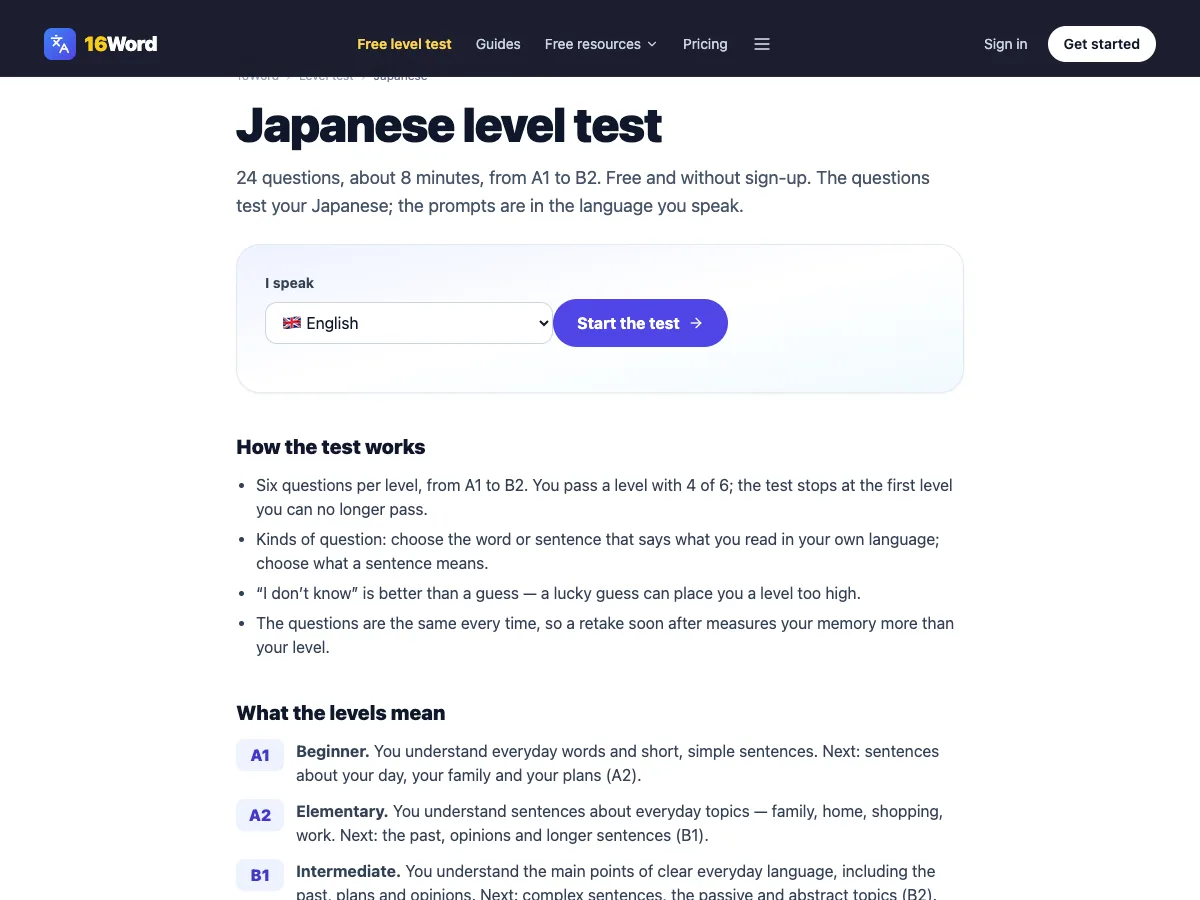
Take the level test and learn 16 words with their sound — about five minutes.
Japanese, Chinese or Korean?
All three sit in the FSI's hardest group, for different reasons. Compare why learn Japanese with why learn Chinese and the Korean alphabet; read the best way to learn Chinese or the easiest way to learn Korean; or take the Chinese and Korean level tests.
Keep learning
- The history of the Japanese language · where Japanese is spoken
- The easiest way to learn a language · the best way to learn a language
- The easiest way to memorize vocabulary · the best vocabulary builder
- A first phrase to learn: how to say thank you in Japanese — arigatō, dōmo and arigatō gozaimasu.
Questions about learning Japanese
What is the easiest way to learn Japanese?
Learn hiragana and katakana first, start with the polite -masu verb form, learn every word with its sound, pick up kanji through words you already know and aim for the JLPT N5. Short daily sessions plus a weekly conversation keep it steady.
Is Japanese hard to learn for English speakers?
The US Foreign Service Institute places it in its hardest group, at 88 weeks of full-time training for professional speaking and listening. The pronunciation and the verb endings are friendlier than the writing system and the levels of politeness.
Should I learn hiragana or katakana first?
Hiragana first, because grammar endings and beginner texts use it; katakana next, for foreign words. The JLPT N5 expects both, plus basic kanji.
How many kanji do I need?
Far fewer than the official Jōyō list to start. Learn kanji as part of the words you meet, level by level; the JLPT N5 asks only for basic kanji.
Can I learn Japanese without learning kanji?
You can start speaking with kana and romanised words, but to read real Japanese you will need kanji. Spread them out over months instead of avoiding them.
Was this guide useful?
Official sources
- JLPT — N1–N5: summary of linguistic competence for each level
- Britannica — Japanese language
- Agency for Cultural Affairs — Jōyō Kanji Hyō (Cabinet Notice No. 2, 2010)
- US Department of State (NFATC) — Foreign Language Training: language learning timelines
- Edluxio — live 1-to-1 lessons with teachers and professionals
Keep going
- Learn Japanese 16 words a day
- Free Japanese level test — A1 to B2, no sign-up
- Why learn Japanese? 7 reasons, with the facts behind them
- The easiest way to learn Arabic: alphabet, roots and one dialect
- The easiest way to learn Korean: Hangul first, then everyday words
- The easiest way to learn German: der, die, das from day one
- The easiest way to learn French: use what English already gave you
- The easiest way to memorize vocabulary: 5 minutes, no willpower
- How to learn Luxembourgish online: free and paid options compared
- Is Luxembourgish hard to learn? An honest guide for beginners
- All guides