Greek travel phrases: greetings, the bill, tickets and help
Greek travel phrases open more doors than you would expect: a kaliméra in the morning or an efcharistó at the till changes the tone of an exchange at once. This guide gives the phrases a visitor really uses — greetings, please and thank you, the café, tickets and buses, and what to say when something goes wrong — each in Greek letters with a transliteration, checked in Wiktionary, plus the official emergency numbers from Visit Greece. If the letters still look strange, read the Greek alphabet first.
Updated · 5 min read
Greetings: hello, good morning, good evening
| Greek | Say it | Meaning | When |
|---|---|---|---|
| Γεια σας | geia sas | hello / goodbye | polite, or to several people |
| Γεια σου | geia sou | hello / goodbye | one friend, a child, family |
| Καλημέρα | kaliméra | good morning | until about midday |
| Καλησπέρα | kalispéra | good evening | later in the day |
| Καληνύχτα | kaliníchta | good night | when leaving at night |
Γεια σας literally means "your health". Wiktionary notes that the singular γεια σου is familiar — family, friends, children — while the plural γεια σας is formal and polite, for strangers and to show respect. As a traveller you will mostly need γεια σας. Καλημέρα is καλή (good) + μέρα (day): "Καλημέρα, τι κάνετε;" — "Good morning, how are you?"
Notice the ";" at the end of that question. In Greek it is the question mark. Wiktionary's ; entry gives the example Με συγχωρείτε· πού είναι οι τουαλέτες; — "Excuse me; where are the toilets?" — where the raised dot · is the Greek semicolon.
Please, thank you and sorry
| Greek | Say it | Meaning |
|---|---|---|
| Ευχαριστώ | efcharistó | thank you |
| Ευχαριστώ πολύ | efcharistó polý | thank you very much |
| Παρακαλώ | parakaló | please; you're welcome; can I help you? |
| Συγγνώμη | syngnómi | sorry; excuse me |
| Ναι | nai | yes |
| Όχι | óchi | no |
Two warnings for English speakers. First, ναι means yes — it sounds like "neh". Second, παρακαλώ does many jobs: "please" in a request (Φέρε μου, σε παρακαλώ, έναν καφέ — "Bring me some coffee, please"), "you're welcome" after a thanks, and, said as a question, "can I help you?" or "hello?" on the phone. A waiter who greets you with Παρακαλώ; is asking what you would like.
To be polite while turning something down, Wiktionary's ευχαριστώ entry has the perfect line: Ευχαριστώ, αλλά δε θα πάρω — "Thanks, but no thanks." A friendly alternative to thank you is να 'σαι καλά (na 'sai kalá), "may you be well".
At the café or taverna
- Φέρε μου ένα νερό, σε παρακαλώ (Fére mou éna neró, se parakaló) — "Bring me a glass of water, please." (Wiktionary's example)
- νερό της βρύσης (neró tis vrýsis) — tap water; εμφιαλωμένο νερό (emfialoméno neró) — bottled water
- Μπορώ να έχω τον λογαριασμό; (Boró na écho ton logariasmó?) — "Can I have the bill, please?"
- Πόσο κάνει; (Póso kánei?) — "How much is it?"
Λογαριασμός (logariasmós) means both the restaurant bill and a bank account — it comes from the verb "to calculate". Prices are in euros: Visit Greece reminds visitors that the cents are called lepta in Greek.
Getting around: tickets, stops and directions
| Greek | Say it | Meaning |
|---|---|---|
| εισιτήριο | eisitírio | ticket |
| απλό εισιτήριο | apló eisitírio | one-way ticket |
| στάση λεωφορείου | stási leoforeíou | bus stop |
| σταθμός | stathmós | station |
| Πού είναι…; | Poú eínai…? | Where is…? |
| Πού είναι η τουαλέτα; | Poú eínai i toualéta? | Where is the toilet? |
Πού with an accent is "where?"; without the accent, που is "that, which". The little accent mark matters in Greek spelling — another reason to learn the alphabet properly. And if you need to check whether someone speaks English: Μιλάτε αγγλικά; (Miláte angliká?) — "Do you speak English?" Wiktionary's example answer is a blunt Όχι (no), so have your Greek ready.
Learn Greek 16 words a day
Active recall, spaced repetition and a short Blocks game between answers. Free to start.
If something goes wrong: help and emergency numbers
Βοήθεια! (voḯtheia) is "Help!", and πρώτες βοήθειες is first aid. Visit Greece's official travel tips list these numbers:
| Number | Service |
|---|---|
| 112 | European emergency number |
| 100 | Police |
| 166 | Ambulances (First Aid National Center) |
| 199 | Fire service |
| 1571 | Tourist Police |
Banks, per Visit Greece, are open 8:00–14:30 Monday to Thursday and 8:00–13:30 on Friday, and closed on public holidays — plan cash and exchange around that.
Practise Greek travel phrases before you go
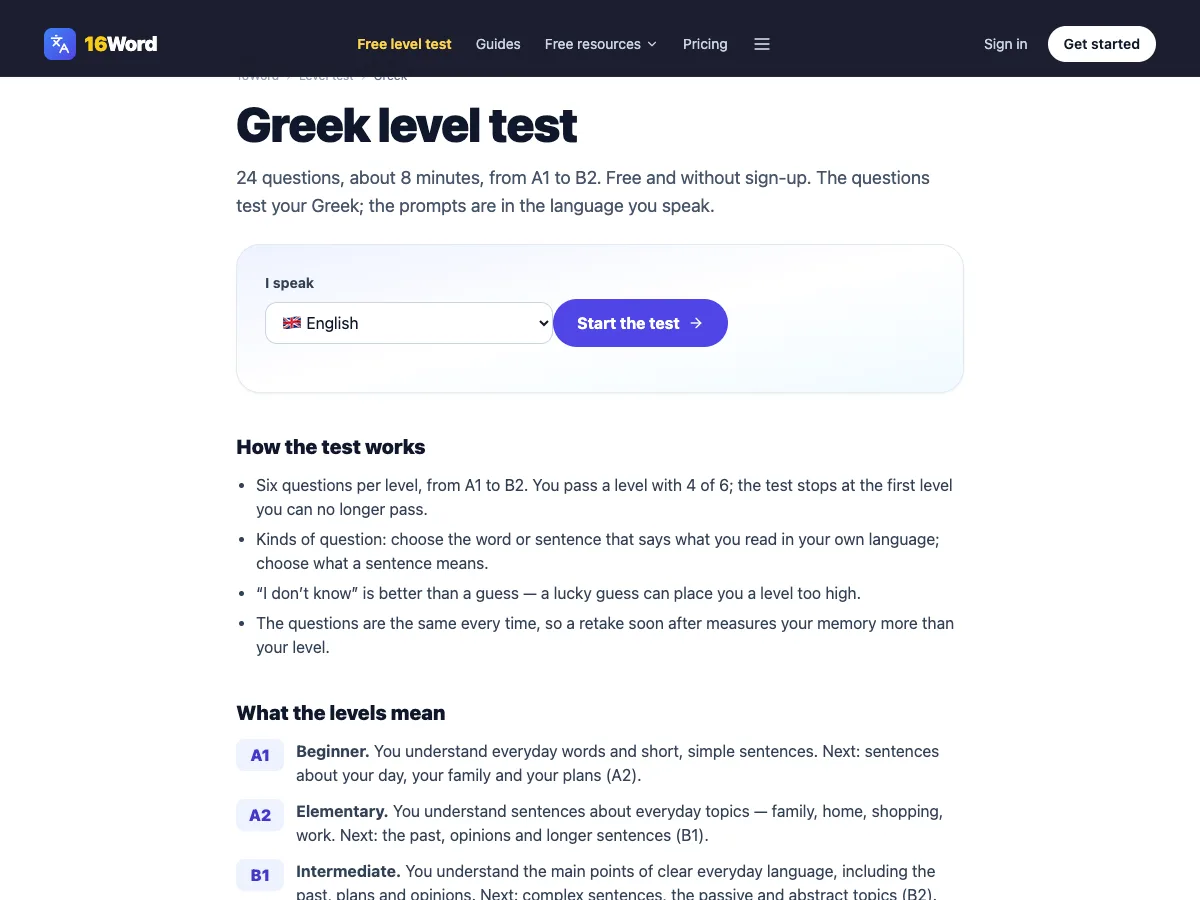
We have no hosted Greek recording we may play here; several of the Wiktionary pages linked above carry their own audio. On 16Word, the free Greek level test shows your level from A1 to B2. If you are thinking further than a holiday — study, work or residence — the Greek Certificate of Attainment path, the certificate explained and how to prepare for it are the next step. For conversation practice with a person, Edluxio offers live 1-to-1 lessons with teachers and professionals in many fields, with a trial lesson and a full refund if it is not right for you.
Keep learning
- The Greek alphabet · free Greek level test
- Travel phrases for your next trip: Italian · Spanish · Portuguese · Turkish · French · German · Dutch · Japanese
- Neighbours: Turkish level test · Italian level test · hello in Italian · English level test
- Another alphabet with Greek roots: the Russian Cyrillic alphabet
- How to memorize vocabulary
- New today: days of the week in Spanish · yalla meaning
- Free level tests in 36 languages · all guides · plans and prices
Greek travel phrases: questions people ask
How do you say hello in Greek?
Γεια σας (geia sas) to strangers or several people, γεια σου (geia sou) to one friend. Both also mean goodbye. In the morning, καλημέρα (kaliméra) works as a greeting too.
How do you say thank you in Greek?
Ευχαριστώ (efcharistó); ευχαριστώ πολύ (efcharistó polý) is "thank you very much". The usual reply is παρακαλώ (parakaló), "you're welcome".
Does nai mean no in Greek?
No — ναι (nai) means yes. "No" is όχι (óchi). It is the classic trap for English speakers.
How do you ask for the bill in Greek?
Μπορώ να έχω τον λογαριασμό; (Boró na écho ton logariasmó?) — "Can I have the bill?" Add παρακαλώ to be extra polite.
What is the emergency number in Greece?
112, the European emergency number, works in Greece. Visit Greece also lists 100 for the police, 166 for ambulances, 199 for the fire service and 1571 for the Tourist Police.
Why do Greek questions end with a semicolon?
Because ";" is the Greek question mark. The Greek semicolon is a raised dot (·), called άνω τελεία.
Was this guide useful?
Official sources
- Wiktionary — γεια σας (Greek)
- Wiktionary — ευχαριστώ (Greek)
- Wiktionary — παρακαλώ (Greek)
- Wiktionary — λογαριασμός (Greek)
- Wiktionary — ; (the Greek question mark)
- Visit Greece (Greek National Tourism Organisation) — Travel tips
- Wiktionary — καλημέρα (Greek)
- Wiktionary — συγγνώμη (Greek)
- Wiktionary — ναι (Greek)
- Wiktionary — όχι (Greek)
- Wiktionary — νερό (Greek)
- Wiktionary — πού (Greek)
- Wiktionary — εισιτήριο (Greek)
- Wiktionary — στάση (Greek)
- Wiktionary — τουαλέτα (Greek)
- Wiktionary — βοήθεια (Greek)
- Edluxio — live 1-to-1 lessons with teachers and professionals
Keep going
- /level-test/greek
- /articles/greek-alphabet
- Czech travel phrases: greetings, tickets, the bill and help
- Luxembourg Airport to the city centre: tram, bus and taxi (free public transport)
- Free public transport in Luxembourg: how it works — and what is not free
- Entering Luxembourg: Schengen, passports, the EES and ETIAS (2026)
- Luxembourg to Paris by train: TGV in about 2h10, fares from €25
- Luxembourg to Brussels and Belgium: hourly trains, €21.30, no booking needed
- Luxembourg to Germany by train: Koblenz, Cologne, Frankfurt, Munich and Berlin
- Luxembourg to Trier and the Moselle: trains in 50 minutes, buses from €3
- All guides