Portuguese travel phrases for Portugal and Brazil
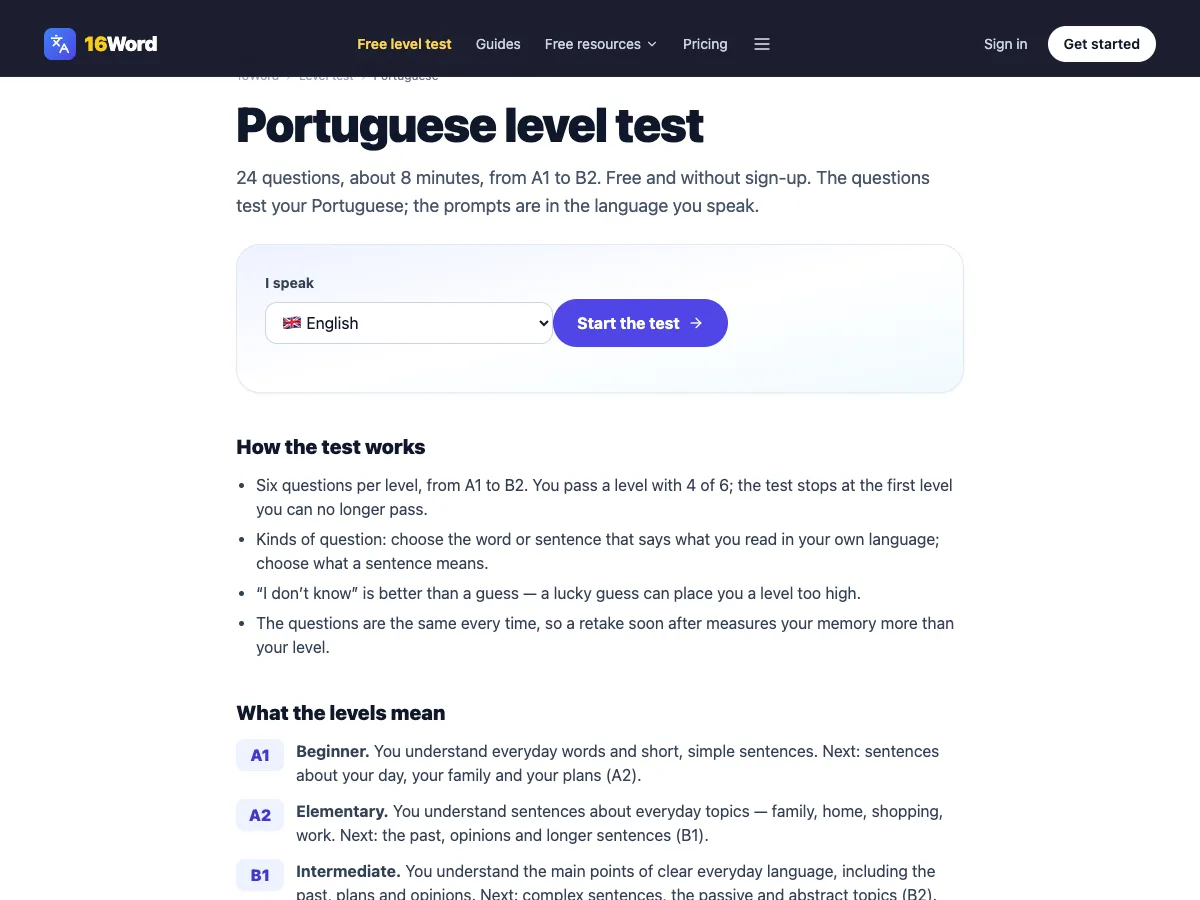
Portuguese travel phrases come with a twist: the language you hear in Lisbon and the one you hear in São Paulo use different everyday words for the train, the bus, breakfast and the toilet. This guide gives you the phrases for getting around, eating out, checking in and asking for help, and marks every word that changes between Portugal and Brazil, so you sound natural on either side of the Atlantic. To see how much Portuguese you already have, take the free Portuguese level test.
Updated · 6 min read
Portuguese travel phrases: the ten you need first
| Portuguese | English |
|---|---|
| Olá · Bom dia · Boa tarde · Boa noite | Hello · Good morning · Good afternoon · Good evening / good night |
| Por favor · Se faz favor | Please |
| Obrigado / Obrigada | Thank you (see below for which one) |
| De nada | You're welcome |
| Com licença | Excuse me (to get attention or to get past) |
| Desculpe | Sorry, excuse me |
| Fala inglês? | Do you speak English? |
| Não percebo. (Portugal) / Não entendo. | I don't understand. |
| Quanto custa? / Quanto é? | How much is it? |
| Tchau · Adeus | Bye · Goodbye |
The single words and their senses come from Wiktionary's Portuguese entries, linked in this guide; the full sentences below are 16Word's model phrases built from them. Wiktionary's example for bom dia is a greeting you will hear constantly: Bom dia, tudo bem? — "Good morning, how are you?" Boa noite is both "good evening" when you arrive and "good night" when you leave.
Obrigado or obrigada?
Obrigado is also an adjective — in formal use "grateful" — and as a thank-you its ending traditionally follows the person speaking: a man says obrigado, a woman obrigada. Wiktionary's usage note on obrigado adds that many women also say obrigado, though this use is often frowned on. The safe rule for visitors: men obrigado, women obrigada. Its own example, Obrigado por tudo, means "Thank you for everything" — a good line for the end of a stay.
Portugal or Brazil? The words that change
It is one language, but the everyday words for transport and meals differ. Wiktionary labels each one by country:
| English | Portugal | Brazil |
|---|---|---|
| train | o comboio | o trem |
| bus | o autocarro | o ônibus |
| bus or tram stop | a paragem | a parada / o ponto |
| underground, metro | o metro | o metrô |
| breakfast | o pequeno-almoço | o café da manhã |
| toilet, bathroom | a casa de banho | o banheiro |
| to understand (everyday) | perceber | entender |
Two false friends. In Brazil, pequeno-almoço is not breakfast but "a light or small lunch". And in Portugal a banheiro is not a bathroom at all — it is a lifeguard. Ask for the casa de banho in Lisbon and the banheiro in Rio.
The rest of this guide gives both forms where they differ. For Portuguese in Brazil and the country's other languages, see our guide What language is spoken in Brazil?
Getting around: tickets, stations and stops
- Um bilhete para Lisboa, por favor. — A ticket to Lisbon, please. (o bilhete = ticket; in Brazil you will also hear a passagem for a travel ticket.)
- Um bilhete de ida e volta, por favor. — A return ticket, please.
- A que horas parte o comboio? (PT) / A que horas sai o trem? (BR) — What time does the train leave?
- De que plataforma? — From which platform? (a plataforma = platform; o cais is used for platforms too)
- Onde é a paragem do autocarro? — Where is the bus stop? (Wiktionary's own example, from Portugal; in Brazil: Onde é o ponto de ônibus?)
- Onde fica a estação? — Where is the station? · o aeroporto — the airport · um táxi — a taxi
The word comboio is used in Portugal and in Portuguese-speaking Africa; in Angola and Mozambique a bus can even be a machimbombo. Wiktionary marks autocarro as Portugal's word for the bus and ônibus as Brazil's — Eu vou de ônibus para a escola, "I take the bus to school".
In a café or restaurant
- Uma mesa para dois, por favor. — A table for two, please.
- Queria uma água, se faz favor. — I'd like a (glass or bottle of) water, please. (Wiktionary's own example.)
- Uma água com gás — sparkling water; sem gás — still.
- A conta, por favor. — The bill, please. (a conta = bill, check)
- Posso pagar com cartão? — Can I pay by card?
A tip is a gorjeta — Wiktionary's example is O Tom deu uma gorjeta ao taxista, "Tom tipped the cab driver". Customs and amounts vary by place, so we give no figure here. In Portugal, multibanco means a cash machine.
At the hotel
- Tenho uma reserva. — I have a booking. (a reserva = booking)
- Tem um quarto para esta noite? — Do you have a room for tonight? (o quarto = room, bedroom)
- A que horas é o pequeno-almoço? (PT) / A que horas é o café da manhã? (BR) — What time is breakfast?
- A chave, por favor. — The key, please.
- Onde é a casa de banho? (PT) / Onde é o banheiro? (BR) — Where is the bathroom?
Directions and help
- à esquerda — on the left · à direita — on the right
- Desculpe, onde fica a farmácia? — Excuse me, where is the pharmacy?
- Pode falar mais devagar? — Could you speak more slowly?
- Socorro! — Help! (a cry for help in danger)
Wiktionary gives a Brazilian example for esquerda: Pega a esquerda que você chega mais rápido — "Take the left and you'll get there faster." On understand: perceber now means "to understand" chiefly in Portugal, so Não percebo sounds natural in Lisbon, while Não entendo works everywhere.
Learn the words before you land
16Word teaches 16 words a day with active recall and spaced repetition, with a short Blocks game between answers. Portuguese is one of 36 languages — free to start.
Hear it and practise
We have no Portuguese recording we are allowed to reuse, so this page has no audio; you can hear and practise Portuguese words in the Portuguese level test. If you want to speak, not just read, a teacher helps: on Edluxio you can book live 1-to-1 lessons with teachers and professionals in many fields, starting with a trial lesson that is fully refunded if it is not the right fit.
Staying longer than a holiday? Our guides to Portuguese nationality and the A2 CIPLE exam and to the CAPLE exams from A1 to C2 explain the official tests, and our CAPLE path takes you there. And one word every visitor ends up asking about: saudade.
Keep learning
- Free Portuguese level test
- Travel phrases in other languages: Spanish, Italian, French, Dutch and Turkish
- Neighbours of Portuguese: free Spanish, Italian and French level tests · ojalá in Spanish
- Speak Portuguese and learning English? English word lists for Portuguese speakers · today's colors in English
- Making it stick: how to memorize vocabulary · today's how to say thank you in Japanese
- All guides · free level tests in 36 languages · plans and prices
- Numbers in Portuguese: 0 to a million, Portugal vs Brazil
Portuguese travel phrases: questions people ask
Is Portuguese in Portugal different from Brazil?
It is the same language, but everyday words differ: train is comboio in Portugal and trem in Brazil, bus is autocarro or ônibus, breakfast pequeno-almoço or café da manhã, toilet casa de banho or banheiro.
How do you say thank you in Portuguese?
Obrigado if you are a man, obrigada if you are a woman. Many women also say obrigado, though this is often frowned on. The answer is de nada, "you're welcome".
How do you ask for the bill in Portuguese?
A conta, por favor — "the bill, please". In Portugal you can also say a conta, se faz favor.
How do you say "I don't understand" in Portuguese?
Não entendo works everywhere. In Portugal you will often hear não percebo, because perceber means "to understand" chiefly there.
How do you say excuse me in Portuguese?
Com licença, to get someone's attention or to get past; desculpe, to say sorry. Both are polite with strangers.
What does multibanco mean in Portugal?
In Portugal, multibanco means a cash machine (ATM).
Was this guide useful?
Official sources
- Wiktionary — obrigado (Portuguese, usage notes)
- Wiktionary — comboio (Portuguese)
- Wiktionary — autocarro (Portuguese)
- Wiktionary — pequeno-almoço (Portuguese)
- Wiktionary — casa de banho (Portuguese)
- Wiktionary — paragem (Portuguese)
- Wiktionary — perceber (Portuguese)
- Wiktionary — gorjeta (Portuguese)
- Edluxio — live 1-to-1 lessons with teachers and professionals
Keep going
- /level-test/portuguese
- /certifications/caple
- German travel phrases: trains, hotels, the bill and help
- Japanese travel phrases: trains, food, hotels and help
- Do they speak English in the Netherlands? Yes — 93% do
- Greek travel phrases: greetings, the bill, tickets and help
- Czech travel phrases: greetings, tickets, the bill and help
- Luxembourg Airport to the city centre: tram, bus and taxi (free public transport)
- Free public transport in Luxembourg: how it works — and what is not free
- Entering Luxembourg: Schengen, passports, the EES and ETIAS (2026)
- All guides