German travel phrases: trains, hotels, the bill and help
You can get around Germany, Austria and Switzerland on a few dozen words — if they are the right ones. This guide gives the German travel phrases for stations, airports, hotels, restaurants, shops and emergencies, with 30 recorded words, der/die/das for every noun and the replies you will hear back. For a full course, see German for Turkish speakers or the German word lists for Arabic speakers.
Updated · 6 min read
German travel phrases: the ten you will use every day
These German travel phrases work in Germany, Austria and German-speaking Switzerland. They are 16Word's own model sentences, built from words checked in Wiktionary; the single words have recordings from Wikimedia Commons, credited at the end. Sie is the polite "you" — use it with anyone you do not know.
| German | English |
|---|---|
| Guten Tag! / Grüß Gott! | Hello! (grüß Gott in southern Germany and Austria) |
| Entschuldigung, sprechen Sie Englisch? | Excuse me, do you speak English? |
| Eine Fahrkarte nach Köln, bitte. | A ticket to Cologne, please. |
| Muss ich umsteigen? | Do I have to change (trains)? |
| Wo ist die Toilette? | Where is the toilet? |
| Ich habe eine Reservierung. | I have a reservation. |
| Die Speisekarte, bitte. | The menu, please. |
| Die Rechnung, bitte. | The bill, please. |
| Kann ich mit Karte zahlen? | Can I pay by card? |
| Danke! Auf Wiedersehen! | Thank you! Goodbye! |
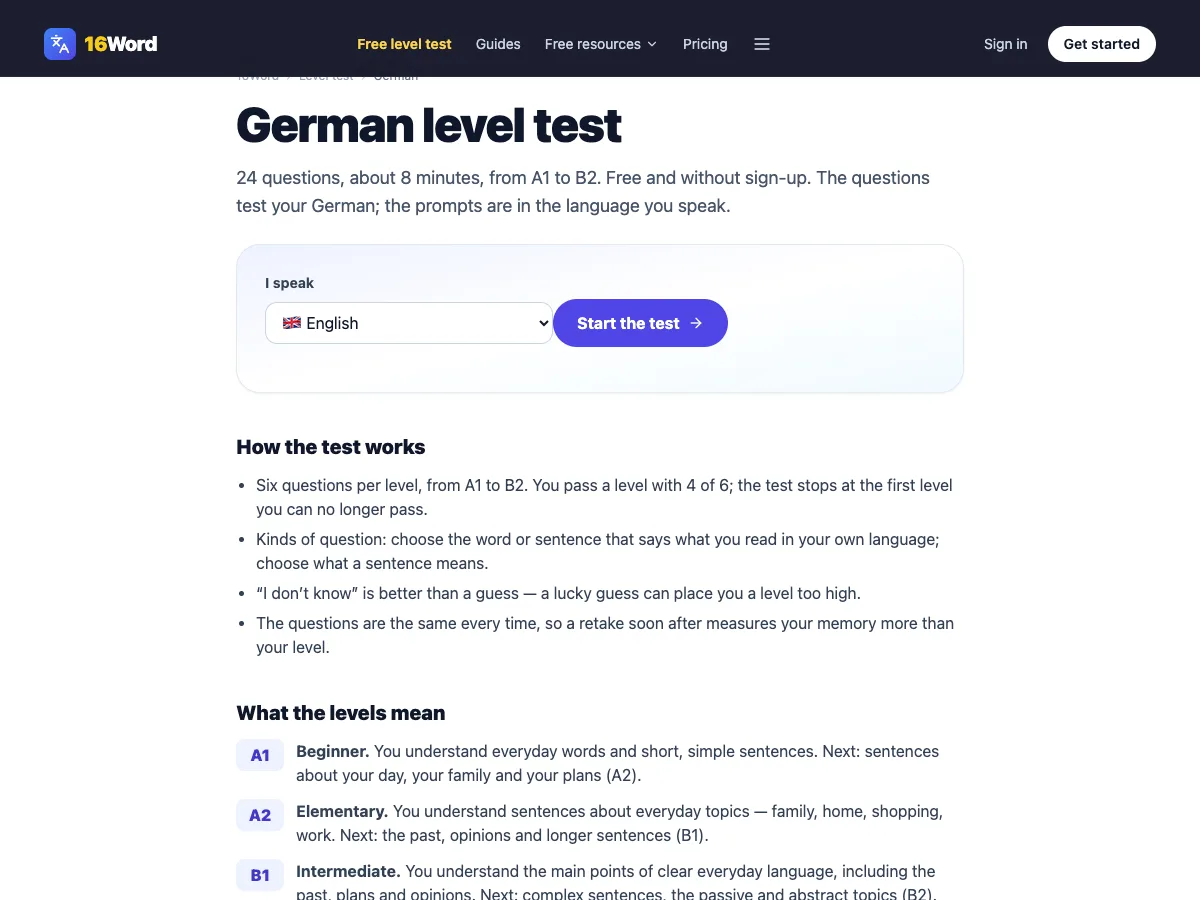
Entschuldigung is both "excuse me" to get attention and "sorry"; Wiktionary notes it is often squeezed to 'tschuldigung in fast speech. Grüß Gott is the everyday "hello" of southern Germany and Austria, where Guten Tag works everywhere. If you are starting from zero, the free German level test shows your level in about 8 minutes, and the easiest way to learn German gives a plan.
At the station: tickets, platforms and changing trains
A ticket is die Fahrkarte (also der Fahrschein, das Ticket; in Switzerland das Billet). The main station is der Hauptbahnhof — on signs and timetables Hbf in Germany and Austria, HB in Switzerland. Your train leaves from das Gleis (the track) at der Bahnsteig (the platform), and the word nobody wants to hear on a board is die Verspätung — delay.
Ticket
Meaning: das Ticket — ticket
Ankunft
Meaning: die Ankunft — arrival (opposite: die Abfahrt, departure)
Bus
Meaning: der Bus — bus
U-Bahn
Meaning: die U-Bahn — underground, metro
Taxi
Meaning: das Taxi — taxi
- Von welchem Gleis fährt der Zug nach München? — Which track does the train to Munich leave from?
- Muss ich umsteigen? — Do I have to change? Umsteigen is changing from one train or bus to another; Wiktionary's example: Am Hauptbahnhof Zürich kann man umsteigen.
- Wo ist die Haltestelle? — Where is the (bus or tram) stop?
- Hat der Zug Verspätung? — Is the train late?
For the whole topic in word-list form: Transportation & Directions for Turkish speakers and for Arabic speakers. Coming from Luxembourg? Luxembourg to Germany by train covers the routes.
At the airport and with your luggage
Flughafen
Meaning: der Flughafen — airport
Flug
Meaning: der Flug — flight
Gepäck
Meaning: das Gepäck — luggage (a collective noun, like English luggage)
Koffer
Meaning: der Koffer — suitcase
Mein Koffer ist nicht angekommen. — My suitcase hasn't arrived. Wo ist der Ausgang? — Where is the exit? The Travel & Tourism list for Turkish speakers and for Arabic speakers have the rest of the airport words.
At the hotel
Hotel
Meaning: das Hotel — hotel
Zimmer
Meaning: das Zimmer — room
Schlüssel
Meaning: der Schlüssel — key
Frühstück
Meaning: das Frühstück — breakfast
Reservierung
Meaning: die Reservierung — reservation, booking
- Ich habe eine Reservierung auf den Namen … — I have a booking in the name of …
- Haben Sie ein Zimmer frei? — Do you have a room free?
- Ab wann gibt es Frühstück? — From what time is breakfast?
- Der Schlüssel funktioniert nicht. — The key doesn't work.
More: Hotel & Hospitality for Turkish speakers and for Arabic speakers, and Home & Household for everything in the room.
At the restaurant: the menu, the bill and the tip
Speisekarte
Meaning: die Speisekarte — menu
Kellner
Meaning: der Kellner — waiter
Wasser
Meaning: das Wasser — water
Kaffee
Meaning: der Kaffee — coffee
Rechnung
Meaning: die Rechnung — bill
Die Speisekarte is the menu. When you are done, ask for die Rechnung — or simply say Zahlen, bitte! ("paying, please"), from zahlen, to pay. A tip is das Trinkgeld: literally "drink money", the small amount given to waiters, hairdressers or taxi drivers. Food words are in our German food vocabulary guide with der/die/das, and in Restaurant & Cuisine for Turkish speakers and Food & Restaurant for Arabic speakers.
Paying and shopping
Bargeld
Meaning: das Bargeld — cash
Kreditkarte
Meaning: die Kreditkarte — credit card
teuer
Meaning: expensive
billig
Meaning: cheap
- Kann ich mit Karte zahlen? — Can I pay by card?
- Nur Bargeld? — Cash only?
- Wie viel kostet das? — How much is it? Wiktionary's example with teuer: Wie teuer ist der Hut? — How much is the hat?
- Das ist zu teuer. — That's too expensive.
- Geschlossen on a door means closed; geöffnet or offen means open.
Numbers and prices: Numbers & Time for Turkish speakers and for Arabic speakers; shops: Shopping & Fashion and Banking & Finance.
Learn 16 German words a day
16Word teaches German with recordings, der/die/das from the first word, spaced repetition and a short Blocks game between answers. Free to start.
Asking the way
Straße
Meaning: die Straße — street
Ecke
Meaning: die Ecke — corner
Museum
Meaning: das Museum — museum
- Wo ist das Museum? — Where is the museum?
- Geradeaus, dann links. — Straight ahead, then left. (rechts is right.)
- An der Ecke. — At the corner.
- Ist es weit? — Is it far?
In an emergency
Toilette
Meaning: die Toilette — toilet (also das WC; informal das Klo)
Polizei
Meaning: die Polizei — police
Notfall
Meaning: der Notfall — emergency
Krankenhaus
Meaning: das Krankenhaus — hospital
- Hilfe! — Help!
- Das ist ein Notfall. — It's an emergency.
- Ich brauche einen Arzt. — I need a doctor.
- Wo ist das nächste Krankenhaus? — Where is the nearest hospital?
Learn these before you need them: Emergency & Safety for Turkish speakers and for Arabic speakers, and Health & Hospital (Arabic speakers).
Every noun above is given with der, die or das — learn the article with the word from day one, or eine Fahrkarte and einen Koffer will never come out right. To practise asking and answering out loud before a trip, Edluxio offers live 1-to-1 lessons with teachers and professionals in many fields, with a trial lesson and a full refund if it is not for you.
Keep learning
- Word lists for Turkish speakers: en sık kullanılan kelimeler, fiiller, günlük isimler, hava durumu — all lists and Almanca.
- For Arabic speakers: common words, common verbs, everyday nouns, weather — all lists.
- German guides: doch meaning, schadenfreude meaning, family members in German and the exams — Goethe-Zertifikat, telc, TestDaF and which German exam to take; paths: Goethe, telc, TestDaF.
- Travelling further? Dutch travel phrases, French, Italian, Spanish, Turkish, Portuguese and Luxembourgish for public transport.
- Also new today: gewoon meaning, animals in English and the Czech alphabet; how to memorize vocabulary and all guides.
- German Christmas market: the words, food and phrases for your visit
Recordings (Wikimedia Commons, MP3 versions): Ticket — Jeuwre, CC BY-SA 4.0; Bus — Kampy, CC BY-SA 3.0; U-Bahn — Jeuwre, CC BY-SA 4.0; Taxi — Pill, CC BY-SA 3.0; Flughafen — Kampy, CC BY-SA 3.0; Flug — Jeuwre, CC BY-SA 4.0; Ankunft — Jeuwre, CC BY-SA 4.0; Gepäck — Jeuwre, CC BY-SA 4.0; Koffer — Jeuwre, CC BY-SA 4.0; Hotel — Kampy, CC BY-SA 3.0; Zimmer — Jeuwre, CC BY-SA 4.0; Schlüssel — Jeuwre, CC BY-SA 4.0; Frühstück — Kampy, CC BY-SA 3.0; Reservierung — Jeuwre, CC BY-SA 4.0; Speisekarte — Jeuwre, CC BY-SA 4.0; Kellner — Balû, CC BY-SA 3.0; Rechnung — Kampy, CC BY-SA 3.0; Wasser — Tosca, CC BY-SA 3.0; Kaffee — Jeuwre, CC BY-SA 4.0; Toilette — Jeuwre, CC BY-SA 4.0; Bargeld — Kampy, CC BY-SA 3.0; Kreditkarte — Jeuwre, CC BY-SA 4.0; teuer — Jeuwre, CC BY-SA 4.0; billig — Jeuwre, CC BY-SA 4.0; Straße — Kampy, CC BY-SA 3.0; Ecke — Jeuwre, CC BY-SA 4.0; Museum — Kampy, CC BY-SA 3.0; Polizei — Jeuwre, CC BY-SA 4.0; Notfall — Jeuwre, CC BY-SA 4.0; Krankenhaus — Kampy, CC BY-SA 3.0.
Questions about German travel phrases
What are the most useful German phrases for travel?
Guten Tag (hello), Entschuldigung (excuse me), Sprechen Sie Englisch? (do you speak English?), Wo ist …? (where is …?), Wie viel kostet das? (how much is it?), Die Rechnung, bitte (the bill, please) and Danke (thank you).
How do you ask for the bill in German?
Say Die Rechnung, bitte or simply Zahlen, bitte. Rechnung is the restaurant bill (and an invoice); zahlen means to pay.
What does Hbf mean in Germany?
Hbf is short for Hauptbahnhof, the main train station. In Switzerland the abbreviation is HB.
How do you say ticket in German?
Die Fahrkarte or der Fahrschein for a train or bus ticket; das Ticket is also common. In Switzerland you will see das Billet.
Is grüß Gott used everywhere in Germany?
No. Wiktionary marks grüß Gott as a greeting of southern Germany and Austria. Guten Tag works everywhere.
Do I need der, die, das for travel German?
You can be understood without them, but learning each noun with its article (die Fahrkarte, der Koffer, das Zimmer) is what makes the rest of the sentence come out right.
Was this guide useful?
Official sources
- Wiktionary — Fahrkarte (German)
- Wiktionary — Hauptbahnhof (German)
- Wiktionary — umsteigen (German)
- Wiktionary — Rechnung (German)
- Wiktionary — Trinkgeld (German)
- Wiktionary — Entschuldigung (German)
- Wiktionary — grüß Gott (German)
- Wikimedia Commons — German pronunciation (recordings, credited per word below)
- Edluxio — live 1-to-1 lessons with teachers and professionals
Keep going
- /level-test/german
- /certifications/goethe
- Japanese travel phrases: trains, food, hotels and help
- Do they speak English in the Netherlands? Yes — 93% do
- Greek travel phrases: greetings, the bill, tickets and help
- Czech travel phrases: greetings, tickets, the bill and help
- Luxembourg Airport to the city centre: tram, bus and taxi (free public transport)
- Free public transport in Luxembourg: how it works — and what is not free
- Entering Luxembourg: Schengen, passports, the EES and ETIAS (2026)
- Luxembourg to Paris by train: TGV in about 2h10, fares from €25
- All guides