The best language app: 9 things to check before you choose
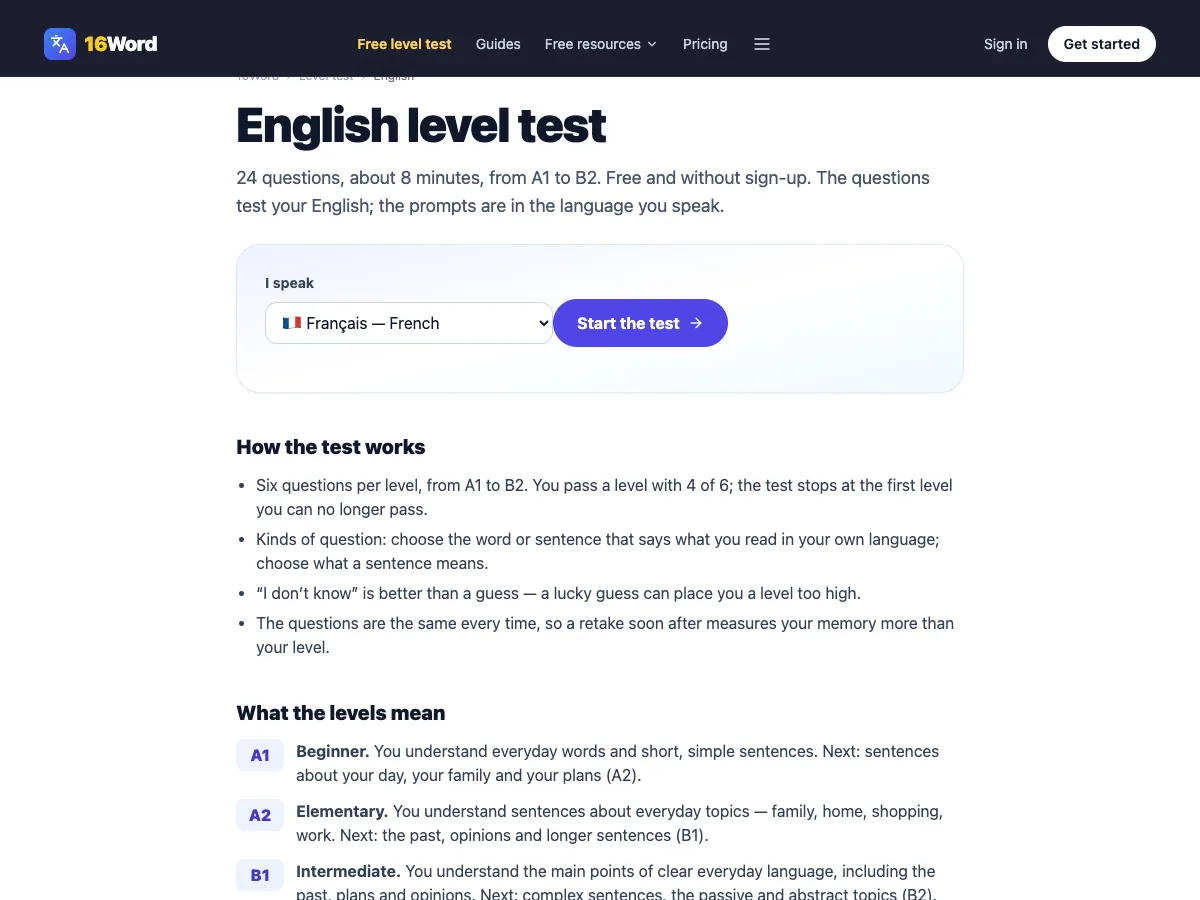
Which is the best language app? The honest answer is not a brand name. It is the app that makes you produce words from memory, brings them back just before you forget them, teaches the language pair you actually need — and that you still open on day 30. This guide gives you nine things to check, a seven-day test you can run on any app, and the part of learning that no app can do for you. Not sure where you start? Take a free level test first: there is one for each of our 36 languages.
Updated · 6 min read
The best language app, in one sentence
Choose the app that tests you, spaces your reviews over days and fits a habit you will keep — after checking that it teaches your language pair at your level. We don't rank other companies' apps here: what decides whether an app works is how it makes you learn, and you can check that yourself in a week.
9 things to check in a language app
- It makes you recall, not just recognise. Typing or saying the word from its meaning is harder than tapping it among four options — and that is why it works. In a study in Science (Karpicke & Roediger, 2008), testing yourself again after learning had a large effect on recall a week later; studying the same words again had none.
- It spaces your reviews. A review of 317 experiments (Cepeda et al., 2006) found that practice spread over time beats the same practice crammed together. A good app does the timing for you; our guide on how to memorize vocabulary explains the research.
- It teaches your pair, not only from English. If you speak Turkish, Arabic or Persian, meanings and hints in English are one more thing to translate in your head. Check the "I speak" list. On 16Word you choose both sides among 36 languages — for example English for Arabic speakers, English for Turkish speakers or German for Turkish speakers.
- You can hear every word — and you know whose voice it is. Recordings by people and synthetic voices both help, but a good app says which is which.
- It places you on the CEFR scale. A1 to C2 is how schools, employers and exams describe a level (Council of Europe). An app that starts with a level test doesn't waste your first week on words you know.
- Short sessions you can keep. Five to ten minutes you never skip beat an hour you skip (our advice, from watching learners: the ones who stop rarely stop because a session was too short).
- Words you will actually meet. Look for topics that match your life — work, travel, an exam. For Luxembourgish and Dutch you can browse ours openly: Luxembourgish vocabulary by topic, Dutch vocabulary by topic, verb tables.
- It works where you are. Phone, computer, a train without signal. If you mostly study at a desk, read the best language software for a computer.
- You can try it before you pay. A real free start, a clear price page and an easy way to cancel. If the price only appears after you sign up, that tells you something.
A 7-day test you can run on any language app
| Day | What to do | The app passes if… |
|---|---|---|
| 1 | Take its placement or level test | you start at your level, not at "hello" if you already know it |
| 2 | Learn 10–16 new words | you had to type or say them at least once |
| 3 | Open it again | yesterday's words come back first, before new ones |
| 4 | Get three words wrong on purpose | those three return sooner than the rest |
| 5 | Use it on a second device | your progress is there |
| 6 | Skip a day | nothing punishes you; the reviews simply wait |
| 7 | Write down the meanings of 20 words from day 2 and recall them without the app | you get most of them — this is the only result that counts |
Day 7 is the real test. In the Science study, students' predictions of how much they would remember had nothing to do with how much they did remember. Trust what you can recall, not how the app feels.
What the best app does — and what no app can do
An app is excellent at the daily part: new words, reviews at the right time, sound, a record of what you know. It is weak at the human part — a conversation where someone asks you a question you didn't expect, corrects your pronunciation and makes you try again. Plan for both. On Edluxio you can book live 1-to-1 lessons with teachers and professionals in many fields; you start with a trial lesson, with a full refund if it is not right for you.
Which language app for which goal
| Your goal | What to look for | Where to start on 16Word |
|---|---|---|
| Citizenship or integration exam | the exam's own level, everyday topics, official sample papers | Sproochentest · inburgering · citizenship exams by country |
| University abroad | academic vocabulary, the exam your university asks for | IELTS · TOEFL · DELF · Goethe · HSK · JLPT |
| Work and visas | job words, emails, meetings | exams for work and visas · Dutch workplace words |
| Travel | phrases with audio, what you will hear back | Dutch · French · Spanish · Italian travel phrases |
| A new alphabet | a script trainer before any vocabulary | Korean alphabet · Arabic alphabet |
Where 16Word fits — and where it doesn't
We built 16Word for the daily part. Each session is 16 words in about five minutes: you type or say each word from its meaning, small typos are forgiven, missed words come back sooner, and a short game of Blocks sits between answers so the session doesn't feel like homework. It runs in 36 languages, in the browser and as an app, and it is free to start. What it is not: a conversation partner, or a full grammar course — for grammar, read our Luxembourgish and Dutch grammar guides or the English grammar basics.
Try 16 words today
Pick the language you speak and the one you want, and do your first 16 words in about five minutes.
Pick your language: a free level test in each
- Western Europe: English, French, German, Spanish, Italian, Portuguese, Dutch, Luxembourgish
- Northern and Eastern Europe: Swedish, Finnish, Icelandic, Polish, Czech, Romanian, Lithuanian, Greek, Russian, Ukrainian, Serbian, Georgian
- Middle East and South Asia: Arabic, Turkish, Persian, Hebrew, Azerbaijani, Kurdish (Kurmanji), Kurdish (Sorani), Pashto, Urdu, Hindi
- East Asia and Africa: Chinese, Japanese, Korean, Somali, Tigrinya — and Latin
Keep learning
- The best language learning platform: apps, courses or live teachers?
- The best vocabulary builder: 8 features that make words stick
- The best way to learn a language: a plan from zero to B1
- The easiest way to memorize vocabulary
- For Luxembourgish and Dutch in particular: best apps to learn Luxembourgish and best apps to learn Dutch
Questions about language apps
What is the best language app?
The one that makes you recall words rather than recognise them, reviews them over days, teaches your language pair at your level and fits a habit you keep. Run the seven-day test above on any app you consider: what you can recall on day 7 without the app is the only result that counts.
Can you become fluent with a language app alone?
An app can build the vocabulary and listening you need, but fluent speaking needs conversations with people who answer back and correct you. Combine a daily app with regular speaking practice — a teacher, a tutor or a language exchange.
How long should I use a language app each day?
Long enough to keep the habit: five to fifteen minutes a day works better than an hour once a week, because spaced reviews only work if you come back. 16Word sessions take about five minutes for 16 words.
Are free language apps good enough?
Many are a good start. Check what the free part really includes, whether you can see the price before signing up and whether your progress stays yours if you stop paying. 16Word is free to start; the plans page lists what the paid plans add.
Which language app is best for beginners?
One that starts with a short level test, teaches the most useful words first and lets you hear each one. If your language has its own alphabet — Korean, Arabic, Russian, Greek — learn the letters first; our alphabet guides help.
Is multiple choice a bad way to learn words?
It is fine for a first look, but it trains recognition. To use a word you have to produce it, so the best apps make you type or say the answer at least some of the time.
Was this guide useful?
Official sources
Keep going
- /level-test
- /
- The best language learning platform: apps, courses or live teachers?
- The best language software for learning on a computer
- The best vocabulary builder: 8 features that make words stick
- The best way to learn a language: a plan from zero to B1
- The easiest way to learn a language (without burning out)
- The easiest way to memorize vocabulary: 5 minutes, no willpower
- How to memorize vocabulary: 7 methods that research supports
- The best way to learn Chinese: tones, pinyin, then characters
- All guides