The Korean alphabet: all 24 Hangul letters, sounds and romanization
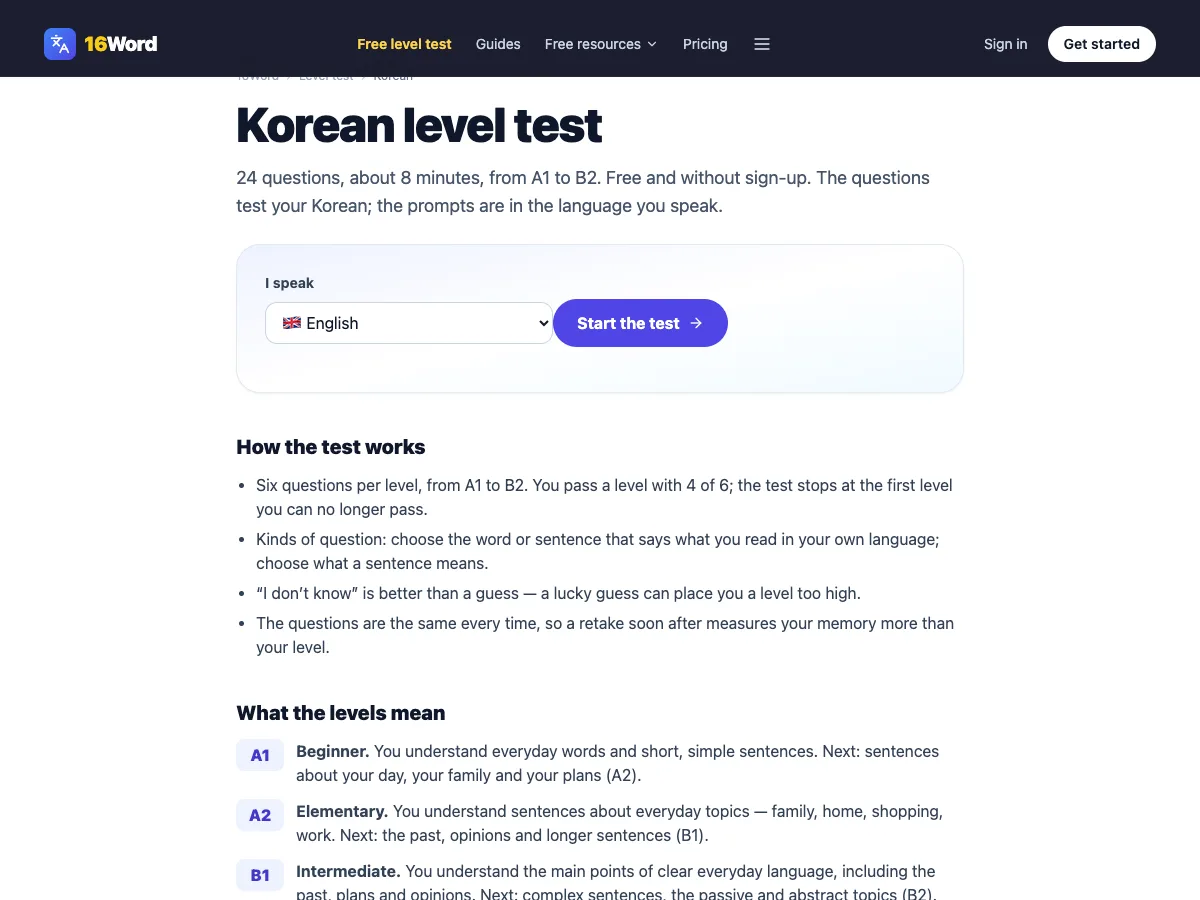
The Korean alphabet, Hangul (한글), has 24 basic letters: 14 consonants and 10 vowels. That is the official count in the Korean orthography rules of the National Institute of Korean Language. Add five doubled consonants and eleven combined vowels and you can read every syllable of modern Korean. This guide lists them all with their names and official romanization, shows how letters stack into syllable blocks, and gives a few words to read on day one. When you can read, test yourself with the free Korean level test.
Updated · 6 min read
How many letters are in the Korean alphabet?
Article 4 of the Korean orthography (한글 맞춤법), published by the National Institute of Korean Language (NIKL), says the alphabet has 24 letters: 14 consonants and 10 vowels. It then lists combined letters — five doubled consonants and eleven vowels made of two or three basic vowels — which are used all the time but are not counted among the 24.
The 14 consonants
| Letter | Name | Romanization | Sounds like |
|---|---|---|---|
| ㄱ | 기역 giyeok | g / k | g in go; k at the end of a syllable |
| ㄴ | 니은 nieun | n | n |
| ㄷ | 디귿 digeut | d / t | d; t at the end |
| ㄹ | 리을 rieul | r / l | between r and l |
| ㅁ | 미음 mieum | m | m |
| ㅂ | 비읍 bieup | b / p | b; p at the end |
| ㅅ | 시옷 siot | s | s |
| ㅇ | 이응 ieung | ng (silent at the start) | ng in sing |
| ㅈ | 지읒 jieut | j | j |
| ㅊ | 치읓 chieut | ch | ch, with a puff of air |
| ㅋ | 키읔 kieuk | k | k, with a puff of air |
| ㅌ | 티읕 tieut | t | t, with a puff of air |
| ㅍ | 피읖 pieup | p | p, with a puff of air |
| ㅎ | 히읗 hieut | h | h |
The names are NIKL's, in dictionary order. The orthography's commentary explains that they go back to Choe Sejin's Hunmong jahoe of 1527, and that ㄱ, ㄷ and ㅅ keep the irregular names 기역, 디귿 and 시옷 by tradition. The romanization column follows the official Revised Romanization of Korean; the "sounds like" column is our simple guide for English speakers.
The 10 vowels
| Letter | Romanization | Sounds like |
|---|---|---|
| ㅏ | a | a in father |
| ㅑ | ya | ya in yard |
| ㅓ | eo | o in hot (British), lips open |
| ㅕ | yeo | y + eo |
| ㅗ | o | o, lips rounded |
| ㅛ | yo | yo in yogurt |
| ㅜ | u | oo in food |
| ㅠ | yu | you |
| ㅡ | eu | like oo with the lips spread, not rounded |
| ㅣ | i | ee in see |
A pattern that helps: one short stroke is a plain vowel (ㅏ a, ㅓ eo, ㅗ o, ㅜ u); two short strokes add a y (ㅑ ya, ㅕ yeo, ㅛ yo, ㅠ yu). Learn four shapes, get eight vowels.
Doubled consonants and combined vowels
The five doubled consonants are ㄲ (kk), ㄸ (tt), ㅃ (pp), ㅆ (ss) and ㅉ (jj) — tense versions, said with no puff of air. NIKL calls them 쌍기역, 쌍디귿, 쌍비읍, 쌍시옷 and 쌍지읒 (ssang = "double").
| Combined vowel | Romanization | Combined vowel | Romanization |
|---|---|---|---|
| ㅐ | ae | ㅘ | wa |
| ㅒ | yae | ㅙ | wae |
| ㅔ | e | ㅚ | oe |
| ㅖ | ye | ㅝ | wo |
| ㅢ | ui | ㅞ | we |
| ㅟ | wi |
ㅙ and ㅞ are the two made from three letters. The romanization rules note that ㅢ is written ui even where it is pronounced like ㅣ, and that long vowels are not marked.
How Hangul letters make syllable blocks
Korean is written in blocks, one per syllable: a consonant, then a vowel, sometimes a final consonant underneath. Vertical vowels (ㅏ ㅓ ㅣ) sit to the right of the first consonant; horizontal ones (ㅗ ㅜ ㅡ) sit below it. A syllable that starts with a vowel sound begins with the silent ㅇ.
- ㅎ + ㅏ + ㄴ = 한 han; ㄱ + ㅡ + ㄹ = 글 geul → 한글 Hangeul, "Hangul"
- ㅇ + ㅏ = 아 a (the ㅇ is silent at the start)
- ㅅ + ㅓ + ㅇ = 성 seong (here ㅇ at the bottom is ng)
- ㅁ + ㅜ + ㄹ = 물 mul (ㄹ at the end is l)
Romanization rules worth knowing
The official system is "based on standard Korean pronunciation", so some letters change with their position. ㄱ, ㄷ, ㅂ are written g, d, b before a vowel and k, t, p before a consonant or at the end of a word. ㄹ is r before a vowel and l before a consonant or at the end; ㄹㄹ is ll. So 한글 is Hangeul (ㄹ at the end), but 하루 would be haru (ㄹ before a vowel).
Who created Hangul, and when?
NIKL's page on the origin of Hangeul cites a royal record from the end of December 1443 saying that King Sejong had invented 28 letters. A record from the end of September 1446 says Hunminjeongeum was completed; NIKL reads it as the completion of the explanatory manuscript and notes that there is no record of an official promulgation ceremony. South Korea celebrates Hangeul Day on 9 October.
Learn Korean words 16 at a time
Active recall, spaced repetition and a short Blocks game between answers. Free to start.
From the alphabet to TOPIK
Reading Hangul comes first; building vocabulary takes longer. If you are aiming for the official Korean test, see TOPIK levels explained, our TOPIK preparation plan and the TOPIK path. For pronunciation — the difference between ㄱ, ㅋ and ㄲ is hard to hear alone — a teacher helps: Edluxio offers live 1-to-1 lessons with teachers and professionals in many fields, with a trial lesson and a full refund if it is not right for you.
There is no Korean recording we may republish here, so this guide has no audio buttons; you can hear Korean in the free Korean level test.
Keep learning
- Other scripts, letter by letter: Georgian · Russian Cyrillic · Hebrew · Arabic · Devanagari · Tigrinya (Ge'ez)
- Latin alphabets with extra letters: Azerbaijani · Romanian
- Japanese next door: why learn Japanese · a short history of Japanese · Japanese grammar basics · Japanese on 16Word · Japanese level test
- Chinese on 16Word · Chinese level test
- How to memorize vocabulary
- All guides
The Korean alphabet: questions people ask
How many letters does the Korean alphabet have?
24 basic letters — 14 consonants and 10 vowels — according to Article 4 of the official Korean orthography. With the 5 doubled consonants and 11 combined vowels, you use 40 letter shapes in all.
Is Hangul an alphabet or characters?
An alphabet: each letter stands for a sound. The letters are grouped into square syllable blocks, which is why Korean text can look like Chinese characters at first glance.
How long does it take to learn Hangul?
Not long compared with the rest of the language: there are only 24 basic letters, and the blocks follow fixed rules. Understanding what you read — vocabulary and grammar — is the longer part.
Why is ㄹ written r in some words and l in others?
The Revised Romanization writes ㄹ as r before a vowel and l before a consonant or at the end of a word, and ㄹㄹ as ll.
Who invented the Korean alphabet?
King Sejong. A royal record of December 1443 says he invented 28 letters; the official orthography today counts 24 basic ones. Hangeul Day is 9 October in South Korea.
What is the dictionary order of Hangul?
Consonants: ㄱ ㄲ ㄴ ㄷ ㄸ ㄹ ㅁ ㅂ ㅃ ㅅ ㅆ ㅇ ㅈ ㅉ ㅊ ㅋ ㅌ ㅍ ㅎ. Vowels: ㅏ ㅐ ㅑ ㅒ ㅓ ㅔ ㅕ ㅖ ㅗ ㅘ ㅙ ㅚ ㅛ ㅜ ㅝ ㅞ ㅟ ㅠ ㅡ ㅢ ㅣ.
Was this guide useful?
Official sources
Keep going
- /level-test/korean
- /certifications/topik
- Luxembourgish personal pronouns: ech, du, hien, hatt, si, mir, dir — with audio
- How to conjugate Luxembourgish verbs in the present tense
- Luxembourgish irregular verbs: sinn, hunn, goen, kommen and the modals
- Luxembourgish word order: verb second, verb last and separable verbs
- The Luxembourgish n-rule (Eifeler Regel) explained with examples
- Negation in Luxembourgish: net, keen, keng, näischt, ni and dach
- How to ask questions in Luxembourgish: wat, wien, wéini, wou, wéi, firwat
- The Luxembourgish past tense: perfect with hunn or sinn, and war and hat
- All guides