A short history of English: from Old English to a world language
English began as the speech of a few Germanic tribes who crossed the North Sea some 1,500 years ago. Six moments shaped the language you are learning — and they explain why English grammar is light while its spelling is so hard. Every date here is from Britannica or the institution concerned.
Updated · 6 min read
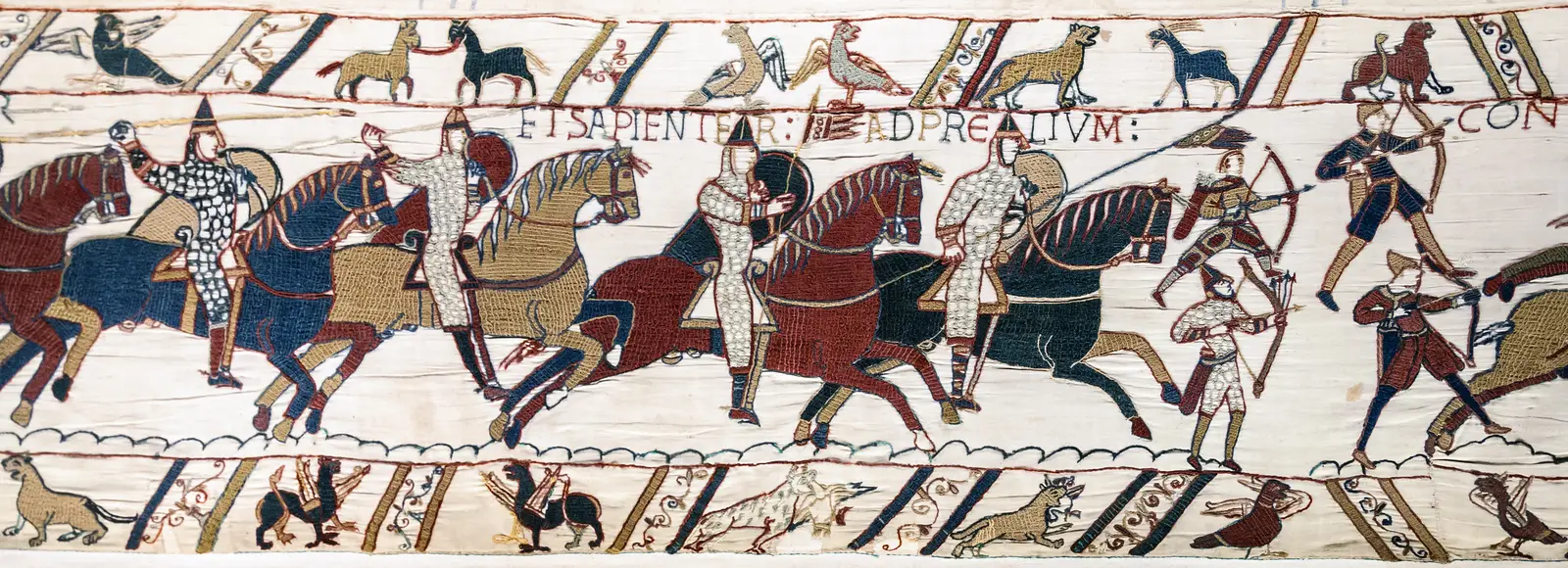
Where English comes from
English is a West Germanic language of the Indo-European family; its closest relatives are Frisian, German and Dutch (Britannica). Its story in Britain starts in the 5th and 6th centuries, when Jutes, Saxons and Angles — from Jutland, Schleswig and Holstein — settled there. The historian Bede dates the first landing of Jutes, at Ebbsfleet, to 449.
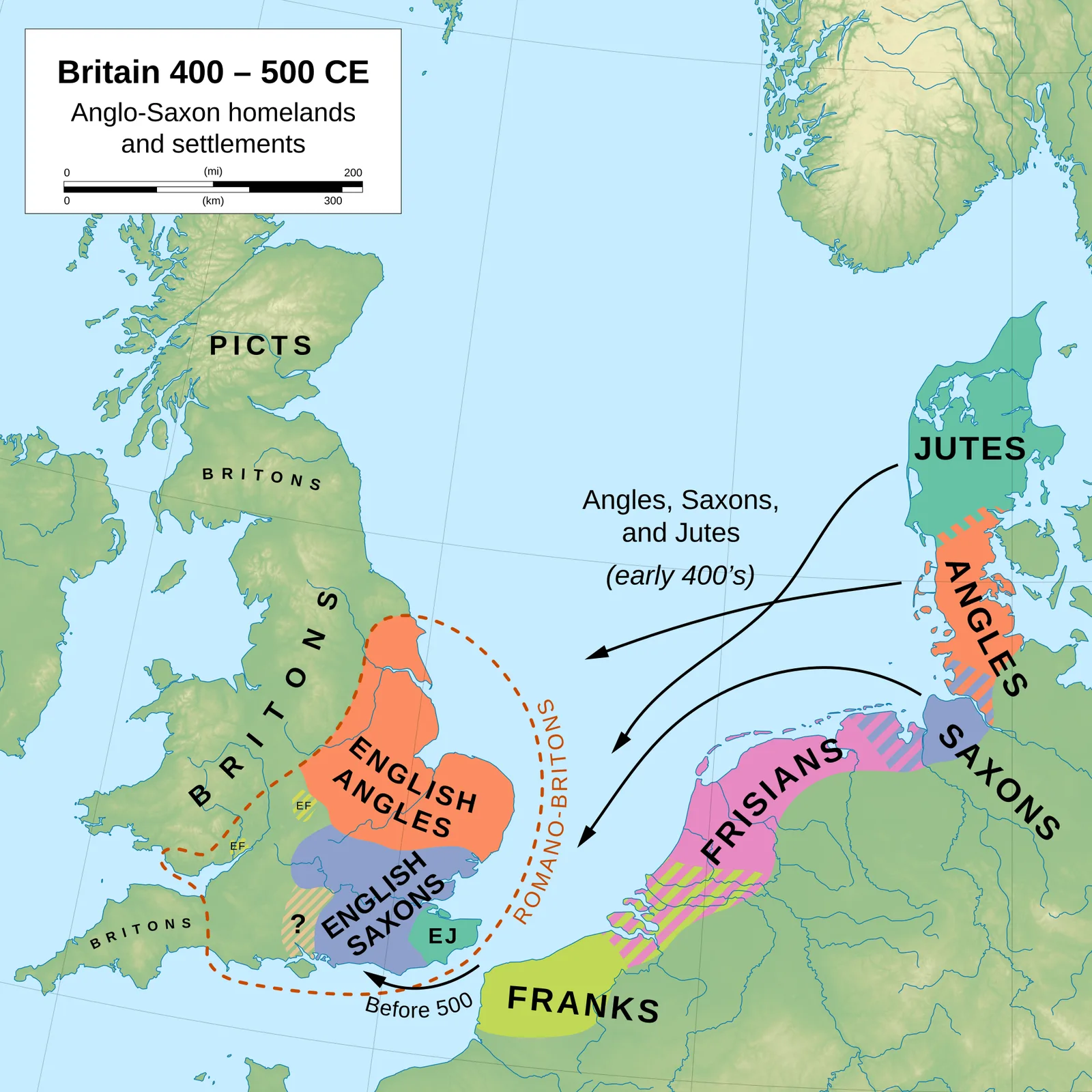
The language is named after the Angles. Their Latin name Angli became Engle in Old English; Engla land — the land of the Angles — became England, and King Alfred called the language Englisc (Britannica).
Old English (5th–11th centuries): endings everywhere
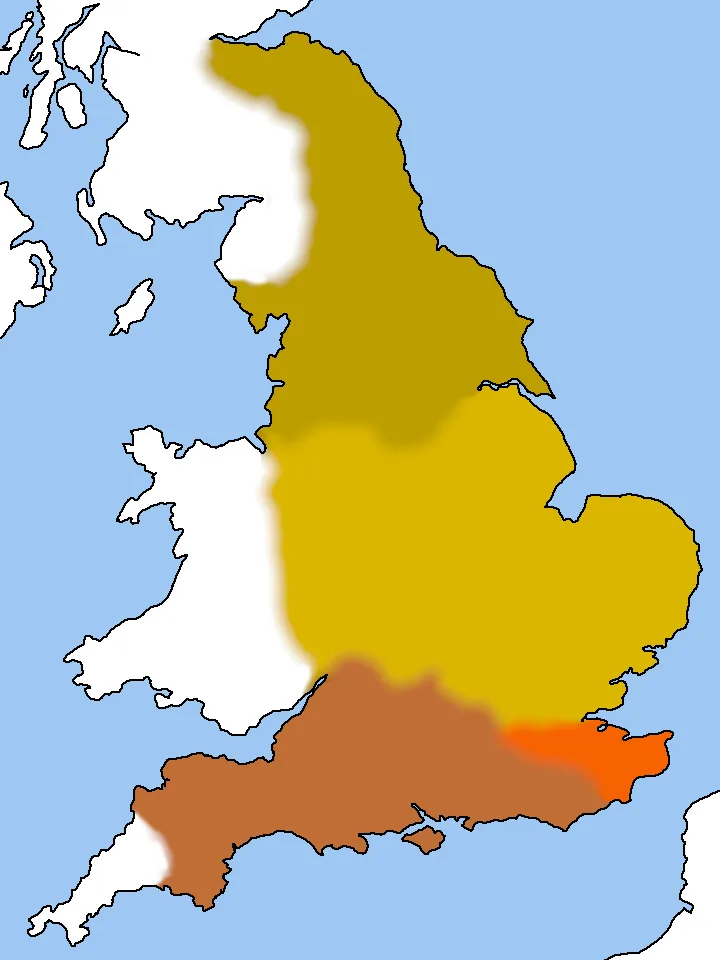
Old English had four main dialects — Northumbrian, Mercian, West Saxon and Kentish. Under King Alfred, at Winchester, West Saxon became “standard Old English”: even the poetry of the north was copied into it. It used two letters we have lost, þ (thorn) and ð (eth), for the sound th.
It was a very different language. Nouns had four cases and a grammatical gender — sunne (sun) was feminine, mōna (moon) masculine. Verbs had only two tenses, present-future and past (compare the tenses of English today). The verb ridan (to ride) had 13 forms; today’s ride has five (Britannica). Many everyday words are still recognisable:
| Old English | Modern English |
|---|---|
| iċ, wē | I, we |
| mōdor, dohtor | mother, daughter |
| hūs | house |
| cwēn | queen |
| sċip | ship |
| miht | might |
The Vikings: they, them, sky and egg
Viking raiders sacked Lindisfarne in 793 and landed in strength in 865; Danes and Norwegians settled across the north. Their language was so close to English that many words were the same in both (father, mother, come, see). From Scandinavian, English took even the pronouns they, their and them, and words such as sky, egg, knife, window, skill, happy, ugly, weak, wrong, call, die and want (Britannica).
1066: the Normans bring French
After the Norman Conquest of 1066, French became the speech of England’s new aristocracy, and for three centuries the literature of England was written in three languages — English, French and Latin (Britannica). French gave English its words for government (parliament, president, constitution), titles (duke, baron), cooking (boil, fry, grill, roast, toast) and many formal pairs:
| From Old English | From French |
|---|---|
| freedom | liberty |
| friendship | amity |
| truth | veracity |
| town, house, home | city, palace, mansion |
| king, queen, lord, lady | duke, marquis, baron |
| breakfast | dinner, supper |
English came back in stages. The Statute of Pleading of 1362 required court proceedings to be held in English, and Geoffrey Chaucer, who died in 1400, chose English for his own writing although he also read Latin and spoke French and Italian.
1476: printing — and why the spelling stopped matching the sounds
In 1476 William Caxton set up the first printing press in England, near Westminster Abbey; he published about a hundred books (Westminster Abbey). Printing slowly fixed the spelling — but the long vowels of London English were moving at the same time. This Great Vowel Shift is why English still writes many words the way they sounded around Chaucer’s time (Britannica):
| Chaucer wrote | and said | Today we write | and say |
|---|---|---|---|
| lyf | /li:f/ | life | /laif/ |
| hous | /hu:s/ | house | /haus/ |
| mone | /mo:nə/ | moon | /mu:n/ |
| name | /na:mə/ | name | /neim/ |
Early Modern English: Latin, Greek and the Bible
Between about 1500 and 1660, scholars borrowed freely from Latin and Greek — sometimes a second time, which gave English pairs like frail and fragile, poor and pauper, and even the triplet real, royal, regal. William Tyndale translated the New Testament in 1525; a third of the King James Bible of 1611 keeps his wording. Science switched language too: Isaac Newton wrote his Principia (1687) in Latin but his Opticks (1704) in English (Britannica).
Dictionaries fix the words
Since Samuel Johnson’s Dictionary of the English Language (1755), spelling has stayed fairly stable. In America, Noah Webster published his Spelling Book in 1783 and his American Dictionary in 1828; some of his simplified spellings caught on in the United States (Britannica). The Oxford English Dictionary was proposed in 1857, published its first part (A–ant) in 1884 and its last in April 1928 — ten volumes, over 250,000 main entries. Today it defines more than 500,000 words (OED).
A world language — and a great borrower
English reached North America and South Africa in the 17th century and India, Australia and New Zealand in the 18th; today about 1.5 billion people speak it — see Where is English spoken?. Its vocabulary shows the journey: about a quarter is Germanic and two-thirds come from Latin and the Romance languages, with borrowings from more than 300 other languages (Britannica). If you speak Arabic or Turkish, you already know a few of the words below — our English word lists with meanings in Arabic and in Turkish start from there.
| From | Words English borrowed |
|---|---|
| Arabic | algebra, alcohol, sugar, syrup, zero |
| Turkish | coffee, kiosk, caviar, turban |
| Persian | bazaar, caravan, chess, paradise |
| Spanish | mosquito, tornado, vanilla, canyon (and potato and tomato, via Spanish) |
| Portuguese | marmalade, flamingo, molasses, veranda |
| Hindi | shampoo, jungle, pajamas, guru |
| Dutch | boss, cookie, yacht, skipper |
| Italian | piazza, corridor, stanza, allegro |
What this history means for you: English lost most of its endings, so its grammar is light — see English grammar basics. The two tenses of Old English grew into the forms in English tenses explained. And the spelling froze before the sounds stopped moving, so learn each new word with its pronunciation.
Learn English words with their sound
16Word gives you 16 words a day with audio, active recall and spaced repetition, and a short Blocks game between answers — about five minutes, free to start.
Keep learning
- Why learn English? 7 reasons
- Where is English spoken? — countries, speakers, official status
- English grammar basics · English tenses explained
- Free English level test — A1 to B2, no sign-up
- English words by topic with meanings: for Turkish speakers · for Arabic speakers
- Level tests in 36 languages · All 16Word guides · Plans and prices
Frequently asked questions
How old is the English language?
It goes back to the Angles, Saxons and Jutes who settled in Britain in the 5th and 6th centuries. Old English lasted until after the Norman Conquest of 1066; scholars place Early Modern English between about 1500 and 1660.
Where does the word “English” come from?
From the Angles. Their Latin name Angli became Engle in Old English, Engla land (the land of the Angles) became England, and the language was called Englisc.
Why is English spelling so irregular?
Most spellings were fixed around the 15th century, while the Great Vowel Shift was changing the long vowels of London English. Words such as life, house and moon kept spellings that matched their older sounds.
Which languages influenced English most?
The base is Old English; Scandinavian gave everyday words and even they, their and them; French, after 1066, gave words of government, law and cooking; Latin and Greek gave learned words. About two-thirds of English vocabulary comes from Latin and the Romance languages.
When was the Oxford English Dictionary finished?
Its last part was published in April 1928, 71 years after the project was proposed in 1857. The first edition had ten volumes and over 250,000 main entries; today the OED defines more than 500,000 words.
Did Old English have a future tense?
No. Old English verbs had two tenses, present-future and past. Modern English still has no future tense form: it uses will, be going to or the present.
Was this guide useful?
Official sources
Keep going
- Free English level test — A1 to B2, no sign-up
- Where is English spoken? Countries, speakers and official status
- A short history of French: from Latin to the Académie française
- Where is French spoken? Countries, speakers and official status
- A short history of Chinese: from oracle bones to pinyin
- Where is Chinese spoken? Mandarin, the dialect groups and a map
- A short history of Japanese: from the Kojiki to kana and kanji
- Where is Japanese spoken? Dialects, the Ryukyuan languages and a map
- Endangered languages: why they disappear, how they come back, and what 16Word is building
- All guides