Goethe A1 vocabulary: the 650-word list, its themes and how to learn
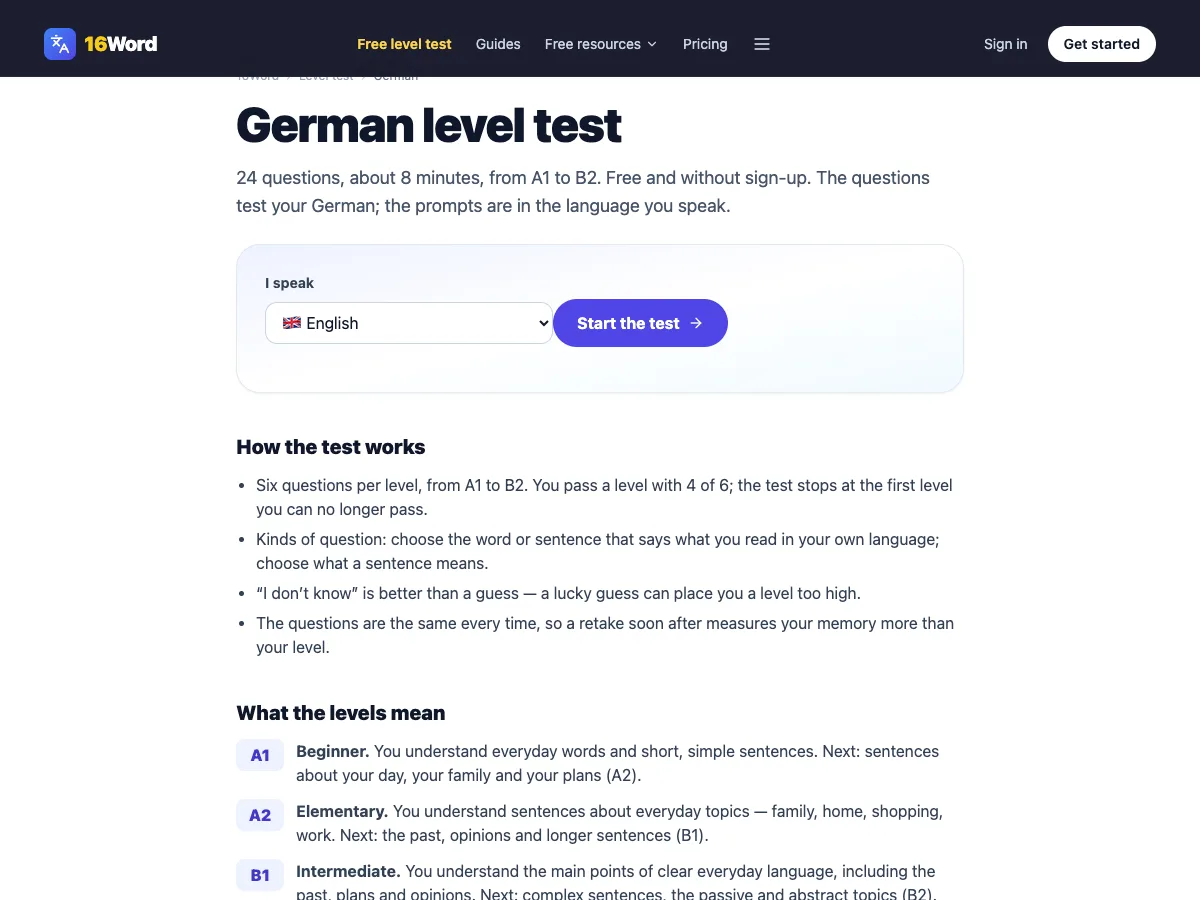
Goethe A1 vocabulary is set out in an official document: the Goethe-Zertifikat A1: Start Deutsch 1 Wortliste, published by the Goethe-Institut. It lists the themes, word groups and words that learners at the first level of German should know — about 650 entries, each with example sentences. This guide explains what is in the list, how it is organised, which half you need to use actively, and how to learn it without just reading a PDF. Not sure if you are at A1 yet? Our free German level test takes a few minutes.
Updated · 8 min read
What the Goethe A1 vocabulary list is
The word list belongs to the exam Start Deutsch 1, which, the Goethe-Institut writes, is recognised by German missions abroad and immigration authorities as proof of German for spousal reunification (Ehegattennachzug). The exam page calls it "a German exam for adults" confirming level A1 of the Common European Framework — the first of six levels.
The key sentence for learners: all the words should be understood passively, when you meet them in spoken or written texts, and about half of these roughly 650 words should be at your disposal actively — words you can say and write yourself.
Wort
Literally: word
lernen
Literally: to learn
Prüfung
Literally: exam
How the list is organised
The Wortliste has three parts:
- Themes (Themen) — the topics A1 covers.
- 13 word groups (Wortgruppenliste) — frequent groups such as numbers, days of the week and months.
- An alphabetical list — every word with one or more example sentences, including set phrases newcomers meet at once, such as Auf Wiedersehen and Guten Appetit.
Some entries are indented under a main word because you can work them out: das Ausland, der Ausländer, ausländisch; danken, der Dank, danke. These are not counted in the 650. Female forms are usually not listed but are part of the vocabulary — next to der Lehrer you are expected to know die Lehrerin. Compound nouns appear only when they mean something new: Kindergarten is in, Kinderbett is not.
The A1 themes
| Theme | What it includes |
|---|---|
| Person | name, address, telephone, date and place of birth, age, family, nationality, appearance, daily routine |
| Wohnen (living) | flat, rooms, furniture, household, rent, moving |
| Umwelt (environment) | plants, animals, climate and weather |
| Reisen/Verkehr (travel) | private and public transport, travel, accommodation, luggage |
| Essen/Trinken (food and drink) | food, meals, dishes, drinks, restaurants and cafés |
| Einkaufen (shopping) | shops, prices and paying, groceries, clothes |
| Dienstleistungen (services) | post, telecommunications, banks, police |
| Lernen (education) | childcare, school, learning languages |
| Arbeit/Beruf (work) | workplace, holidays |
| Freizeit (free time) | interests, sport, radio and TV, internet, reading |
For each theme, 16Word has German word lists in Turkish and Arabic — for example family (Turkish, Arabic), home (Turkish, Arabic), food (Turkish, Arabic), transport (Turkish, Arabic), shopping (Turkish, Arabic), health (Turkish, Arabic), school (Turkish, Arabic), work (Turkish, Arabic) and weather (Turkish, Arabic).
Adresse
Literally: address
Arbeit
Literally: work
Bad
Literally: bathroom
The 13 word groups: numbers, days, colours…
Before the alphabetical list, the Wortliste gathers the words you need in groups. Among them:
- Numbers — eins to eine Milliarde, and the ordinals der/die/das erste, zweite, dritte; years such as 1999 = neunzehnhundertneunundneunzig.
- Clock time — the official 7.15 Uhr = sieben Uhr fünfzehn and the everyday Viertel vor/nach, halb drei.
- Days of the week — Montag to Samstag/Sonnabend, and das Wochenende.
- Times of day — der Morgen, Vormittag, Mittag, Nachmittag, Abend, die Nacht.
- Months and seasons — Januar to Dezember; Frühling/Frühjahr, Sommer, Herbst, Winter.
- Money, measures and weights — 1 Euro = 100 Cent; ein Pfund = 500 g; ein Liter, ein Kilo.
- Countries and nationalities — for example Türkei, Türke/Türkin, türkisch.
- Colours — schwarz, weiß, grau, rot, blau, gelb, grün, braun; and the points of the compass.
eins
Literally: one
drei
Literally: three
zehn
Literally: ten
Uhr
Literally: o'clock; clock
Stunde
Literally: hour
Minute
Literally: minute
Tag
Literally: day
Woche
Literally: week
Wochenende
Literally: weekend
Monat
Literally: month
Abend
Literally: evening
Nacht
Literally: night
Sommer
Literally: summer
schwarz
Literally: black
weiß
Literally: white
rot
Literally: red
blau
Literally: blue
grün
Literally: green
gelb
Literally: yellow
Norden
Literally: north
Süden
Literally: south
Our German numbers and time list (in Turkish; also in Arabic) and the colours list (Turkish) cover these groups word by word.
Example entries from the alphabetical list
Each word comes with real sentences. A few, exactly as the Goethe-Institut prints them:
| Word | Example in the Wortliste | English |
|---|---|---|
| alt | Wie alt sind Sie? | How old are you? |
| der Apfel | Ein Pfund Äpfel bitte. | A pound of apples, please. |
| der Appetit | Guten Appetit! | Enjoy your meal! |
| arbeiten | Wo arbeiten Sie? | Where do you work? |
| die Arbeit | Mein Bruder sucht Arbeit. | My brother is looking for work. |
| die Adresse | Können Sie mir seine Adresse sagen? | Can you tell me his address? |
| auf | Wie heißt das auf Deutsch? | What is that called in German? |
| ausfüllen | Füllen Sie bitte dieses Formular aus. | Please fill in this form. |
| der Ausgang | Wo ist der Ausgang? | Where is the exit? |
| baden | Ich bade nicht so gern, ich dusche lieber. | I don't like baths much, I prefer a shower. |
alt
Literally: old
Apfel
Literally: apple
Appetit
Literally: appetite (Guten Appetit!)
Formular
Literally: form
Wie heißt das auf Deutsch? may be the most useful sentence in the whole list. The list even includes words for the exam itself — Antwortbogen (answer sheet), ankreuzen (to tick), ergänzen (to complete), zuordnen (to match) — and the Goethe-Institut says it chose words for everyday communication in four areas (private life, work, education, public life), not by how often native speakers use them.
Frage
Literally: question
Antwort
Literally: answer
How Goethe A1 vocabulary is used in the exam
The exam page lists four parts, conducted and graded the same way worldwide:
| Part | Time | What you do |
|---|---|---|
| Listening | 20 minutes | short everyday conversations, telephone messages, announcements |
| Reading | 25 minutes | short notes, classified ads, signs and notices |
| Writing | 20 minutes | fill in simple forms and write a short personal text |
| Speaking | 15 minutes | a group exam: introduce yourself, ask and answer everyday questions, ask someone for something |
hören
Literally: to listen, to hear
lesen
Literally: to read
schreiben
Literally: to write
sprechen
Literally: to speak
That is 80 minutes in all. The Goethe-Institut recommends the exam from age 16 and estimates 80 to 200 lessons of 45 minutes to reach A1, depending on what you already know. For the rest — registration, results and certificates — see our Goethe-Zertifikat guide, the Goethe path, and how it compares with telc and TestDaF in which German exam do you need?.
How to learn the A1 word list
The Goethe-Institut is honest about its own document: the list is meant as information and reference, and it is "less suited" to practising and consolidating vocabulary — for that it recommends a course and teaching material. In practice that means:
- Learn in themes, not alphabetically. Start with Person and the word groups — you need them in the writing part's forms and the speaking part's introductions.
- Learn each noun with its article and plural, as the list prints them: die Adresse, -n.
- Test yourself instead of re-reading. Active recall and spaced repetition — explained in how to memorize vocabulary — move words from "I recognise it" to "I can say it".
- Aim for the active half. About half of the 650 should be words you can produce; the rest you only need to understand.
Learn the 16 German words you need today
Turn the A1 list into words you can actually use. 16Word gives you 16 words a day with active recall, spaced repetition and a short Blocks game between answers. Free to start.
If you want to rehearse introducing yourself and asking questions with a person, Edluxio has live 1-to-1 lessons with teachers and professionals in many fields, with a trial lesson and a full refund if it is not right for you.
Keep learning German
- The A1 exam in other languages: Almanca A1 sınavı and eş birleşimi A1 (Turkish), امتحان الألمانية A1 and لمّ الشمل A1 (Arabic)
- German word lists: for Turkish speakers — most common words, verbs, adjectives, everyday nouns, travel; for Arabic speakers — common words, verbs, adjectives, everyday nouns, travel
- Family members in German, German food vocabulary and German travel phrases
- Doch meaning, Feierabend meaning and the German Christmas market
- The easiest way to learn German, German for Turkish speakers and the German level test in Turkish or in Arabic
- Also new today: days of the week in Luxembourgish and what is Thanksgiving?
- All guides
Recordings (Wikimedia Commons, MP3 versions): Wort — User:Tosca, CC BY-SA 3.0; lernen — Kampy, CC BY-SA 3.0; hören — Kampy, CC BY-SA 3.0; lesen — Kampy, CC BY-SA 3.0; schreiben — Jeuwre, CC BY-SA 4.0; sprechen — Kampy, CC BY-SA 3.0; Prüfung — Jeuwre, CC BY-SA 4.0; Frage — Jeuwre, CC BY-SA 4.0; Antwort — Kampy, CC BY-SA 3.0; Formular — Alexandra Poelzlbauers, Vion Nicolas, CC BY 2.0 fr; Adresse — Jeuwre, CC BY-SA 4.0; Arbeit — Jeuwre, CC BY-SA 4.0; Apfel — Kampy, CC BY-SA 3.0; Appetit — Jeuwre, CC BY-SA 4.0; Bad — Jeuwre, CC BY-SA 4.0; alt — Oceancetaceen Alice Chodura, CC BY-SA 3.0; Woche — Kampy, CC BY-SA 3.0; Tag — Kampy, CC BY-SA 3.0; Monat — Kampy, CC BY-SA 3.0; Wochenende — Jeuwre, CC BY-SA 4.0; Abend — Arnim Faryn, CC BY-SA 3.0; Nacht — Kampy, CC BY-SA 3.0; Uhr — Kampy, CC BY-SA 3.0; Stunde — Kampy, CC BY-SA 3.0; Minute — Kampy, CC BY-SA 3.0; eins — Jeuwre, CC BY-SA 4.0; drei — joni, CC BY-SA 3.0; zehn — Jeuwre, CC BY-SA 4.0; schwarz — User:Tosca, CC BY-SA 3.0; weiß — Jeuwre, CC BY-SA 4.0; rot — Bleibein, CC BY-SA 3.0; blau — Kampy, CC BY-SA 3.0; grün — Kampy, CC BY-SA 3.0; gelb — Kampy, CC BY-SA 3.0; Sommer — Jeuwre, CC BY-SA 4.0; Norden — Kampy, CC BY-SA 3.0; Süden — Kampy, CC BY-SA 3.0.
Goethe A1 vocabulary: questions people ask
How many words do you need for Goethe A1?
The official Start Deutsch 1 word list has about 650 entries. All of them should be understood, and about half should be words you can use yourself.
Where can I find the official Goethe A1 word list?
The Goethe-Institut publishes it as a PDF, "Goethe-Zertifikat A1: Start Deutsch 1 — Wortliste". It is linked in the sources of this guide.
What topics are in the Goethe A1 vocabulary?
Person, living, environment, travel and transport, food and drink, shopping, services, education, work and free time — plus 13 word groups such as numbers, days, months, colours and countries.
Is the word list enough to pass Goethe A1?
It shows the level, but the Goethe-Institut itself says the list is less suited to practising vocabulary and recommends a course and teaching material. You also need listening, reading, writing and speaking practice.
How long does it take to learn A1 German vocabulary?
The Goethe-Institut estimates 80 to 200 lessons of 45 minutes to reach A1, depending on your previous knowledge. Learning a little every day with spaced repetition helps the words stay.
Is Start Deutsch 1 accepted for a spouse visa?
The Goethe-Institut says the exam is recognised by German missions abroad and immigration authorities as proof of German for spousal reunification. Check the current rules for your own case with the German mission.
Was this guide useful?
Official sources
Keep going
- /certifications/goethe
- Free German level test — A1 to B2, no sign-up
- Goethe-Zertifikat explained: levels A1 to C2 and how to prepare
- TestDaF explained: TDN 3 to 5 and studying in Germany
- telc Deutsch explained: exams, skills and how to prepare
- Goethe, TestDaF or telc: which German exam should you take?
- The Dutch inburgering exam in 2026: routes, parts, fees and FAQ
- Sproochentest speaking (A2): topics, picture description and how to prepare
- Sproochentest listening (B1): the three recordings and how to practise
- A 60-day Sproochentest preparation plan, week by week
- All guides