A short history of Japanese: from the Kojiki to kana and kanji
Japanese has written records going back to the 8th century, and its grammar has stayed remarkably stable ever since — a modern reader with some training can still enjoy poetry from the 700s. Seven moments shaped the language you will learn, and they explain why it uses three scripts at once. The facts come from Britannica and Japan’s Agency for Cultural Affairs.
Updated · 4 min read
1. Japonic: a small family of its own
Japanese and the Ryukyuan languages — Amami, Okinawan, Miyako, Yaeyama and Yonaguni — and possibly Hachijō form the Japonic language family. Most linguists believe Japonic emerged in Japan during the Yayoi period (about 300 BCE–250 CE). Links to Korean, to the so-called Altaic languages or to Austronesian have all been proposed, and none has won wide agreement (Britannica). The map of today’s dialects is in Where is Japanese spoken?
2. Chinese writing arrives
Some Chinese words probably reached Japan in the 1st century CE or earlier, but the systematic introduction came about 400 CE, when Korean scholars brought Chinese books to Japan (Britannica). Japan had no writing of its own, so it adopted the characters — the same script whose story is told in A short history of Chinese.
3. The Kojiki and the Man’yōshū
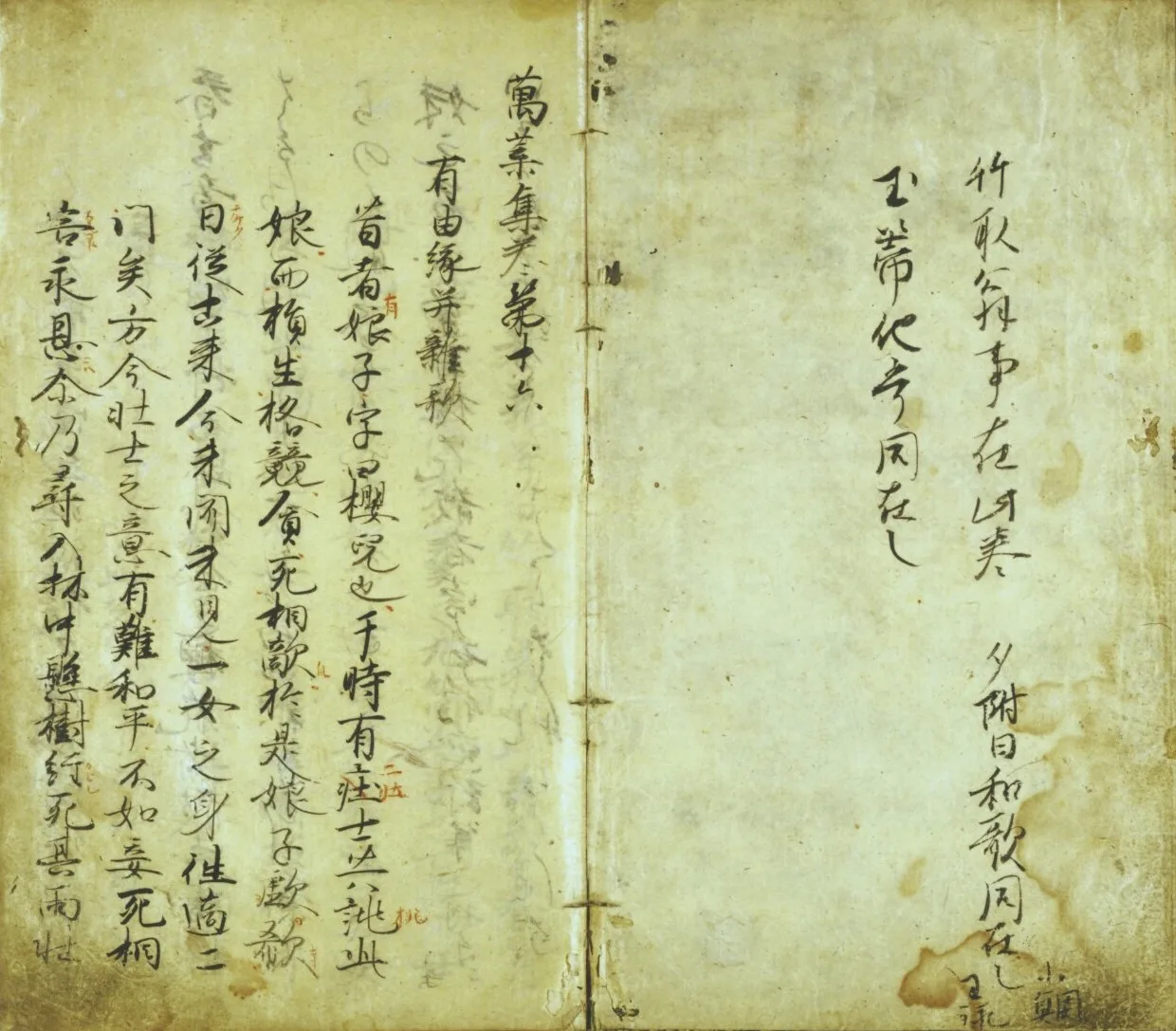
Written records of Japanese date from the 8th century; the oldest is the Kojiki (712), whose preface is written in Chinese characters with classical Chinese grammar. Within about 50 years, by the time of the Man’yōshū — the anthology of Japanese verse compiled after 759, shown at the top of this page — scribes used the sounds of characters to write Japanese words: yama ‘mountain’ as one character read ya and one read ma. This use is called man’yō-gana (Britannica).
4. Kana: two scripts born from characters
Two syllabic scripts grew out of man’yō-gana. Katakana, angular, came from abbreviated characters; hiragana, rounded, from simplified cursive writing. Kana were taken up by women writers, and Murasaki Shikibu’s 11th-century Tale of Genji — considered by many Japan’s greatest literary work — is written almost entirely in hiragana (Britannica).
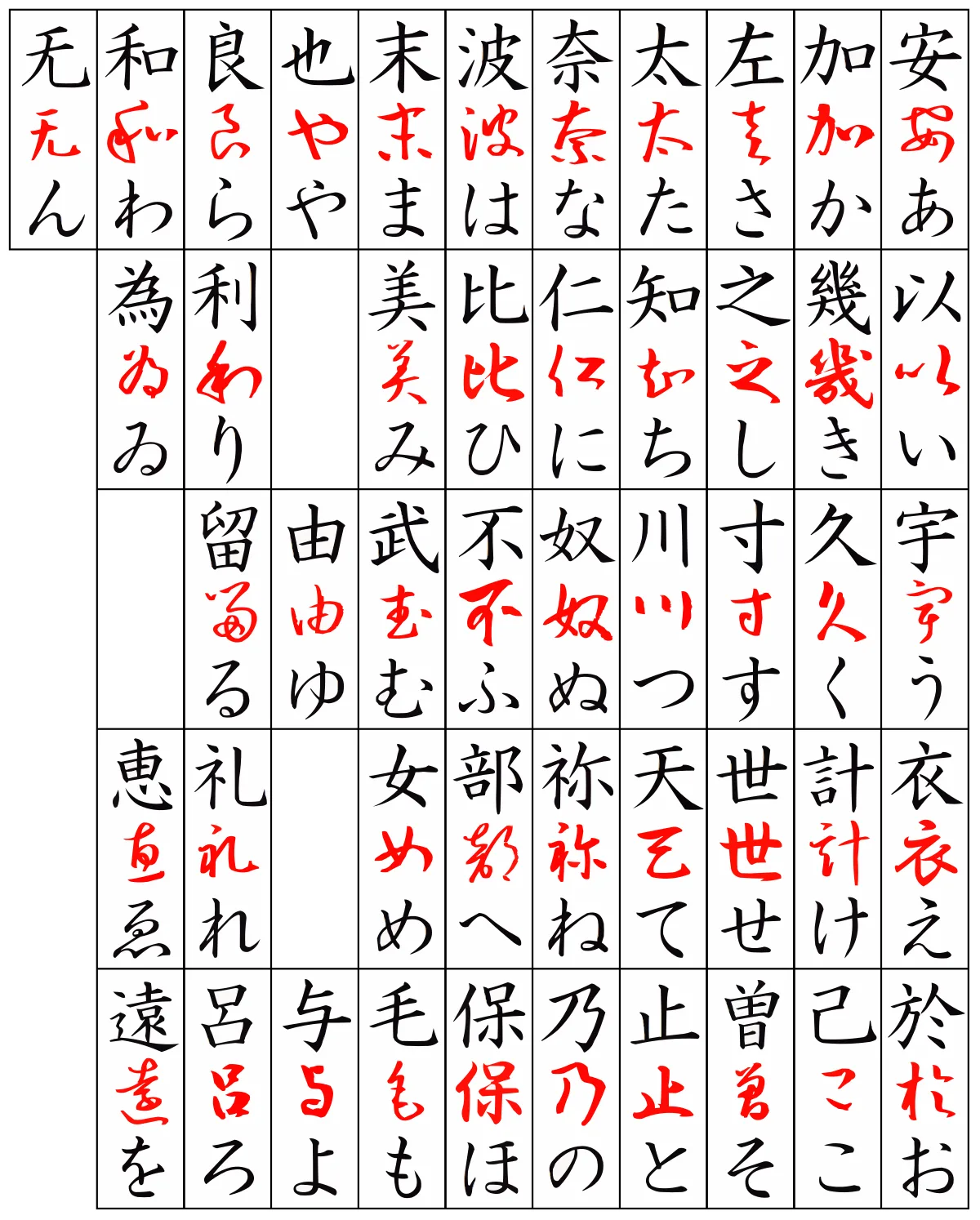
Kana also gave every character two readings: the Sino-Japanese on-yomi and the native kun-yomi — 山 ‘mountain’ is san in one and yama in the other (Britannica). Today kanji write content words, hiragana write particles and endings, and katakana write mostly foreign loanwords — see how they work together in Japanese grammar basics.
5. Old, Middle and Modern Japanese
The 1,200 years of written Japanese are usually split into Old Japanese (to the 8th century), Late Old Japanese (9th–11th), Middle Japanese (12th–16th), Early Modern Japanese (17th–18th) and Modern Japanese (from the 19th century). One change was the shift of p to h: Okinawan still says pi ‘fire’ and pana ‘flower’ where Tokyo says hi and hana (Britannica).
6. Words from Portugal, the Netherlands and English
Sixteenth-century Portuguese, Spanish and Dutch missionaries and traders left words still in daily use: pan ‘bread’ (Portuguese pão), tabako, tenpura (Portuguese tempero) and biiru ‘beer’ (Dutch bier). Today slightly more than 80% of Japan’s foreign loanwords come from English, and slightly more than half of all its vocabulary is Sino-Japanese (Britannica) — more reasons in Why learn Japanese?
7. One standard and a list of kanji
A standard written language came with compulsory education, which began in 1886, and the national kyōtsū-go ‘common language’ is based on the Tokyo dialect (Britannica). The government limited the kanji in common use: 1,850 characters in 1946, 1,945 in the 1981 Jōyō kanji list (Britannica), and since a cabinet notice of 30 November 2010 the list has 2,136 characters (Agency for Cultural Affairs). They are best learned in small daily steps — 16 words a day.
| Date | Event |
|---|---|
| c. 300 BCE–250 CE | Japonic emerges in Japan (Yayoi period), most linguists believe |
| c. 400 CE | Chinese books introduced systematically by Korean scholars |
| 712 | Kojiki, the oldest written record of Japanese |
| after 759 | Man’yōshū compiled; man’yō-gana |
| c. 1010 | The Tale of Genji, almost entirely in hiragana |
| 16th century | Portuguese and Dutch loanwords: pan, tenpura, biiru |
| 1886 | Compulsory education spreads a standard written language |
| 1946 / 1981 / 2010 | Official kanji lists: 1,850 / 1,945 / 2,136 characters |
What this history means for you: learn hiragana and katakana first, then kanji with the words that use them, each with its reading. Start at your level with the free Japanese level test; the verb system is in Japanese tenses explained.
Learn Japanese words with their sound
16Word gives you 16 words a day with audio, active recall, spaced repetition and a short Blocks game between answers — about five minutes, free to start.
Keep learning
- Why learn Japanese? 7 reasons
- Where is Japanese spoken? — dialects and the Ryukyuan languages on a map
- Japanese grammar basics · Japanese tenses explained
- Why learn Chinese? · Learn Chinese · Level tests · All guides · Plans
Frequently asked questions
How old is written Japanese?
Written records date from the 8th century; the oldest is the Kojiki, from 712.
Where do hiragana and katakana come from?
Both grew out of man’yō-gana, Chinese characters used for their sounds. Katakana came from abbreviated characters, hiragana from simplified cursive writing.
Is Japanese related to Chinese?
Not by family: Japanese belongs to the Japonic family. It borrowed Chinese writing and many words — slightly more than half of its vocabulary is Sino-Japanese.
How many kanji are in everyday use?
Japan’s official list of characters for general use, from 30 November 2010, has 2,136 kanji.
Why does Japanese have Portuguese words?
Portuguese, Spanish and Dutch missionaries and traders came in the 16th century; words such as pan (bread) and tenpura date from that time.
Was this guide useful?
Official sources
Keep going
- Free Japanese level test — A1 to B2, no sign-up
- Learn Japanese 16 words a day
- Where is Japanese spoken? Dialects, the Ryukyuan languages and a map
- Endangered languages: why they disappear, how they come back, and what 16Word is building
- Is Latin a dead language? Where Latin lives today — and how to learn it
- Luxembourgish: how a small language keeps growing
- Is Luxembourgish a language or a German dialect? History, law and the differences
- What language is spoken in Luxembourg? Luxembourgish, French and German explained
- Luxembourgish vs Dutch: how close are they?
- Ons Heemecht: Luxembourg’s national anthem — words, translation and history
- All guides