French grammar basics: the 8 rules that matter most
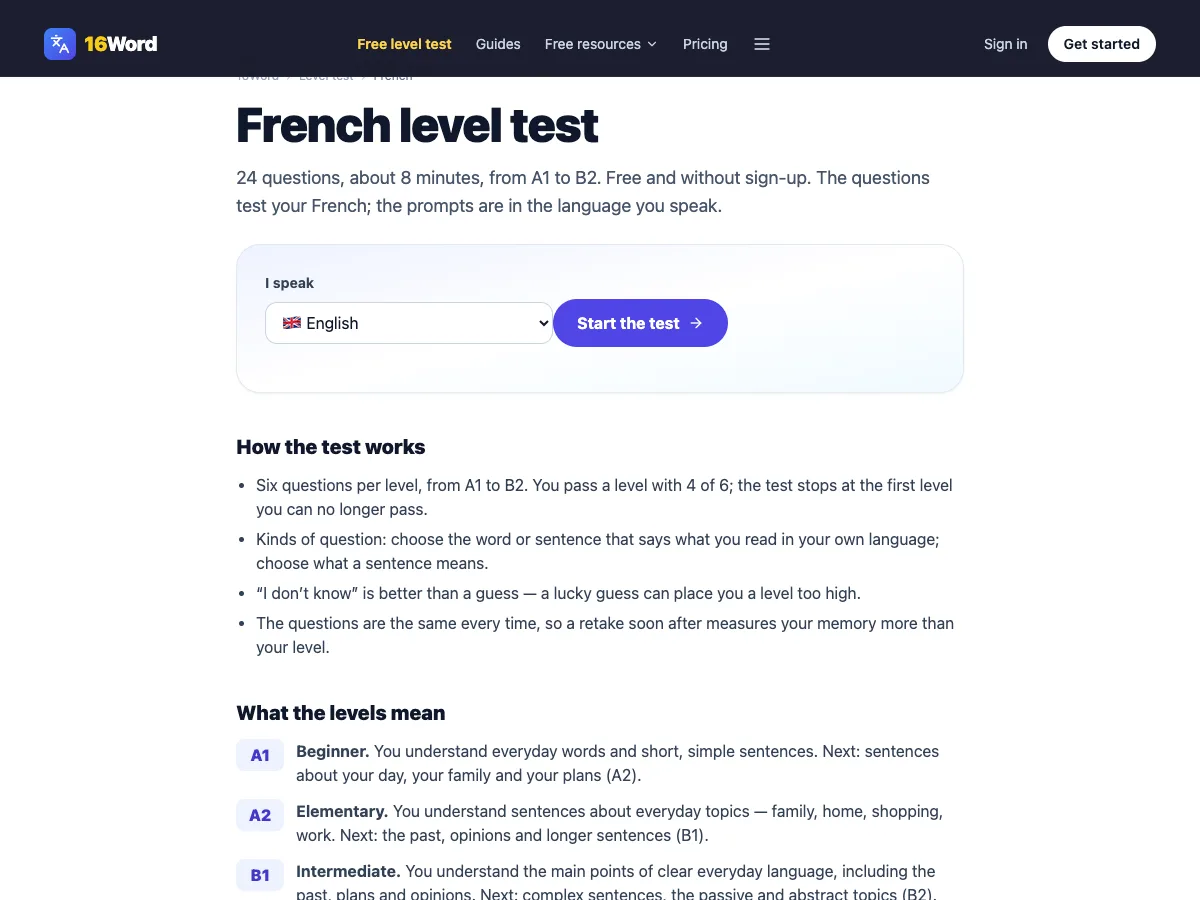
French grammar looks long because the spelling shows a lot that you never hear. Its core is eight rules — gender, agreement, adjective position, verb persons, two auxiliaries, the near future and the subjunctive. Each rule below is checked against Britannica or the Office québécois de la langue française. Not sure of your level? Take the free French level test first.
Updated · 4 min read
1. Every noun is masculine or feminine
French distinguishes masculine and feminine, but you usually see it in the article or the adjective, not in the noun itself (Britannica): le livre (the book, masculine), la table (the table, feminine). The gender is often not guessable — so learn every noun with its article: un or une, le or la — from your very first 16 words a day.
2. Adjectives agree — and some go before the noun
An adjective takes the gender and number of its noun (OQLF): un petit chat, une petite maison, des petites maisons. Many adjectives follow the noun (une voiture rouge), but a qualifying adjective can also stand before it (un grand homme) — the OQLF notes both positions.
| Masculine | Feminine | |
|---|---|---|
| Singular | un petit chat | une petite maison |
| Plural | des petits chats | des petites maisons |
3. The plural is mostly written, not heard
French marks the plural with -s or -es, but this ending, kept in spelling, has generally been lost in speech (Britannica): chat and chats sound the same. You hear the plural in the article — le chat / les chats — so listen to the little words.
4. Verbs change with the person — but several forms sound alike
A French verb is conjugated for three persons, singular and plural, and several of these forms are pronounced the same although spelt differently (Britannica): je parle, tu parles, il parle, ils parlent all sound like “parl”. Learn the endings for writing; for speaking, the subject pronoun does most of the work.
5. Two auxiliaries: avoir and être
The compound tenses use avoir or être + past participle. Avoir is the most frequently used; être is used with all pronominal verbs and with some verbs of movement or change — aller, arriver, devenir, entrer, mourir, naître, partir, rester, sortir, tomber, venir (OQLF): j’ai mangé but je suis parti, je me suis levé.
6. The past you need first: the passé composé
The passé composé is avoir or être in the present + the past participle. It presents a finished action whose result is linked to now (OQLF): J’ai apporté ton billet — “I’ve brought your ticket”. It is the everyday past of conversation; the others are in French tenses explained.
7. The easy future: aller + infinitive
Aller in the present + an infinitive gives the futur proche: je vais partir, il va neiger demain (OQLF). In everyday French, especially spoken, it competes with the simple future and feels more certain. If you know aller, you can talk about tomorrow on day one.
8. The subjunctive: for wishes, doubts and necessity
The subjonctif expresses what is wished, doubted, feared or necessary — not a fact (OQLF). It follows phrases such as il faut que and je veux que: J’insiste pour qu’il vienne. Learn it after the indicative, as fixed phrases first.
The eight rules at a glance
| Rule | Example | Watch out |
|---|---|---|
| Gender | le livre, la table | learn the article with the noun |
| Agreement | une petite maison | adjective takes gender and number |
| Silent plural | les chats | hear it in the article |
| Verb persons | je parle / ils parlent | same sound, different spelling |
| être verbs | je suis parti | movement, change, pronominal |
| Passé composé | j’ai mangé | the everyday past |
| Futur proche | je vais partir | aller + infinitive |
| Subjonctif | il faut que tu viennes | after wishes and necessity |
Where the rules come from: French grew out of Latin and lost most of its endings in speech while keeping them in writing — the history of French explains why. For the bigger picture, see why learn French and where it is spoken.
Learn French words with their articles
Grammar needs words. 16Word gives you 16 French words a day with active recall, spaced repetition and a short Blocks game between answers — free to start.
Keep learning
- French tenses explained — the forms you need, in order
- A short history of French · Where is French spoken?
- Free French level test · Learn French with 16Word
- Level tests in 36 languages · All guides · Plans
Frequently asked questions
How do I know if a French noun is masculine or feminine?
Often you cannot guess it, and the noun itself rarely shows it; the article and the adjective do. Learn every noun with le or la, un or une.
Do French adjectives go before or after the noun?
Many go after the noun (une voiture rouge), but some qualifying adjectives can go before (un grand homme). In both positions they agree with the noun in gender and number.
When do I use être instead of avoir?
With all pronominal verbs (je me suis levé), with some verbs of movement or change such as aller, arriver, partir, venir, naître and mourir, and in the passive. Everything else uses avoir.
Why are French plurals hard to hear?
The -s or -es of the plural is still written but generally not pronounced. You hear the plural in the article: le chat, les chats.
Do I need the subjunctive as a beginner?
Not at first. Learn the present, the passé composé and the futur proche; then learn the subjunctive in fixed phrases such as il faut que.
Was this guide useful?
Official sources
Keep going
- Free French level test — A1 to B2, no sign-up
- Learn French 16 words a day
- French tenses explained: the 7 you need, in the order to learn them
- Chinese grammar basics: the 8 rules that matter most
- Chinese tenses? How Chinese shows time with 了, 过, 在 and 着
- Japanese grammar basics: the 8 rules that matter most
- Japanese tenses explained: past, non-past and ている
- Luxembourgish personal pronouns: ech, du, hien, hatt, si, mir, dir — with audio
- How to conjugate Luxembourgish verbs in the present tense
- Luxembourgish irregular verbs: sinn, hunn, goen, kommen and the modals
- All guides