Where is Chinese spoken? Mandarin, the dialect groups and a map
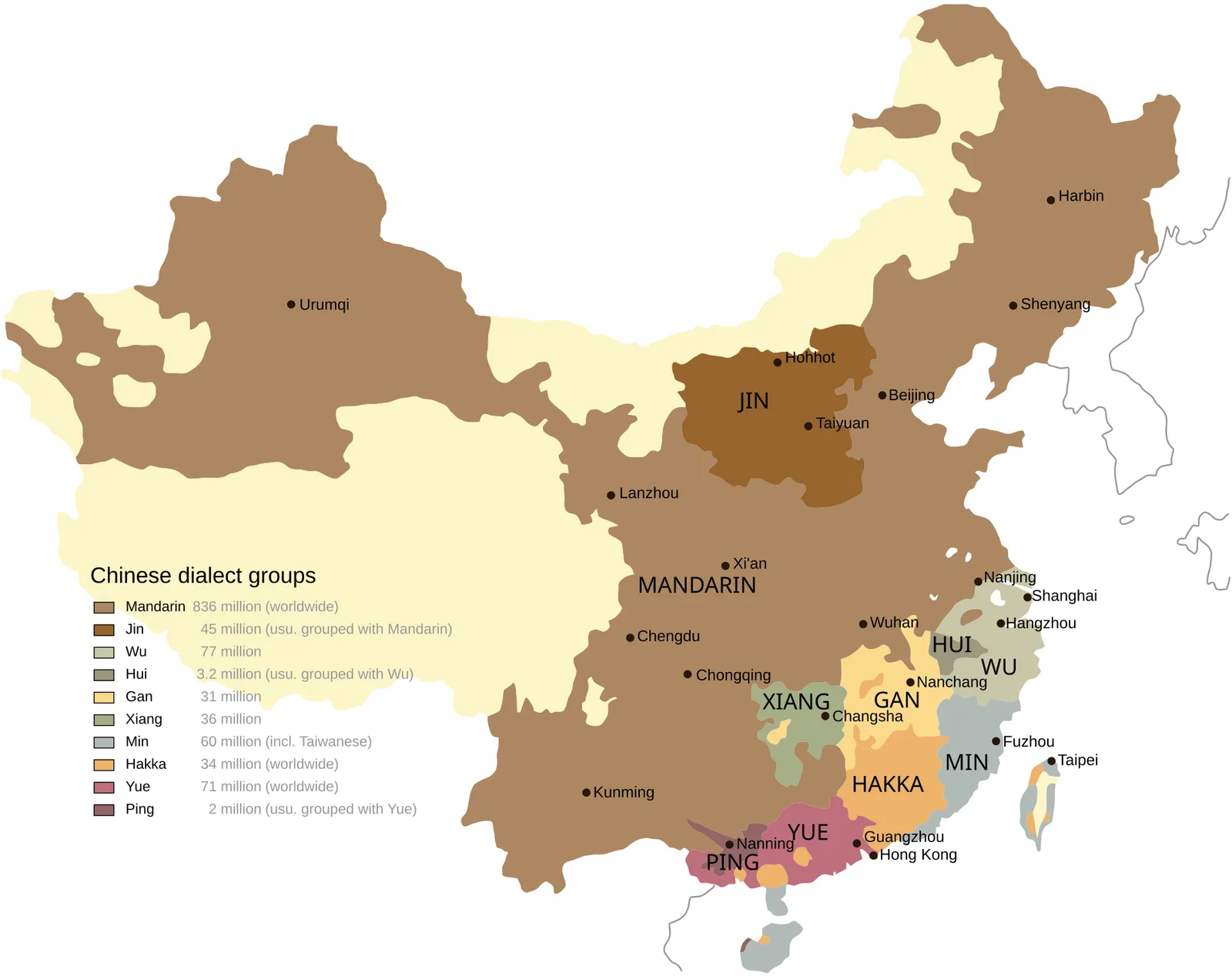
“Chinese” is not one spoken language but a family: Mandarin across the north, centre and west of China, and Wu, Gan, Xiang, Min, Hakka and Cantonese in the south-east. The map below shows them. This guide explains what each is, which one learners study, and where Chinese is official.
Updated · 3 min read
A family of languages, one writing system
The Chinese languages belong to the Sino-Tibetan family. Their spoken varieties are popularly called dialects but are usually classified by scholars as separate languages: speakers of different varieties cannot understand each other, and the varieties differ about as much as the Romance languages, mostly in pronunciation and vocabulary rather than grammar (Britannica). What unites them is writing — the characters, which a reader of any variety can read in his or her own pronunciation. Why learn it at all: Why learn Chinese?
Reading the map
On the map at the top of the page, the large brown area is Mandarin, spoken in the northern, central and western parts of China. In the south-east the colours change: Wu (around Shanghai), Gan, Xiang, Min (including Taiwan’s Southern Min), Hakka and Yue, better known as Cantonese (around Guangzhou and Hong Kong). The groups follow Britannica’s list (Britannica); the map’s own speaker counts are its author’s estimates.
Northern and southern Chinese
Britannica divides the Sinitic languages into a Northern group — the Mandarin dialects, which are more similar to each other — and a Southern group: Wu, Xiang, Gan, Hakka, Yue and Min. Southern varieties keep more one-syllable words; Cantonese uses at least six tones, where Modern Standard Chinese has four (Britannica). The history of how they drifted apart is in A short history of Chinese.
The standard you will learn
Modern Standard Chinese grew out of an early-1900s programme to unify the national language on the basis of Mandarin, and pinyin — based on Beijing pronunciation — was adopted to help spread it (Britannica). In mainland China, the State Council’s 2013 Table of General Standard Chinese Characters sets the standard written forms (State Council). It is the Chinese written in pinyin, and the one our Chinese level test checks.
Where Chinese is official
| Where | Status | Source |
|---|---|---|
| United Nations | Modern Standard Chinese is one of six official languages. | UN |
| Singapore | Malay, Mandarin, Tamil and English are the four official languages; Malay is the national language. | Constitution, Art. 153A |
| Mainland China | The State Council’s standard character table implements the national law on the common spoken and written language. | State Council, 2013 |
One script across East Asia
Chinese writing was fundamental to the writing systems of East Asia; Britannica estimates that some 1.34 billion people use the characters, called hanzi in Chinese, kanji in Japanese and hanja in Korean (Britannica). That is why learners of Japanese recognise many Chinese characters — and why our Japanese level test is a natural next step for some.
Chinese learners worldwide
The HSK, China’s international proficiency test, reports about 800,000 test takers a year at more than 1,500 test centres in 169 countries (chinesetest.cn). On the websites W3Techs can classify, Chinese is the content language of 1.2% (W3Techs).
Mandarin or Cantonese? Start with Modern Standard Chinese (Mandarin) unless you live in a Cantonese-speaking area or have family who speak it. Check your level first with the free Chinese level test, then learn 16 words a day.
16 Chinese words a day, about five minutes
16Word teaches the words you need with active recall, spaced repetition and a short Blocks game between answers. Free to start.
Keep learning
- Why learn Chinese? 7 reasons
- A short history of Chinese — oracle bones to pinyin
- Chinese grammar basics · Chinese tenses: time and aspect
- Level tests in 36 languages · All guides · Plans
Frequently asked questions
Are Mandarin and Cantonese different languages?
Britannica says the spoken varieties of Chinese are usually classified by scholars as separate languages: their speakers cannot understand each other, and they differ about as much as the Romance languages. They share the written characters.
How many Chinese dialect groups are there?
Britannica names Mandarin in the north, centre and west, and Wu, Northern and Southern Min, Gan, Hakka, Xiang and Cantonese (Yue) in the south-east.
Which Chinese should I learn?
Most learners start with Modern Standard Chinese, the national standard based on Mandarin and written in pinyin for learners.
Is Chinese official in Singapore?
Yes. Mandarin is one of Singapore’s four official languages, with Malay, Tamil and English; Malay is the national language.
Can a Cantonese speaker read Mandarin?
In standard written Chinese, yes: the varieties share the characters and a common literary tradition, and each reads them in its own pronunciation. Spoken, they are not mutually intelligible.
Was this guide useful?
Official sources
- Britannica — Chinese languages
- Britannica — Chinese writing
- United Nations — Official languages
- Singapore Statutes Online — Constitution, Art. 153A
- Chinese Tests Service Website (HSK)
- W3Techs — Content languages for websites (November 2026)
- State Council of the PRC — Table of General Standard Chinese Characters (2013)
Keep going
- Free Chinese level test — A1 to B2, no sign-up
- Learn Chinese 16 words a day
- A short history of Chinese: from oracle bones to pinyin
- A short history of Japanese: from the Kojiki to kana and kanji
- Where is Japanese spoken? Dialects, the Ryukyuan languages and a map
- Endangered languages: why they disappear, how they come back, and what 16Word is building
- Is Latin a dead language? Where Latin lives today — and how to learn it
- Luxembourgish: how a small language keeps growing
- Is Luxembourgish a language or a German dialect? History, law and the differences
- What language is spoken in Luxembourg? Luxembourgish, French and German explained
- All guides