Where is Japanese spoken? Dialects, the Ryukyuan languages and a map
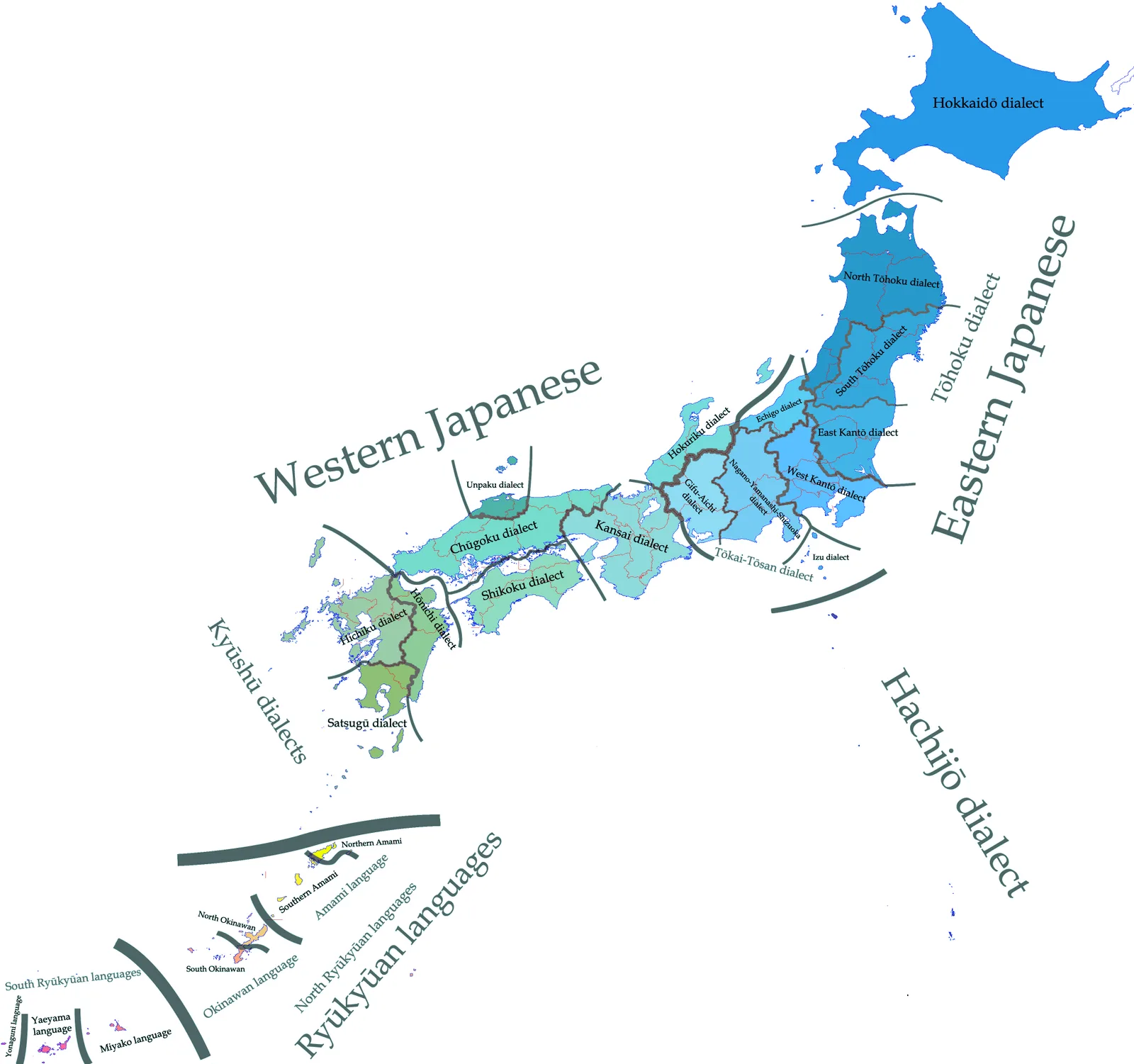
Japanese is spoken almost entirely in Japan — and yet it is far from one uniform language. The map below shows its dialect areas: Eastern and Western Japanese, Kyushu, the island of Hachijō and, in the far south, the Ryukyuan languages. This guide explains the map, the standard learners study, and where Japanese lives outside Japan.
Updated · 3 min read
A language of one country
Britannica counts more than 125 million speakers of Japanese in the early 2020s, more than 3.5 million of them outside Japan, and notes that since the mid-20th century no country other than Japan has used Japanese as a first or second language (Britannica). Why so many people still learn it is in Why learn Japanese?
Reading the map
The map at the top of the page divides the main islands into Eastern and Western Japanese, with Kyushu dialects in the south-west — Britannica describes three groups, or two when Kyushu is counted with the West. The isolated Hachijō dialect sits on its own island south of Tokyo, and the Ryukyuan languages stretch from Amami to Yonaguni (Britannica).
Dialects that do not understand each other
Mountains, deep valleys and small islands let dialects drift apart, and some are mutually unintelligible: people from Kagoshima in Kyushu are not understood by most people on the main island of Honshu, and speakers from Aomori or Akita in the north are not understood in Tokyo. Even the pitch of words changes: in Tokyo hashi with a high-low pitch means ‘chopsticks’, in Kyōto it means ‘bridge’ (Britannica).
The standard you will learn
What unites the country is kyōtsū-go, the ‘common language’, based on the Tokyo dialect. A standard written language has been taught in compulsory education since it began in 1886, and mobility and mass media have levelled many differences (Britannica). This standard is what textbooks teach and what our Japanese level test checks; how it developed is in A short history of Japanese.
The Ryukyuan languages
Amami, Okinawan, Miyako, Yaeyama and Yonaguni are Japonic languages of their own, and together with Japanese — and possibly Hachijō — they form the Japonic family. They keep old sounds the standard lost: Okinawan pi ‘fire’ and pana ‘flower’ match Tokyo hi and hana (Britannica).
Japanese around the world
The largest community of Japanese descent outside Japan is in Brazil — about 2.7 million people, according to Japan’s Ministry of Foreign Affairs, whose emigration began in 1908 with the ship Kasato Maru. About 49,000 Japanese nationals lived in Brazil in October 2025, and about 210,000 Brazilians in Japan (Ministry of Foreign Affairs of Japan).
Where people learn Japanese
| Country or region | Learners (2024) |
|---|---|
| China | 1,019,197 |
| Indonesia | 732,914 |
| Korea | 555,396 |
| Australia | 424,316 |
| Thailand | 194,366 |
| Vietnam | 164,495 |
| United States | 134,096 |
| All 143 countries and regions | 4,000,750 |
The figures come from the Japan Foundation’s 2024 survey of institutions abroad; almost 80% of the learners are in Asia and about half are in secondary school (Japan Foundation). Online, Japanese is the content language of 4.9% of the websites W3Techs can classify (W3Techs). Many learners in China and Korea also share the characters — see A short history of Chinese.
Which Japanese should I learn? The standard based on Tokyo speech — it is what you hear on television and read everywhere. Check your level first with the free Japanese level test, then learn 16 words a day.
16 Japanese words a day, about five minutes
16Word teaches the words you need with active recall, spaced repetition and a short Blocks game between answers. Free to start.
Keep learning
- Why learn Japanese? 7 reasons
- A short history of Japanese — from the Kojiki to kana
- Japanese grammar basics · Japanese tenses explained
- JLPT levels N5 to N1 · Level tests in 36 languages · All guides · Plans
Frequently asked questions
Is Japanese spoken outside Japan?
Britannica counts more than 3.5 million speakers outside Japan, but since the mid-20th century no other country has used Japanese as a first or second language.
Do all Japanese people understand each other?
Through the standard language, yes. Some local dialects, such as Kagoshima’s or those of Aomori and Akita, are not understood by most speakers from other regions.
Is Okinawan a dialect of Japanese?
Britannica classes Okinawan with Amami, Miyako, Yaeyama and Yonaguni as Ryukyuan languages, which together with Japanese form the Japonic family.
Where is the largest Japanese community abroad?
In Brazil: about 2.7 million people of Japanese descent, according to Japan’s Ministry of Foreign Affairs. Emigration began in 1908.
Which countries have the most learners of Japanese?
China, Indonesia and Korea, followed by Australia and Thailand, according to the Japan Foundation’s 2024 survey.
Was this guide useful?
Official sources
- Encyclopædia Britannica — Japanese language
- Encyclopædia Britannica — Japanese language: Vocabulary and relationships to other languages
- The Japan Foundation — Survey on Japanese-Language Education Abroad 2024
- Ministry of Foreign Affairs of Japan — Brazil: basic data (in Japanese)
- W3Techs — Content languages for websites (November 2026)
Keep going
- Free Japanese level test — A1 to B2, no sign-up
- Learn Japanese 16 words a day
- A short history of Japanese: from the Kojiki to kana and kanji
- Endangered languages: why they disappear, how they come back, and what 16Word is building
- Is Latin a dead language? Where Latin lives today — and how to learn it
- Luxembourgish: how a small language keeps growing
- Is Luxembourgish a language or a German dialect? History, law and the differences
- What language is spoken in Luxembourg? Luxembourgish, French and German explained
- Luxembourgish vs Dutch: how close are they?
- Ons Heemecht: Luxembourg’s national anthem — words, translation and history
- All guides