St Lucia Day in Sweden: candles, songs and saffron buns
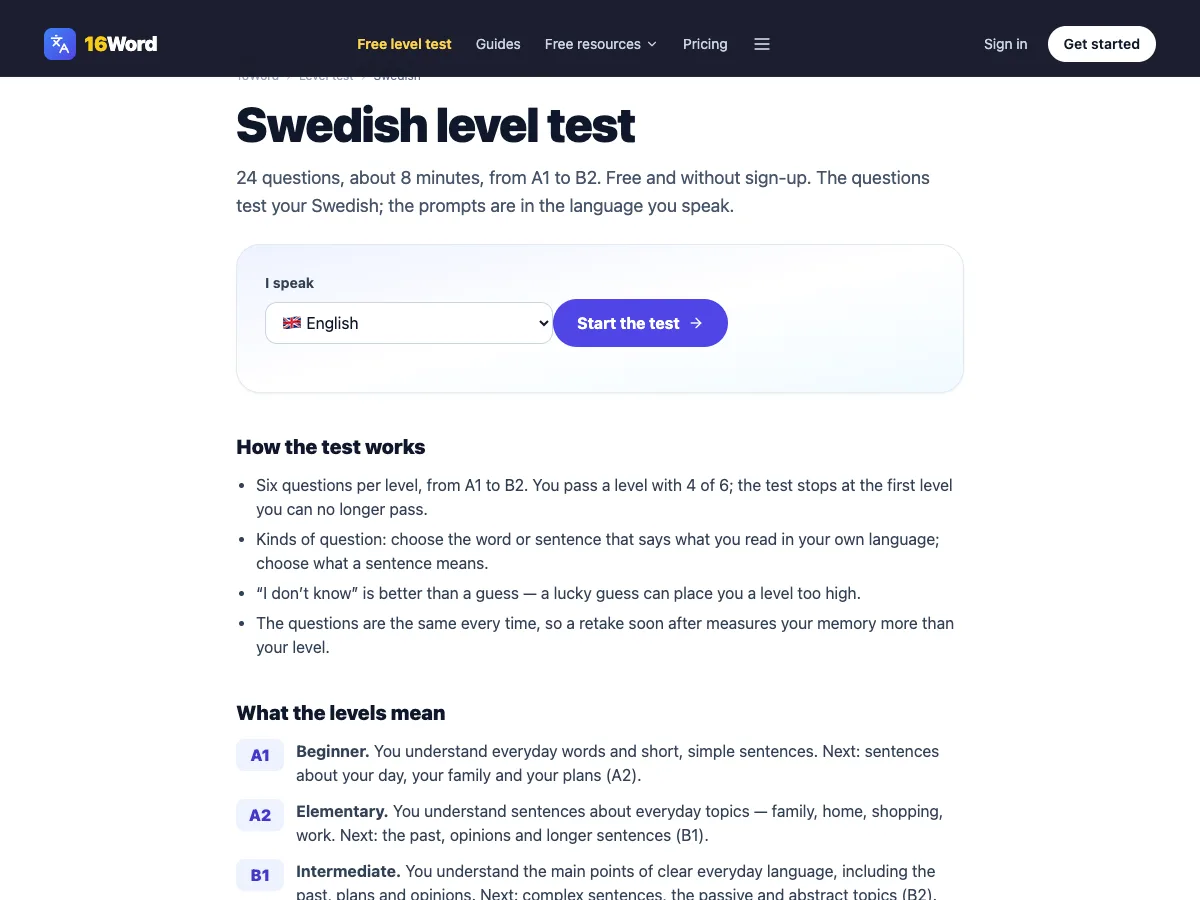
St Lucia Day in Sweden falls on 13 December, and in 2026 that is a Sunday. Before dawn — or, more often today, at dusk — a girl in a white gown with a crown of candles walks in front of a singing procession, in schools, churches, offices and care homes across the country. The Swedish Institute calls Lucia, alongside Midsummer, "one of the foremost traditional celebrations in Sweden". This guide explains what happens, where the custom comes from, and the Swedish words you will hear: lucia, luciatåg, tärna, stjärngosse, lussekatt and glögg. Learning Swedish? Try the free Swedish level test.
Updated · 6 min read
What is St Lucia Day in Sweden?
Lucia — Saint Lucy's Day — is a celebration of light in the darkest weeks of the Swedish winter. Visit Sweden traces it to the 4th century and the martyr Lucia of Syracuse, who in the legend brought food to Christians hiding in the Roman catacombs, "lighting her way with a candlelit wreath on her head". Nordiska museet, Sweden's museum of cultural history, says she was killed for her faith on 13 December 304, and that in the Swedish Catholic calendar 13 December was her saint's day until the 16th century.
Today the day is less about the saint than about the procession, the song and the buns. Sweden's television broadcasts a Lucia celebration on SVT, traditionally on 13 December itself, and Isof, the Swedish Institute for Language and Folklore, notes that the luciatåg is on Sweden's national list of intangible cultural heritage.
The luciatåg: who is who in the procession
The procession is a luciatåg (neuter, plural luciatåg) — Wiktionary notes that "Lucia procession" is the usual translation. Everyone in it wears white, and each figure has its own Swedish name:
| Swedish | Plural | Who | What they wear or carry |
|---|---|---|---|
| lucia | lucior | the girl or woman who plays Lucia and leads the procession | a white gown and a crown of candles (luciakrona) |
| tärna | tärnor | Lucia's handmaidens | white gowns, a candle each, glitter or a wreath without candles in the hair, often a red ribbon at the waist |
| stjärngosse | stjärngossar | star boys | white robes, tall cone hats with stars, a star on a stick |
| tomtenisse | tomtenissar | Christmas elves | small lanterns; they come last |
| pepparkaksgubbe | pepparkaksgubbar | gingerbread men | full gingerbread costumes, with lanterns |
Wiktionary gives lucia with a small letter as "the girl or (young) woman … portraying Saint Lucy and leading a Saint Lucy's Day procession"; with a capital, Lucia is the saint herself. A tärna is a maiden or handmaiden (also a bridesmaid), and a stjärngosse is literally a "star boy" — stjärna, star, plus gosse, boy. Nordiska museet says the star boys represented the Three Wise Men.
"Light in her hair": tradition says Lucia wears ljus i håret. The Swedish word ljus means both "light" and "candle". Today, Visit Sweden notes, the candles in the crown are usually battery candles, for safety.
The song: Sankta Lucia
Processions enter and leave singing Sankta Lucia, "the version almost every Swede knows by heart", as the Swedish Institute puts it. The melody is Italian: Isof names the composer Teodoro Cottrau, whose song praising the Santa Lucia district of Naples was first published in 1850. Sweden has several texts for it; Isof says the journalist Sigrid Elmblad wrote one of the most widespread in 1924, and the teacher Arvid Rosén another well-known one in 1928, for a school songbook. If you are learning Italian, the Italian level test is the place to start; and there is more Italian in our guide to numbers in Italian.
Lussekatter, pepparkakor and glögg
Lucia serves coffee and buns — a custom the Swedish Institute dates to the 1880s. The bun is a lussekatt (plural lussekatter), "a Swedish bun made with raisins and saffron … commonly s-shaped", also called lussebulle. Sweden.se describes them as "shaped like curled-up cats with raisin eyes", and its food page calls them "Lucia cats". Wiktionary says the name possibly comes from Lucifer + katt, cat; an older name was dövelskatt, "devil-cat". Nordiska museet adds that saffron only came into them at the end of the 19th century.
| Swedish | Meaning | Note |
|---|---|---|
| lussekatt, lussebulle | saffron bun | S-shaped, with raisins |
| pepparkaka (pl. pepparkakor) | gingerbread biscuit | from peppar + kaka: pepper was once an ingredient |
| glögg | Swedish mulled wine | also alcohol-free; served with almonds and raisins |
| saffran | saffron | the spice that makes the buns yellow |
| kaffe | coffee | the traditional drink with the buns |
Wiktionary explains pepparkaka as gingerbread "traditionally eaten around Christmas", named so "since pepper was originally an ingredient", and glögg as "a Scandinavian version of vin chaud or mulled wine", from glödga, "to mull".
Learn 16 Swedish words a day
From lucia to lussekatt: 16Word gives you 16 words a day with active recall, spaced repetition and a short Blocks game between answers. Free to start.
The longest night: where the custom comes from
The old Swedish customs are darker than the white gowns. In the old almanac, the Swedish Institute writes, Lucia Night was the longest of the year — "a dangerous night when supernatural beings were abroad and all animals could speak". Visit Sweden explains why: 13 December was the shortest day of the historic Julian calendar; Isof adds that only the calendar reform of 1753 moved the winter solstice to around 21 December. People were urged to eat seven or nine hearty breakfasts, and young people dressed up as lussegubbar and went from house to house singing for food and schnapps. Nordiska museet notes that the name Lucia was sometimes linked by its sound with Lucifer.
From one country house to every school
- 1764 — the first recorded white-clad Lucia, in a country house (sweden.se); Nordiska museet says she had wings and served Lucia treats on an estate.
- 1820s — the first known Lucia with lights in her hair, a farmhand at Skinnskatteberg Manor (Nordiska museet).
- 1890s — Lucia is shown at Skansen in Stockholm as a tradition of western Sweden (1892 for Nordiska museet, 1893 for Isof).
- 1927 — Stockholms Dagblad organises the first public Lucia (Isof and sweden.se; Nordiska museet dates its Lucia competition to 1928).
- 1944 — the tradition spreads to Denmark as a silent protest against the German occupation (Nordiska museet).
- 1950s — Lucia becomes widespread in Sweden and spreads to Norway (Nordiska museet).
Lucia words and the Swedish Christmas
Lucia opens the Christmas season. Jul means Christmas — the same word as English "Yule" — and the greeting is god jul, "Merry Christmas". The tomte was a small creature of folklore living on farms; tomten is also what Swedes call Santa Claus. Compare the season elsewhere in Europe: Sinterklaas in the Netherlands, the German Christmas market and the Luxembourg Christmas market, and how to say merry Christmas in Dutch or in Luxembourgish. December also brings Hanukkah.
If you live in Sweden
If your children go to a Swedish school or preschool, expect a luciatåg — and perhaps a white gown to find. Saying the words out loud helps: lucia, tärnor, lussekatter. If you are learning Swedish for work or for citizenship, our guide to the Swedish citizenship language requirement explains what is planned, and lagom is the Swedish word everyone asks about. For live speaking practice, Edluxio offers one-to-one lessons with teachers and professionals in many fields, with a trial lesson and a full refund if it is not right for you.
Keep learning
- Free Swedish level test · Finnish · all 36 languages
- Lagom meaning · Sisu meaning — its Finnish neighbour
- Swedish citizenship language requirement
- Winter traditions: Sinterklaas · Hanukkah · Luxembourg traditions and their words · Dutch holidays and traditions
- How to memorize vocabulary · All guides
St Lucia Day in Sweden: questions people ask
When is St Lucia Day in Sweden?
Every year on 13 December. In 2026 it falls on a Sunday. Tradition says Lucia comes before dawn, but many events are held at dusk.
Why does Lucia wear candles on her head?
Lucia is a bearer of light in the dark Swedish winter; in the legend, Lucia of Syracuse lit her way with a candlelit wreath. Today the crown usually holds battery candles.
What do Swedes eat on Lucia?
Lussekatter (S-shaped saffron buns with raisins) and pepparkakor (gingerbread biscuits), with glögg, coffee or tea.
What is a luciatåg?
The Lucia procession: Lucia with her crown of candles, followed by her handmaidens (tärnor), star boys (stjärngossar) and sometimes Christmas elves and gingerbread men, all singing.
What does lussekatt mean?
A lussekatt (plural lussekatter) is an S-shaped saffron bun with raisins. Sweden.se calls them "Lucia cats"; Wiktionary says the name possibly comes from Lucifer + katt, cat.
When did Lucia become popular in Sweden?
A white-clad Lucia is first recorded in 1764, but the custom spread across Swedish society in the 1900s, when schools and local associations promoted it; Nordiska museet dates its spread to the 1950s.
Was this guide useful?
Official sources
- Swedish Institute (sweden.se) — Lucia in Sweden
- Swedish Institute (sweden.se) — Saffron buns and gingerbread biscuits
- Visit Sweden — Lucia in Sweden
- Nordiska museet — Lucia
- Isof (Institutet för språk och folkminnen) — Lucia
- Wiktionary — lucia
- Wiktionary — luciatåg
- Wiktionary — tärna
- Wiktionary — stjärngosse
- Wiktionary — lussekatt
- Wiktionary — pepparkaka
- Wiktionary — glögg
- Wiktionary — ljus
- Wiktionary — jul
- Wiktionary — god jul
- Wiktionary — tomte
- Edluxio — live 1-to-1 lessons with teachers and professionals
Keep going
- Free Swedish level test — A1 to B2, no sign-up
- /articles/lagom-meaning
- What language is spoken in Egypt? Arabic, Masri and more
- Endangered languages: why they disappear, how they come back, and what 16Word is building
- Is Latin a dead language? Where Latin lives today — and how to learn it
- Luxembourgish: how a small language keeps growing
- Is Luxembourgish a language or a German dialect? History, law and the differences
- What language is spoken in Luxembourg? Luxembourgish, French and German explained
- Luxembourgish vs Dutch: how close are they?
- Ons Heemecht: Luxembourg’s national anthem — words, translation and history
- All guides