How to say thank you in Arabic: shukran, shukran jazilan and replies
The simplest way to say thank you in Arabic is شكرا — shukran. It works in every Arab country, in Modern Standard Arabic and in every dialect. But Arabic has more than one thank you: a stronger shukran jazīlan, a religious jazāka llāhu khayran, Egyptian motashakker, and even a French merci. This guide gives each one in Arabic script, with the transliteration and meaning from Wiktionary, and — just as important — how to answer when someone thanks you. If the script is new to you, start with our Arabic alphabet guide.
Updated · 6 min read
Shukran: the everyday way to say thank you in Arabic
Shukran (شكرا) means "thanks". Wiktionary explains it as the adverbial accusative of the noun shukr (شُكْر), "thankfulness" — so word for word it is something like "(with) thanks". The standard pronunciation is /ʃuk.ran/: shuk as in "shook", then ran with a tapped r. In the Gulf you will hear [ˈʃʊkrɐn], in Egypt [ˈʃokɾɑn], but everyone understands the same word.
| Arabic | Transliteration | Meaning | When |
|---|---|---|---|
| شكرا | shukran | thanks, thank you | everywhere, any situation |
| شكرا جزيلا | shukran jazīlan | thank you very much | MSA, polite, written and spoken |
| جزاك الله | jazāka llāhu (to a man) / jazāki llāhu (to a woman) | may God reward you — thank you | religious, among Muslims |
| متشكر / متشكرة | motashakker (m) / motashakkera (f) | thanks (I'm grateful) | Egyptian Arabic |
| شكرا كتير | shukran ktīr | thank you very much | Levantine (South Levantine) |
| مرسي | mersī | thanks (from French merci) | colloquial, Egypt and the Levant |
Shukran jazilan: "thank you very much" in Arabic
To make it stronger, add jazīlan: شكرا جزيلا shukran jazīlan, pronounced /ʃuk.ran d͡ʒa.ziː.lan/. Wiktionary gives "thank you very much, thanks a lot, many thanks", literally "abundant thankfulness". It is the polite phrase for an email, a teacher, a doctor or a host.
In the Levant (Jordan, Palestine, Syria, Lebanon) people more often say shukran ktīr (شكرا كتير), "thanks a lot", or address the person directly: shukran ilak to a man, shukran ilek to a woman — "thanks to you". Wiktionary records both in its South Levantine section.
The verb behind it: shakara, "to thank"
All these words come from the three-letter root ش ك ر (sh-k-r), which carries the idea of gratitude. The verb شَكَرَ shakara means "to thank, be thankful, grateful; to praise"; its present tense is yashkuru, and "I thank" is ashkuru. Wiktionary's example: shakara lahu ʿamalahu — "he thanked him for his work." In Levantine Arabic, a formal "I thank you" is ashkorak (to a man) or ashkorek (to a woman).
The adjective مُتَشَكِّر mutashakkir ("thankful, grateful") is from the same root. In Egypt it has become the everyday thank you: motashakker if you are a man, motashakkera if you are a woman — you are describing yourself, so the ending matches the speaker, not the listener. Roots like sh-k-r are the reason Arabic vocabulary grows quickly once you see the pattern; our guide to the easiest way to learn Arabic explains how to use them.
Jazak Allah: the religious thank you
جزاك الله jazāka llāhu (to a man) or jazāki llāhu (to a woman) is a thank you that asks God to reward the other person. Wiktionary gives it as an interjection meaning "thank you", a shortening of jazāka llāhu khayran — "may God reward you with good". Because it calls on God, it belongs to religious speech — like inshallah and mashallah, which are also part of everyday conversation.
Merci and the other dialect words
Arabic dialects borrow freely. Wiktionary lists مرسي mersī — from French merci — as a colloquial "thanks" in Egypt and the Levant, also spelt ميرسي. In the Hijaz (western Saudi Arabia) Wiktionary records تسلم tislam, "thanks" (to a man), and in the Hijaz and the Gulf يعطيك العافية yiʿṭīk al-ʿāfya, literally "may [God] give you wellness", used to mean "thank you". If you are not sure which dialect you are in, shukran never fails.
Which Arabic is spoken where is a story of its own: our guide to what language is spoken in Morocco shows how Arabic, Amazigh and French live side by side, and yalla meaning and habibi meaning are two more words you will hear in every dialect.
Learn 16 Arabic words a day
Thank you is the first word. 16Word gives you 16 words a day with active recall, spaced repetition and a short Blocks game between answers. Free to start.
How to reply to shukran: "you're welcome" in Arabic
| Arabic | Transliteration | Meaning | Note |
|---|---|---|---|
| عفوا | ʿafwan | you're welcome, don't mention it | the standard reply; also means "excuse me, pardon" |
| العفو | al-ʿafw | you're welcome, not at all | a little warmer |
| لا شكر على واجب | lā shukr ʿalā wājib | no thanks needed for a duty | formal, polite |
| أهلا وسهلا | ahlan wa-sahlan | you're welcome | Levantine reply (also "welcome") |
عفوا ʿafwan (/ʕaf.wan/) is the reply you will use most. It starts with ʿayn (ع), the throat sound that has no English equivalent — Wiktionary writes it ʕ. Notice that ʿafwan has two jobs: after shukran it means "you're welcome", but on its own, when you bump into someone, it means "excuse me, sorry". Al-ʿafw is the same word with the article. Lā shukr ʿalā wājib — "duty needs no thanks" — is the polite way of saying "it was the least I could do".
A short exchange
- A: Shukran jazīlan! (شكرا جزيلا) — Thank you very much!
- B: ʿAfwan. (عفوا) — You're welcome.
- A: Mersī! (مرسي) — Thanks! (Egypt, the Levant)
- B: Al-ʿafw. (العفو) — Not at all.
Mistakes to avoid
- Keep the long vowel in jazīlan: Wiktionary writes /d͡ʒa.ziː.lan/ — ja-zee-lan, not ja-zi-lan.
- Match jazāka / jazāki to the person you thank, but motashakker / motashakkera to yourself.
- Don't answer shukran with shukran: reply with ʿafwan or al-ʿafw.
- Don't worry about the dialect: shukran is understood from Morocco to Oman.
Where to hear and practise Arabic
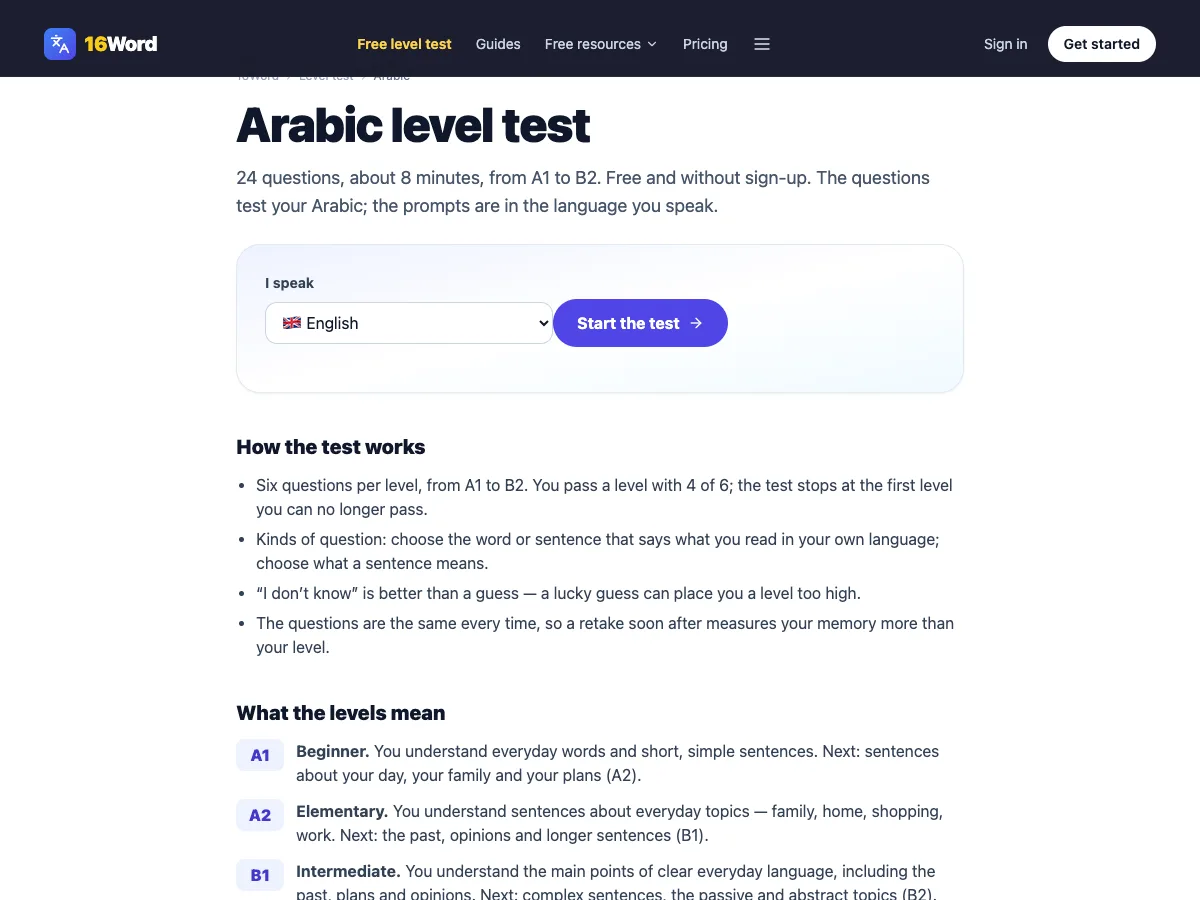
We have no licensed Arabic recordings to play on this page, so the best place to hear the sounds is the 16Word app itself, and the free Arabic level test, which shows you where you stand. The ʿayn and the r of shukran are easier with a person who corrects you: on Edluxio you can book live 1-to-1 lessons with teachers and professionals in many fields, starting with a trial lesson that is fully refunded if it is not right for you.
Learning another language from Arabic? 16Word has English for Arabic speakers, English word lists, German word lists and Turkish word lists explained in Arabic, and level tests in Arabic — for English, German and Turkish.
Thank you in other languages
Compare shukran with its neighbours: thank you in Turkish, thank you in Hindi, thank you in Russian, thank you in Japanese and thank you in Korean. The phrase pages for thank you in Dutch and thank you in Luxembourgish have recordings.
Keep learning
- The Arabic alphabet and the easiest way to learn Arabic
- Arabic words explained: inshallah, mashallah, habibi and yalla
- Neighbouring scripts: the Persian alphabet, the Urdu alphabet and the Hebrew alphabet
- Free level tests: Arabic, Turkish, Persian, Hebrew, French and English
- Turkish travel phrases, how to memorize vocabulary and all guides
Thank you in Arabic: questions
How do you say thank you in Arabic?
Shukran (شكرا). For "thank you very much" say shukran jazīlan (شكرا جزيلا). Both are understood in every Arab country.
How do you reply to shukran?
ʿAfwan (عفوا), "you're welcome", or al-ʿafw (العفو). A formal reply is lā shukr ʿalā wājib, "no thanks needed for a duty".
What does shukran literally mean?
It is the adverbial accusative of shukr (شُكْر), "thankfulness", from the root sh-k-r — so roughly "(with) thanks".
What does jazak Allah mean?
Jazāka llāhu (to a man) or jazāki llāhu (to a woman) means "may God reward you" and is used as a thank you, short for jazāka llāhu khayran, "may God reward you with good".
How do Egyptians say thank you?
Shukran, or motashakker (a man speaking) / motashakkera (a woman speaking), "I'm grateful". Many also say mersī, borrowed from French merci.
Does afwan mean sorry?
It means both: after a thank you it is "you're welcome", on its own it is "excuse me, pardon".
Was this guide useful?
Official sources
- Wiktionary — شكرا (shukran)
- Wiktionary — شكرا جزيلا (shukran jazilan)
- Wiktionary — شكر (shakara, to thank)
- Wiktionary — متشكر (mutashakkir)
- Wiktionary — جزاك الله (jazak Allah)
- Wiktionary — مرسي (mersi)
- Wiktionary — تسلم (tislam)
- Wiktionary — يعطيك العافية
- Wiktionary — عفوا (afwan)
- Wiktionary — العفو (al-afw)
- Edluxio — live 1-to-1 lessons with teachers and professionals
Keep going
- /level-test/arabic
- /articles/arabic-alphabet-guide
- 32 Luxembourgish greetings and everyday phrases, with audio
- Luxembourgish at the doctor and the pharmacy: words and sentences with audio
- Shopping and eating out in Luxembourgish: ordering, prices and paying
- 20 Luxembourgish expressions every newcomer hears (and what they mean)
- Luxembourgish for public transport: bus, train and travel phrases with audio
- Dutch greetings and everyday phrases (with audio)
- Dutch at the doctor and the pharmacy: phrases you need
- Dutch at the gemeente: registration, BSN, DigiD and the counter
- All guides